


Governor Chukwuma Soludo of Anambra State has said Nigeria has moved beyond debating whether to establish state police, arguing that the focus should now be on designing an effective framework while pursuing broader constitutional reforms to strengthen the country’s federal security and justice system.
Speaking virtually at the ARISE News Town Hall on State Police, Soludo described the proposed creation of state police as part of a wider journey towards a more functional and effective federal system, while calling for reforms to revenue allocation and the judiciary alongside policing.
The governor apologised for his inability to attend the event physically because of scheduling conflicts but commended ARISE News for convening what he described as an important national conversation.
“My deepest apologies that, due to scheduling conflicts, I am unable to join you live. Thank you to ARISE News for organising this programme and to everyone who has participated. I listened to some of the earlier speakers, including Senator Adams Oshiomhole and my brother governor from Enugu. They made excellent presentations.”
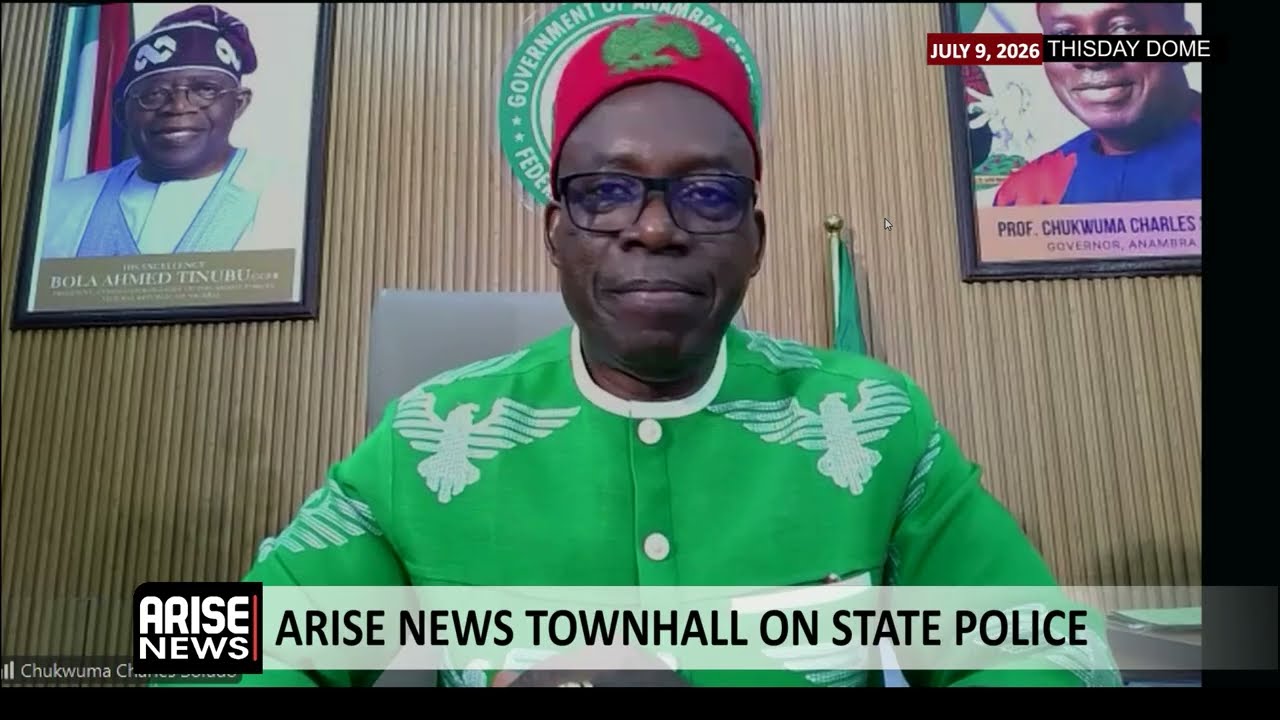
He also commended the National Assembly for advancing the constitutional amendment on state police and praised President Bola Tinubu for driving reforms aimed at strengthening Nigeria’s federal structure.
“I also want to thank the National Assembly for passing this constitutional amendment and the President of Nigeria, Bola Ahmed Tinubu, whom I refer to as a Professor of Federalism. I see the issue of state police within the broader context of marching towards a more functional and effective federal structure.”
According to Soludo, the national conversation has already settled the question of whether state police should exist.
“The issue is no longer whether or not to have state police. I think we have gone beyond that. The issue now is how.”
Without dwelling on Anambra’s security achievements, Soludo said practical experience had demonstrated the importance of collaboration among security agencies.
“I will not spend time talking about what we did in Anambra to clear eight local government areas that were under siege, dismantle 62 criminal camps or end the sit-at-home disruptions. Those successes required coordination and collaboration with federal and private security agencies.”
He noted that government committees, including those involving the National Security Adviser, the Attorney General of the Federation, the Chief of Staff to the President and state governors, were already working through the implementation details.
“There are ongoing efforts involving the National Security Adviser, the Attorney General, the Chief of Staff to the President and governors to work out the details. There are practical issues, including the types of arms and ammunition state police should use. You cannot send officers carrying inferior weapons to confront criminals armed with AK-47 rifles and General Purpose Machine Guns.”
Soludo, however, argued that state police should not be considered in isolation but as part of a broader restructuring of Nigeria’s security and governance architecture.
“I am afraid this whole issue of state police should not be seen in isolation. It must be viewed within the context of what I call the unfinished business of building a sustainable federal security and justice system.”
He said while significant progress had been made through constitutional devolution of powers—including electricity market reforms, local government autonomy and state policing—critical reforms remain outstanding.
“There are still many elephants in the room. Yes, we have seen devolution in electricity markets, local government autonomy and now state police. But responsibilities are being transferred from the Exclusive Legislative List to the Concurrent List without corresponding changes to the revenue allocation formula.”
The governor argued that the current revenue-sharing arrangement leaves states financially constrained despite taking on greater constitutional responsibilities.
“The federal government still retains about 53 per cent of federation revenue, while states share only about 26 per cent. If we truly want sustainable federalism, then we must revisit the revenue allocation formula. The federal government should retain no more than 40 per cent of federation revenue, with the balance devolved to the states.”
Soludo also identified judicial restructuring as another major reform that must accompany state policing.
“The second unfinished business is the federal judicial system. We currently operate what is essentially a unitary judicial structure.”
He questioned why purely state matters continue to travel through Nigeria’s entire appellate system.
“If somebody steals a pot of soup in a village in Anambra and the matter goes to court, the appeal can end up at the Supreme Court of Nigeria. Land is exclusively a state matter under the Land Use Act, yet land disputes in Anambra—which account for nearly 70 per cent of litigation and even violence because of our limited landmass—can take 30 or 40 years before reaching final judgment.”
The governor argued that such cases should terminate within state judicial institutions.
“I do not understand why issues relating to land should go beyond the state. In the United States, from where we copied our federal system, every state has its own Supreme Court.”
He maintained that establishing state supreme courts and appellate systems would make justice faster and more efficient.
“As states begin establishing their own correctional centres, imagine convicting someone only for the appeal process to remain in the federal courts for another 30 or 40 years over a village land dispute. That does not make sense.”
Soludo urged policymakers to widen the ongoing constitutional conversation beyond policing alone.
“As part of this conversation, we need a broader discussion about building a more sustainable federal security and justice system. That includes the devolution of resources and a fundamental restructuring of our judicial architecture.”
Concluding his remarks, the Anambra governor urged stakeholders to use the state police debate as an opportunity to complete Nigeria’s transition to a truly federal system.
“Let this conversation move towards building a more sustainable federal structure. That is the unfinished business before the National Assembly and the President, who has consistently demonstrated his commitment to advancing true federalism.”
Boluwatife Enome
Follow us on:


