


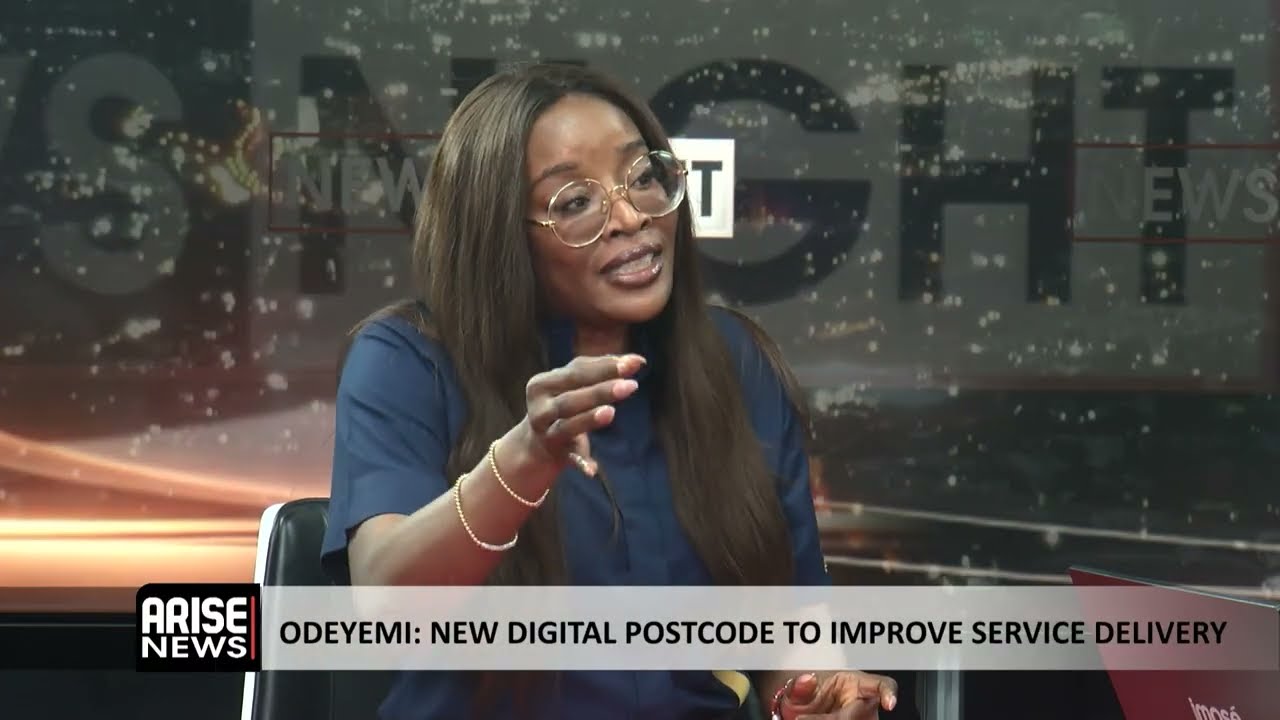
Postmaster General and CEO of the Nigerian Postal Service, Tola Odeyemi, has said the newly launched 11-digit post code system will drive Nigeria’s digital postal revolution by improving location identification and enabling new applications across key sectors.
Speaking with Arise News on Wednesday, Odeyemi said the system would address longstanding challenges around location verification, particularly for banks conducting Know Your Customer (KYC) checks, where the absence of formal addresses has made it difficult to establish customers’ exact locations.
“I’ll start with the basics, which is what most people know us for: mail and deliveries. Missed deliveries, having to be on endless calls, using different landmarks as a description of an address—which is very fundamental. We realized that identification of a geospatial space actually has way more impact.
“For example, if you think about KYC (Know Your Customer) verification for bank account opening, banks want to know exactly where you are, which has been very difficult. A lot of Nigerian locations do not have formal addresses, which we learned while doing our ground-truthing. So, the post code helps.
“Then you think about government. As a government, you need to plan emergency services and security services. Being able to query geospatial information in an organized manner also helps government,” she explained.
Odeyemi said the system could also help prevent damage to underground fibre infrastructure, as post codes would allow construction companies to identify the exact locations of fibre lines and manholes before commencing work.
“After the launch, we’ve seen so many technology companies reaching out to us to build things using this geospatial information that we never even thought of.
“For example, somebody was talking to me about fiber cuts. Because where the fiber is laid underground, people can’t see it. Having post codes for the locations where the manholes are and where the fiber goes to ensures that when people are planning to do construction work, they know exactly where those lines are.”
Addressing concerns over privacy and digital security, Odeyemi explained that the post code system uses building identifiers rather than residents’ identities, with the codes designed to replace informal location descriptions tied to prominent individuals in communities.
“The dataset that we used came from an MOU with the National Population Commission, who did an enumeration exercise towards the census that was meant to happen in 2023.
“What the post code does is remove and anonymize some of that information so you don’t have to say, ‘It’s right next to Chief’s house’. It becomes LA 412, etc. We are helping to move away from those informal descriptors. It’s a building identifier. Think of it like a National Identity Number, but for a standing, unmovable building.”
Odeyemi also said NIPOST generated more than 49 million unique post codes ahead of the October 1 launch, adding that the system was deliberately launched as a live dataset to allow for continuous refinement, with users able to report errors through the portal or app for correction.
“We generated over 49 million unique post codes towards the launch on the 1st of October.
“Some of the things we learned: first, not all buildings had post codes, which we already knew because we were looking at an 85% to 90% coverage. Because it’s a live dataset, we’ve been able to get more post codes and buildings integrated. Second, we are using satellite imagery for that last point of identification. Right now, if there’s an issue, you can request a review on the portal or in the app, it generates a ticket, and then we fix it. In the last six days, we’ve done a turnaround time of less than 4 hours.”
Speaking on the technology behind the digital postcode system, Odeyemi said it was developed by an all-Nigerian consortium involving NIPOST, the National Population Commission, the National Space Research and Development Agency, the Office of the Surveyor-General of the Federation, and local technology providers.
“The Minister made a post about the technology company. It was a consortium of all-Nigerian entities: NIPOST, National Population Commission, expertise from the Space Research and Development Agency, the Office of the Surveyor General of the Federation, as well as technology hardware and software providers. All Nigerians.”
Speaking on the coverage of the system, the NIPOST official said the digital postcode framework extends to both formal and informal settlements, with more than 70 million buildings already enumerated nationwide and about 50 million considered addressable.
“Kudos to the Federal Government of Nigeria because we actually have way more expertise and data than most people think. There’s a database of over 70 million enumerated buildings in Nigeria, both formal and informal. Out of those 70 million, about 50 million are addressable, meaning you can deliver and someone is there. As long as it’s a standing building that can be captured and people are there, it’s captured.”
She explained that Nigerians can generate their post codes by enabling location services on their devices and using the NIPOST postcode portal to identify their exact building, with the system assigning the state, local government area, district, area and unit based on location.
“Turn on location services on your device, then go to www.postcode.gov.ng/find. Click on ‘Find My Postcode”‘ It will use your location, so you have to be at the location where you want to generate the post code.
“It will automatically detect your location. It will state the Federal Capital Territory or State, then assign the Local Government Area, the post code district, the post code area, and then prompt you to choose the unit based on the cluster of buildings around you using a 20-meter proximity. Once you pinpoint it, it automatically generates the post code for you.
“We have different algorithms and logic for different population and building densities—whether it’s Oshodi, Gwagwalada, or places in the North with more land.”
She added that unlike conventional postcode systems in countries such as the UK and US, Nigeria’s 11-digit system is designed to serve as a complete address, rather than an additional code used alongside a house number and street address.
“People think of post codes as what they see in the UK or US zip codes. In those places, you still have to put your house number, street address, and then the post code. What we have developed in Nigeria end-to-end is your entire address.”
Emphasising the system’s role in governance, Odeyemi said government agencies are adopting it for policy implementation and emergency response, with the long-term goal of making the 11-digit postcode every Nigerian’s official address.
“Yes, for policy implementation and emergency response. The goal is for it to be your official address.”
Favour Odima
Follow us on:


