


A lawyer and human rights activist, Liborous Oshoma, has said the Independent National Electoral Commission (INEC) has no stake in the dispute over the Accord Party’s 2027 presidential primary and should comply with the Federal High Court judgment affirming Gbenga Olawepo-Hashim as the party’s valid presidential candidate.
Recall that the dispute arose after Olawepo-Hashim emerged as the sole aspirant and winner of Accord Party’s presidential primary held on May 30, 2026, which was monitored by INEC officials. Despite paying the ₦50 million nomination fee and contributing ₦7 million towards the party’s electronic registration, the party leadership allegedly sought to cancel the primary and declined to upload his name to INEC’s portal, prompting him to challenge the decision in court.
Following that development, on October 5, a Federal High Court in Abuja, presided over by Justice Mohammed Garba Umar, dismissed Accord Party’s preliminary objections, rejected the purported cancellation notice and affirmed Gbenga Olawepo-Hashim as the party’s valid presidential candidate for the 2027 general election, ordering both the party and the Independent National Electoral Commission (INEC) to recognise his candidacy and upload his name to the commission’s platform.
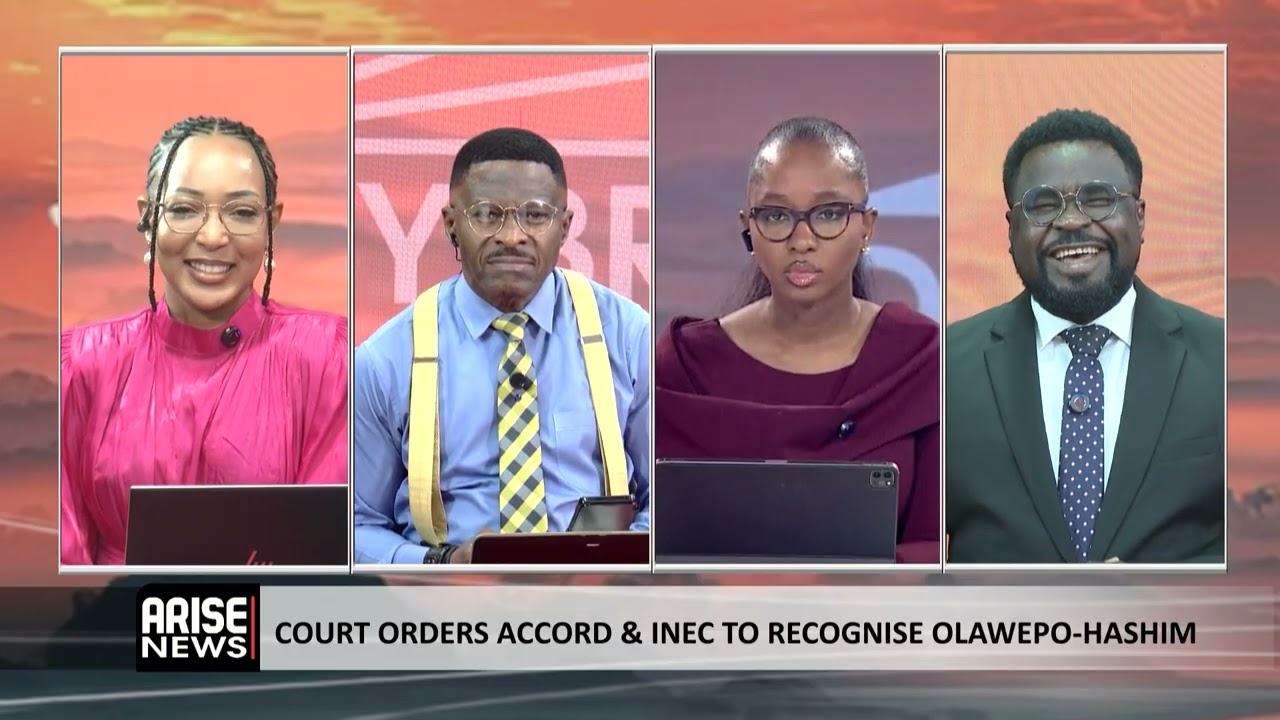
Against the backdrop of the court’s ruling and its directive to INEC, Oshoma, in an interview on ARISE NEWS on Tuesday, explained why the electoral commission is expected to recognise Olawepo-Hashim’s candidacy, arguing that INEC had no stake in the dispute and was therefore bound to comply with the judgment.
“In this matter, INEC is actually a nominal party, and being a nominal party, INEC has no dog in the fight. So it is for INEC to comply with the judgment of the court,” he said.
On the evidence before the court, the lawyer said that the documents contradicted the Accord Party’s claim that no presidential primary was held, pointing to the ₦50 million nomination fee, the party’s submission of its candidate list to INEC and the notice of the May 30 primary. He argued that the absence of any evidence showing that Olawepo-Hashim’s payment was refunded or rejected further supported the finding that the primary took place.
“In law, you cannot contradict documentary evidence with oral evidence. The documents presented by the Accord Party show that it was an afterthought.
“The party said they didn’t conduct any primaries, but the court looked at the documents that the applicant had submitted and discovered that indeed there was a primary. INEC had not come out to say they did not monitor any primary. INEC was a party in the matter and didn’t state that they didn’t monitor any primary.
“So the only conclusion any reasonable person can draw is that indeed there was a primary, because after you collected money, you submitted a list of candidates to INEC, met the deadline of May 10th, and fixed a date for primaries, only to turn around to say that despite the notice given to INEC, you did not conduct any primary. It would be foolhardy for anybody to think otherwise—that indeed the party didn’t conduct primaries.
“The question should be: despite all of these documents, what evidence did the party place before the court to show that they did not conduct primaries? Is there any document showing that the money he paid was refunded or rejected? The answer is no. The only conclusion anybody can draw is that indeed there was a primary, and he being the sole candidate of that primary, he won. But they probably had sold the mandate, so now they were looking for a way out. They didn’t expect that he would go to court; they probably thought there would just be a compromise to negotiate the candidacy away.”
On the broader implications of the case, Oshoma said the increasing number of election-related disputes reflected Nigeria’s longstanding culture of litigation, noting that political party primaries and elections had increasingly become subjects of court battles.
He added that recent Supreme Court judgments on Sections 285(9) and 84(14) of the Electoral Act had opened a new avenue for further litigation, particularly over the interpretation and application of electoral laws.
“Apart from our political parties, Nigerians are very litigious people. I’ve always said that; we like going to court.
“With the recent Supreme Court judgments validating Section 285(9) and Section 84(14), it has opened a new vista, and we are going to see more after the elections.
“The judgment takes effect from the day the law was made. So basically, we are going to see more cases in court, whether frivolous or otherwise. That’s why consistently, every election cycle, we try to amend the Electoral Act to ensure compliance with some of the interpretations that the courts have given.”
On the wider question of the role of the courts in politics, Oshoma argued that Nigeria had “judicialised politics” by repeatedly relying on the courts to resolve disputes that should be settled through credible electoral processes, stressing that the ballot should remain supreme.
“We have judicialized politics and politicized law in our bit to grow democracy, which is actually not good for our democracy. If we have to really develop democracy, we must look at how we can ensure that the ballot becomes supreme, not the court.”
He also linked the Accord dispute to the weakness of fringe political parties, arguing that Nigeria needs a more formidable opposition rather than parties that become active only during election periods.
“Take, for example, this Accord Party case. What would it have taken the people who collected nomination funds and expression of interest forms to say, ‘We do not want to mortgage our party to another party, whether ruling or opposition party; we would rather remain in opposition and be relevant to a few people’? But no, after collecting money from a candidate, they said they didn’t conduct primaries.
“Now, coming to the question of a house divided against itself: some of these political parties are what I call fringe parties, pretenders, and contenders. You have some who are really not in the game; they just want to bear the name ‘one-time presidential aspirant’ so they have a complementary card to show.
“I don’t see a path of victory for some of these political parties. The best thing should be to let them be where they are, because we usually have big ruling parties. Let’s have a formidable, solid opposition.”
Turning to INEC’s responsibility in the Accord Party primary process, Oshoma said the commission had not denied receiving notice of the May 30 primary, arguing that its role was to monitor the process and comply with the court’s eventual decision.
He maintained that INEC had no basis to challenge the ruling after failing to tell the court it was not notified of the primary.
“INEC has not said they did not monitor any primaries, because the rule says you must give INEC notice under Section 82.
“In this case, INEC had not even come out to say they were not informed. It is not INEC’s job to fight for the party. They are nominal members because, at the end of the day, once the court delivers a judgment, it is for INEC to enforce. In that step, it is always very convenient to add INEC as a party in the matter so that the court order can be directed at INEC.
“In this case, INEC had not denied anything, unlike when INEC felt their timetable had been affected by a decision and they were the ones that appealed. In this case, INEC is the umpire; theirs is to watch, and whatever the court says.
“INEC has nothing to do apart from complying with the decision of the court. They were a party in the matter, and they didn’t tell the court that they didn’t get notice. It is between both parties and the court, based on the threshold of evidence submitted. The court believed one party against the other and ordered INEC to enlist him as the candidate of the party.”
Favour Odima
Follow us on:


