


The Chairman of the House of Representatives Ad Hoc Committee investigating the activities surrounding the alleged fake government agency, Honourable Yusuf Gagdi, has clarified that the committee’s probe was not targeted at the Chief of Staff to the President, Femi Gbajabiamila.
He said that the committee was mandated to establish whether the agency had legal backing, verify its appointment and authorisation documents, and examine how it gained access to the Federal Government system and budget.
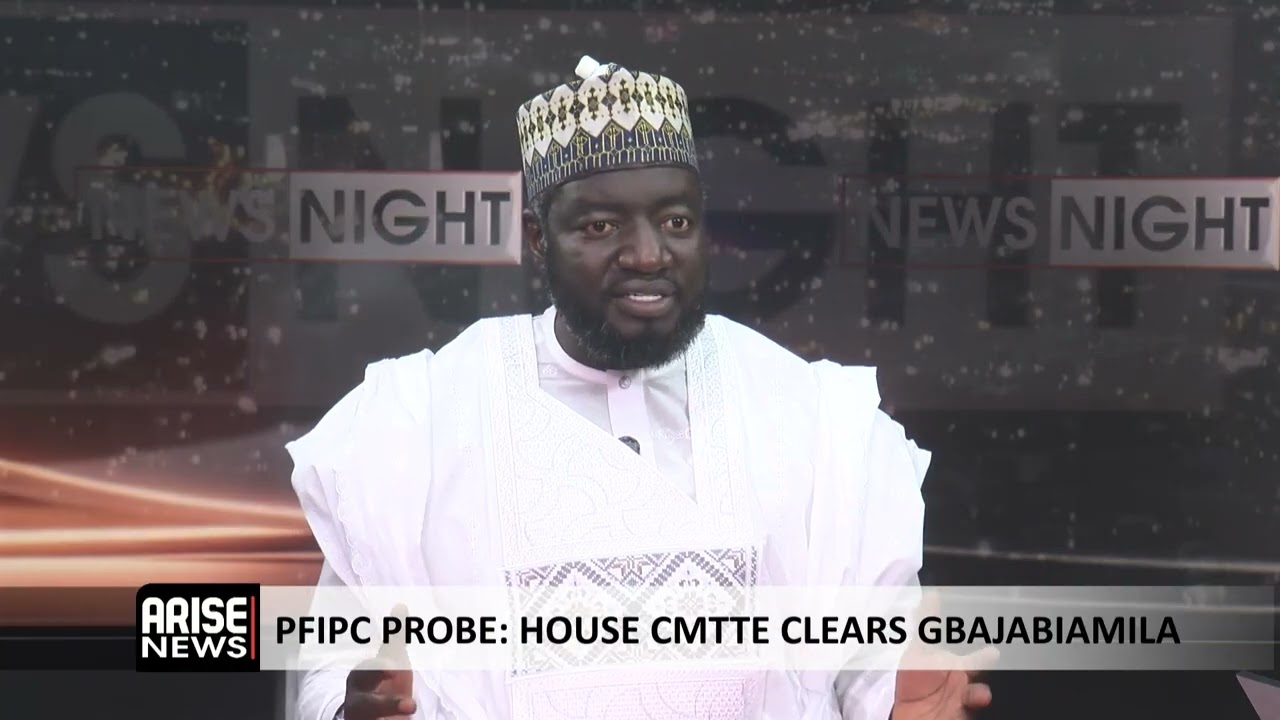
“First and foremost, the impression that people have that the entirety of that committee is about Femi Gbajabiamila is not true. We were first asked to establish whether it has any legal backing. In the course of determining whether the agency has legal backing, whether the appointment letter is true, whether the authorization directive by the presidency is true, whether the presidential order establishing that agency is true, and so many other things, I think there are so many enormous things that the committee was asked to do, instead of focusing on an individual.
“First, our priority was not even about Prince Adeniyi Adeyemi or Femi Gbajabiamila. Our priority was to call the agencies concerned: How can an institution not established by law find itself through the Nigerian Federal Government system to an extent of having accommodation?”
Speaking on what the committee had discovered in its investigations, Gagdi highlighted documents and findings from the ICPC, EFCC, DSS and Nigeria Police concerning the agency and its Director-General, Prince Adeyemi Ade.
“We obtained documents. In those documents, we discovered a lot. The security agencies—the ICPC, the Economic and Financial Crimes Commission, the Department of State Services, the Nigerian Police through the office of the Inspector-General of Police—wrote to us and equally gave us what they have done so far about the DG in question, about the agency in question. We discovered that there were a lot of things they have discovered in an ongoing investigation.”
Gagdi added the documentation obtained by the committee also revealed a number of documents and issues connected to the Chief of Staff to the President, Femi Gbajabiamila.
“Through those documentation processes, we laid our hands on a lot of documents that are connected to Femi Gbajabiamila,” he revealed.
Responding to claims that the investigation was conducted behind closed doors, Gagdi said the committee’s proceedings were open and covered live by Arise News, except for its meeting with Prince Adeyemi. He explained that the committee could not question Adeyemi because the police, who had custody of him, cited a court order directing that he remain in police custody.
“It wasn’t behind closed doors. Even the Arise TV here covered all our proceedings live. There was nothing that was carried out behind closed doors except our meeting with the so-called DG, Prince Ade.
“Why was it under closed doors? We wrote to the police, who are the custodian of Prince Ade, to present him before the committee in the National Assembly. The police replied to us—they would have wished to do so, with utmost respect to the Inspector-General of Police who signed the response—saying that they would have wished to present him before us. It was open; none of our meetings was under closed doors.”
Speaking more on the committee’s findings, Gagdi said it discovered that the purported Act establishing the Presidential Foreign Intervention Promotion Council, also referred to as the Presidential Economic Advisory Council, did not exist, while the Act, Villa directive and appointment letter presented to the committee were forged.
He added that Gbajabiamila only became aware of the agency in February last year, based on documents before the committee, while noting that the preliminary investigation identified possible accomplices across government agencies.
“We discovered that the Act is forged, the letter instructing the takeoff of the agency by the Villa is forged, and the appointment letter is forged. How do we discover all of this without calling Femi?
“The Chief of Staff learned about that in February last year in the course of our investigation, based on the relevant documents that were before us.”
Honourable Gagdi further disclosed that 58 bank accounts linked to Prince Adeniyi Adeyemi’s BVN were traced to 12 different agencies.
“There are definitely compliances in different agencies that are accomplices to Prince Adeyemi, but predominantly, we have not seen anybody as a signatory to 58 different bank accounts that are tied to his own BVN.
“That agency that was only pronounced as Presidential Foreign Intervention Promotion Council, otherwise, according to him, referred to as Presidential Economic Advisory Council—the agency has two names—we discovered that in the course of tracing those, whether compliances are involved in one way or the other, we discovered that he had opened different accounts amounting to 58 different accounts, out of which the accounts belonged to 12 different agencies. Linked to his BVN, yes. 58 bank accounts in different accounts. Some banks have one or two accounts,” he revealed.
On the committee’s next steps, Gagdi said the final report would address questions about how the banks allowed the alleged fake agency’s Director-General to open the accounts. He added that the committee was working to tidy up its findings and present a comprehensive report to the House when plenary resumes.
“I am very sure in our final report, we will answer that. If the House resumes during plenary. We are working to tidy up and present a comprehensive report to the House.”
Responding to calls by Nigerians for an independent investigation, amid concerns that the government could be acting as judge and jury in its own case, Gagdi defended the House committee’s mandate, saying the committee was constituted through a clear parliamentary process and was not set up by the Presidency.
“What independent body does Nigeria need to investigate other than the House of Representatives? Are we under anybody? Is it the presidency that put together this committee?”
Rejecting suggestions that the probe was sub judice, Gagdi said the House did not investigate matters before the court, which centre on the agency’s DG and alleged fraudulent activities. He said the committee instead examined how the agency entered the Federal Government’s budget and whether it was lawfully established.
“It’s not sub judice, because what did we do? We did not investigate what is before the court. We investigated what… There is nothing about how does the budget come into the budget of the Federal Republic of Nigeria in court. There is nothing before the court as regards to whether that agency is lawful or unlawful. What is before the court is the activities of the DG and his fraudulent way that is suspected to have been taking place, that is in court. It doesn’t stop the parliament from having a conversation or investigating the aspect of the matter that is not before the court.”
Defending the National Assembly against suggestions that its oversight failure allowed the alleged fake agency to emerge, Gagdi said responsibility for verifying the legality and authenticity of government agencies lies with the Executive during the budgetary process.
He explained that ministries, the Head of Service and Budget Office should verify agencies’ submissions before they reach the National Assembly, whose role is to scrutinise funding allocations. He added that the legislature can address such gaps through legislation and policy frameworks.
“I’m not shifting blame, but you can only say that those disappointments and gaps exist in agencies, but not with the National Assembly. Because the work of the National Assembly in the budgetary process is not to scrutinize agencies to know whether you are legal or illegal. That is the work of the executive arm of government.
“It is expected in the budget process at the administrative level, each ministry, will summon departments under it to submit their budget, discuss their authenticity. Head of Service will do the same; Budget Office will do the same.
“Ours is to scrutinize the allocation of funds in the budget. It is not the responsibility of the National Assembly to start asking agencies, ‘Are you legal or illegal?’
“You only recommend or make policy framework in terms of legislation.”
Follow us on:


