


Deputy Chairman, ADC Manifesto and Policy Committee, Professor Pat Utomi has said those in power are blocking democracy’s full practice, warning that it is eroding public confidence and calling for urgent efforts to save the country.
The Professor said this in an interview with ARISE NEWS on Tuesday.
“The consistent outcome of this longitudinal data is that African people want democracy, but the people getting into power in Africa are preventing democracy from really taking place, and the people are losing hope in democracy. We must save our country from that,” he urged.
Responding to concerns about the legal challenge to the party’s leadership, Prof. Utomi said a court ruling against the current leadership would not invalidate the convention outcome.
“To be honest, it won’t make any difference in so many ways. First of all, the rules, the way they are set up—anybody who understands the Constitution and all of that—INEC really has no right, if it is given the due notice, to interfere. They can choose not to show up, but it doesn’t affect what happens ‘in the family.’ It has the obligation, the duty, to put on that ballot box the people that come forward out of this kind of leadership, and the collective commitment is what really matters at the end of the day,” he said.
Adding, Prof. Utomi said internal party disputes are often driven by external influence within political parties, warning that a lack of political civility makes it easier for such interference to destabilise party structures.
“First and foremost, as with the Labour Party, PDP, and now with the ADC, some unseen hands—or probably quite seen, but not trying to be who they are—are trying to disrupt these parties. In all political parties, you’re going to have the good, the bad, and the ugly—people who are just scoundrels who drift in and are willing tools. So, if there is a determined effort from outside, if there isn’t a political culture of civility that recognizes that this is the proper way to act in the public sphere, then it is easy to find those willing tools and use them to cause irritations within the system,” he warned.
He further said Nigerians are deeply dissatisfied with the current situation and widely desire change, arguing that this public frustration creates a strong demand for an alternative political option.
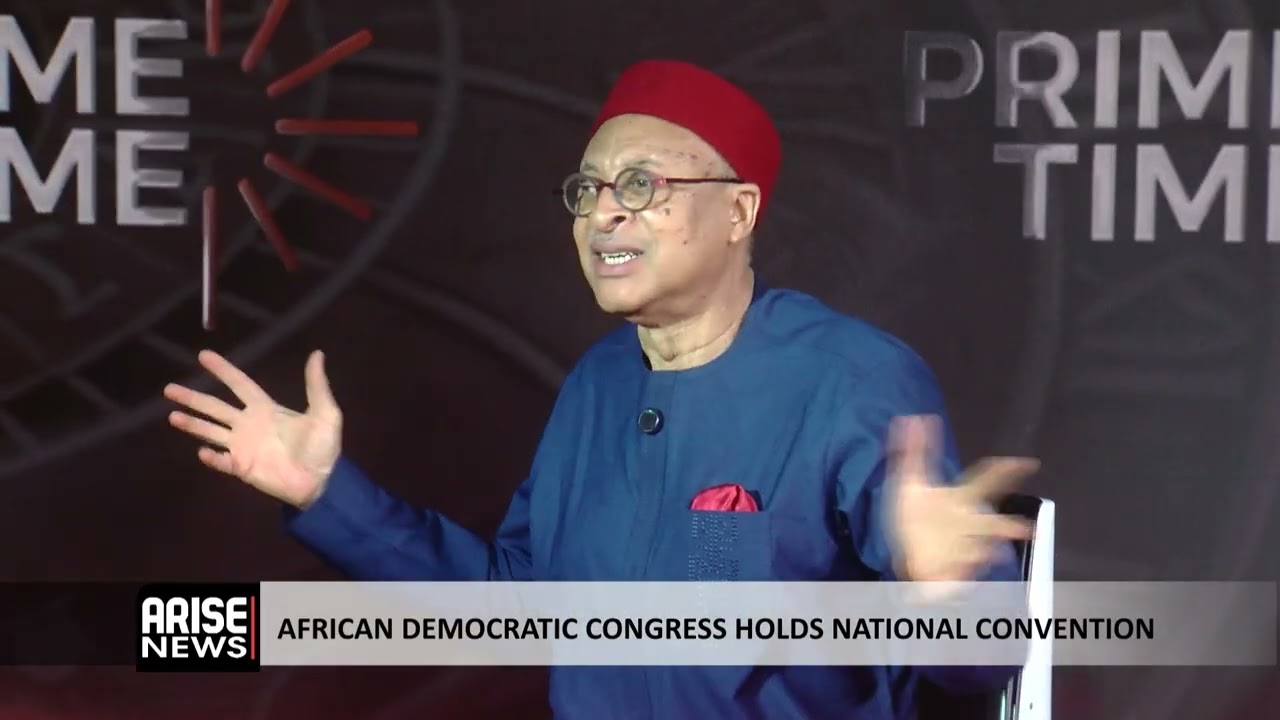
“The purpose of government is the well-being of the people. Nigerian people are at the very worst they’ve ever been, and so they want something to replace what is there now. There is no question about that. You go to any street corner in Nigeria, they’ll tell you they’ve had it up to here. So, that is one starting point.”
Speaking on the ADC’s internal disputes, Prof. Utomi said the challenges would not cause the party to collapse, but were instead strengthening it by forcing members to set aside personal ambitions for the national interest.
“There’s no crisis that can lead to collapse. In fact, these so-called tests are strengthening the party. Those who thought. So, it’s actually strengthening the party. You’re getting these so-called ‘big men’ to begin to rein in their egos because what is at stake is much, much larger,” he said.
Responding to the question of who would emerge as the ADC’s strongest candidate, Prof. Utomi said the process is open and not centred on any single “strongman” figure.
“We need to have a very broad field, and there’s no problem with that. But what is really interesting is it’s a process. People think that this ADC just jumped from the sky. No, I have been attending meetings that have taken place in Europe, in Africa, and all of that, building up to what you see today. It didn’t just happen. It was a systematic process of building. And one of the things we agreed from the very beginning—I can say publicly here, at a meeting in Barcelona more than a year ago—was we’re not going to have a ‘boss’ of government, this ‘strongman president.’ No, it’s going to be collective responsibility. All of us are holding each other accountable now to make sure that governance is people-centered. It’s about the people of Nigeria, not about a privileged group that has been having fun while the Nigerian people writhe,” he explained.
He maintained that efforts are underway to prevent division, expressing confidence in members’ commitment to the national interest while acknowledging that a few may still opt out over disagreements.
“We’re going to do our damnedest best to make sure that doesn’t happen. And there are good signs to suggest that it will not matter. But if some people, driven by their egos, choose to walk away from something, you can’t stop that. That’s a natural thing. But I think there is enough sensitivity to the duty to the Nigerian people among these people. I’ve interacted with them, and I know that there are many who are willing to sheathe their swords,” he revealed.
Expressing confidence in the ADC, Prof. Utomi said the party is ready for immediate political engagement and pointed to its policy platform as evidence of its preparedness.
“I can assure you that the ADC is ready for right now, not even 2027. I wish we could spend an hour on the policy platform or plank of the ADC that has been put together.”
Adding, he said the ADC’s policy direction focuses on job creation, security, and good governance, with emphasis on youth empowerment, and education reform.
“It’s about jobs, jobs, jobs. Powering these processes, security, and integrity in governance. The ADC recognizes that its essence is future-proofing the youth of Nigeria, to get young people with talent to be able to do the things that will ensure that they’ll have a higher quality of life from production.
“So we take the factor endowment of all of those parts of Nigeria, ensure that the value chain is properly developed, ensure that the quality of education the young people are getting is such that will make them competitive globally on those value chains from all parts of Nigeria. Inclusion and balanced development is central. We don’t want a situation where there are some people outside the house looking in,” he emphasised.
Speaking on Nigeria’s economic direction, he said stabilization alone is insufficient, noting that past policies failed to deliver growth.
“They don’t understand the problem. They’re saying that before you get high economic growth, you’ve got to stabilize. It is not true because we said the same thing in 1987 and we never got high economic growth because high economic growth doesn’t just happen. We must say to ourselves, look, the purpose of stabilization usually is to benefit a few at the top and their external partners that they want to pay off their debts,” he noted.
Sharing details of the ADC’s manifesto, the Deputy Chairman of the ADC Manifesto and Policy Committee said it is centred on production-led growth, job creation, and inclusion.
“Absolutely, that is the manifesto base. Even more interestingly, I’ve worked with this team of technocrats who are translating these ideas coming from us. We can actually get a system that works. So it’s plausible that we can very easily translate all these great ideas into implementable policies that lead to rapid growth. Go back to China, go back to what happened in 1978 when the new leader of China, Deng Xiaoping, spoke: ‘We must ensure that our people recognize the value of knowledge, of education,’ and how this is the rest of history,” Prof. Utomi concluded.
Favour Odima
Follow us on:


