


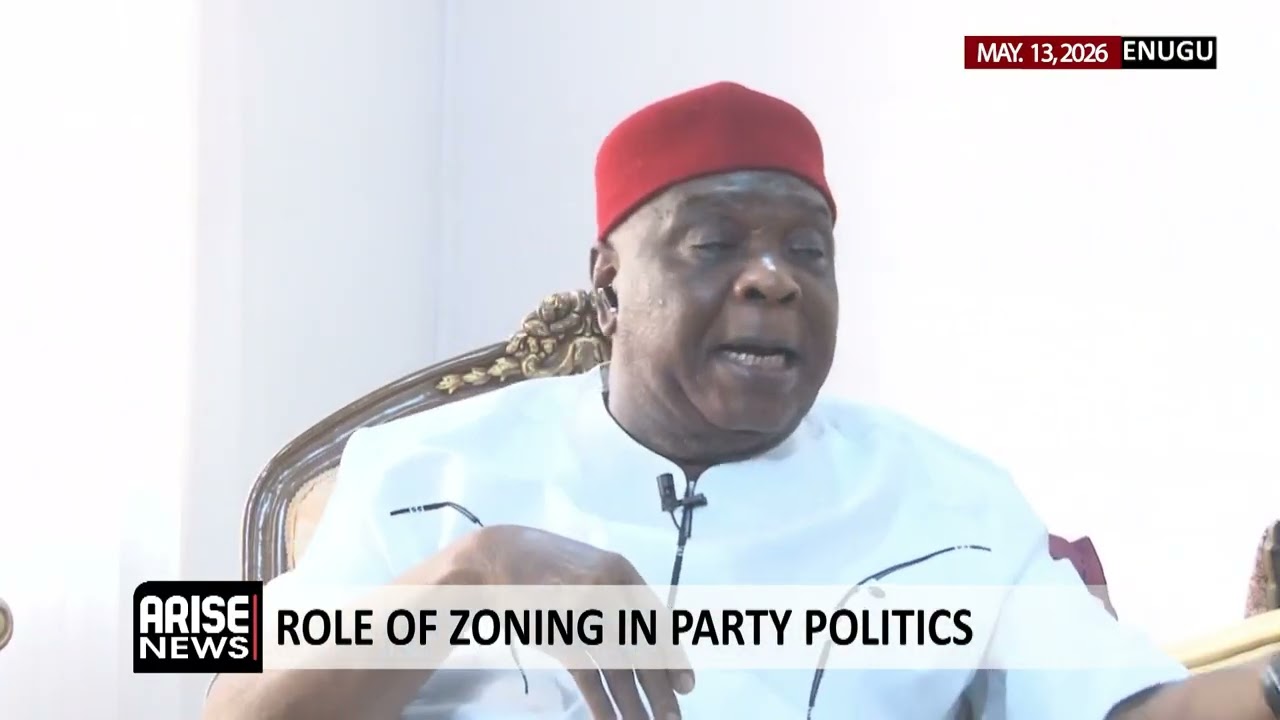
A chieftain of the Peoples Democratic Party (PDP), Dan Ulasi, has criticised Nigeria’s political system, governance outcomes, and the ongoing debate around zoning, arguing that corruption, lack of accountability, and weak leadership values have undermined development across the country.
Speaking in an interview on ARISE News on Wednesday, Ulasi said Nigeria’s political structure has failed to deliver meaningful development despite repeated rotations of power and long-standing zoning arrangements.
He insisted that while zoning is not constitutionally backed, it remains a political tool meant to promote inclusion and a sense of belonging among diverse groups in the country.
“Zoning is not a constitutional matter, but it is a matter of confidence that gives everybody a sense of belonging,” Ulasi said.
“It is not constitutionally wrong, but it is morally wrong to the extent that those other people don’t have a sense of belonging.”
He referenced Nigeria’s pre-civil war political arrangement to argue that inclusion has always been central to national cohesion.
“For almost five, six years, Attah of Faba was the first Governor-General and top president, non-executive president so to speak. But at least he gave a sense of belonging to people from different parts of this country,” he said.
Ulasi, however, warned that zoning without accountability has created a culture where political office is seen as an avenue for personal enrichment rather than public service.
“When you see a society where people take a vow for unsupported devotion to stealing instead of unsupported devotion to public work, then you see the problem we have,” he said.
“People go into governance, and the conclusion is that there is a way of making money from the people.”
He argued that corruption has become deeply entrenched in society, saying many public office holders accumulate unexplained wealth shortly after assuming office.
“In a local government where they are paid four or five pounds, you see somebody after two years driving a big car, building a house in his father’s compound. These are people in your own environment,” Ulasi stated.
According to him, Nigeria’s political parties have become mere platforms that are often personalised by individuals seeking power for self-interest.
“The political parties are only platforms. It is the individual who personalises the political party,” he said.
“If we have a wrong individual with a wrong conception, then we are finished.”
Ulasi further lamented the lack of accountability in governance, citing abandoned projects and poor infrastructure delivery across the country.
“There are very few examples of a project that is started and completed. More than 80 percent of projects are abandoned in this country,” he said.
“That is the only country you hear of abandoned property. It means money was misappropriated.”
He also criticised what he described as elite detachment from the realities faced by ordinary Nigerians, especially in rural communities.
“How can you not give water to your citizens? Even some African countries have water running, but here we cannot,” he said.
“See our people in the villages drinking dirty water—you weep. They have a right to clean water.”
On leadership and competence, Ulasi argued that Nigeria must allow competent individuals from all regions equal opportunity to serve, while stressing that inclusion should not replace accountability.
“Every zone should have competent people to represent the interests of their people,” he said.
“Let’s give every zone, every community a chance to be part of the system.”
He also called for what he described as a “values revolution” in Nigerian politics, warning that the current trajectory is unsustainable.
“We need values. We need sympathy for our people. This is no longer colonisation, but what we have now is worse,” he said.
“We cannot continue like this in the 21st century while ordinary water is still a problem.”
Ulasi concluded by urging a fundamental rethink of governance priorities, stressing that Nigeria’s development challenge is rooted more in leadership values than in constitutional design or zoning arrangements.
Boluwatife Enome
Follow us on:


