


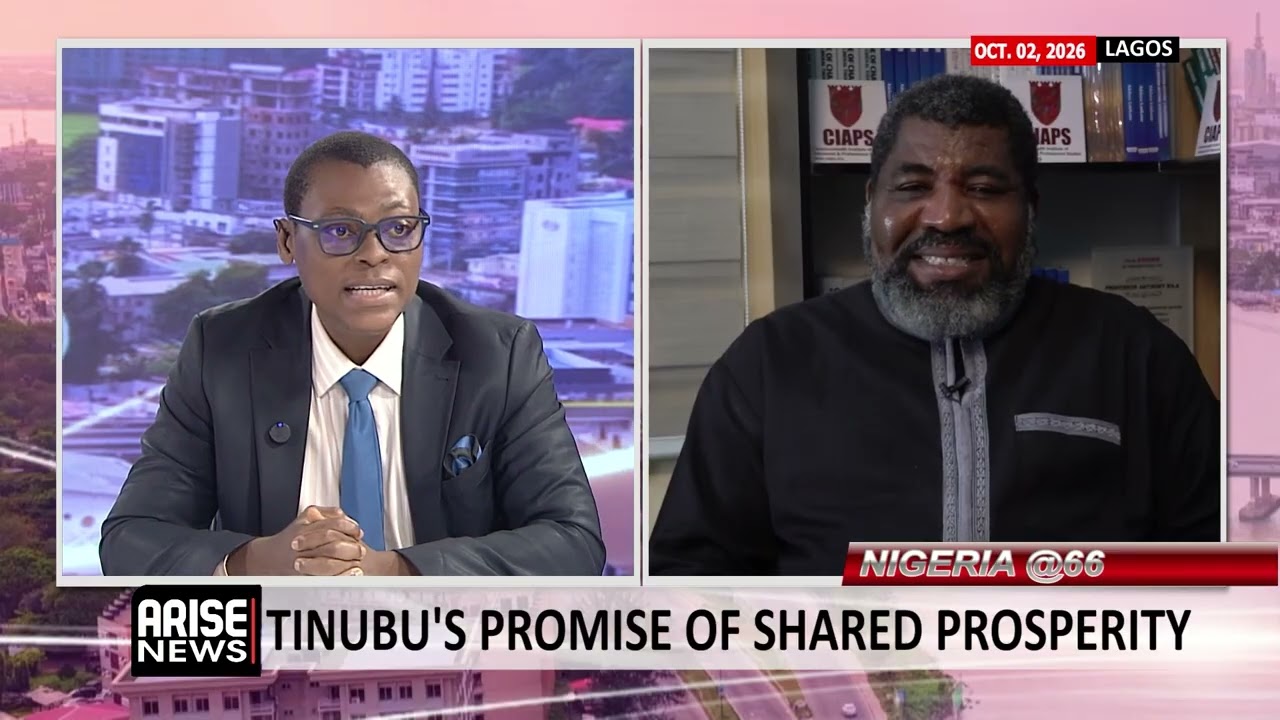
Director at the Commonwealth Institute of Advanced and Professional Studies, Professor Anthony Kila, says the Federal Government’s claim that Nigeria has moved from painful economic reforms into an era of stability and prosperity must be tested against the realities faced by Nigerians.
Kila, speaking in an interview with ARISE NEWS on Friday while reviewing President Bola Tinubu’s Independence Day address, said Nigerians should assess the administration’s economic progress based on improvements in their daily lives rather than simply accepting or rejecting the president’s claims.
“I think that is a speech that needs to be tested. With what the president said on Independence Day, the president has given an unusually clear test of his administration,” Kila said.
“The president said that the country has gone through years or decades of sickness, and now they’ve treated that sickness and the country is healing. I quote that illustration because that is a very strong metaphor. And the president made the case that the treatment is not the cost of the pain, but the treatment is the means to healing the pain.”
Kila said the president had shifted the focus of his administration from defending the economic reforms to being held accountable for their outcomes, particularly in areas such as the cost of living, agricultural security, access to credit and employment.
“So what I would say is this, now that the president agrees with some of us that it is not enough to measure growth by GDP or what the IMF says, and we must take note of this, that the president now talks about reducing cost of living, farmers being able to cultivate in safety, access to credit and employment for young people,” he said.
“That is the right way. So we’ve moved away, or the president himself has now shifted away from justification to accountability. So I stand for evidence. I say let us test what the president has said. There’s no point in saying it’s not true what he has said. Let us test it.”
Kila said the president’s cancer metaphor should similarly be assessed by examining whether the reforms would actually improve Nigerians’ lives, noting that the ultimate test would be felt in homes, workplaces, markets and banks.
“The president said there was cancer. Instead of treating the symptoms, we have gone for the therapy. We’ve gone to cut away that cancer. Let us now test if that treatment will lead to curing of the illness that people have,” he said.
“Politicians will judge the content of the speech. Some of us will judge the construction, the eloquence and the cadence used in the speech. But in the offices, in the classrooms, in the market and in the banks, what people will be asking is, how has this affected my life? Will the cost of food be cheaper? Will there be more stable electricity? Will there be access to loans? Will I, a young graduate willing to work, be able to get a job? That is the test.”
On the benchmarks Nigerians should use to assess the administration’s claim of economic stability, Kila identified greater certainty in economic transactions, access to credit and changes in the cost of food and transportation.
“One thing, let’s start from what they’ve actually achieved. There’s one thing that this government achieved that they’re not saying, which is certainty. The fact that you can predict the cost of transaction, especially for forex, I think is a good thing,” he said.
“I have reservation because I think you can predict it on a high level. It was lower than this where they came in. But with the reform, at least we have some sort of stability there.”
He added: “So the next test will now be to say, the president has said, we have the credit card. Can I, as a Nigerian, get a loan easily? That would be a test. How much does it cost me to buy my food, to pay for transport? Is it easier or is it getting better?”
Kila said the administration’s shift from macroeconomic indicators to issues directly affecting citizens was significant, but cautioned against declaring that the economic difficulties were already over.
“The president talks about the cost of production, which is a very crucial thing, because that way we’re moving from macro economics and GDP to real-life economics,” he said.
“I would be cautious, unlike the president, that I use expressions like, the trouble is over, the pain is over. Because, you see, what the president has done in reality is to change direction, to say we’re moving away from focusing on macro and we’re moving towards real life.”
“Now, if you change the direction of a ship or a car, it doesn’t mean you’ve arrived at your destination. Other elements like the weather, capacity of the driver, the amount of petrol or fuel you have in it, will still come into play.”
Kila also raised the issue of whether the benefits of economic reforms would be broadly shared, arguing that the government’s reference to “shared prosperity” should be subjected to the same scrutiny.
“There’s another test I will add, and this is the test of shared prosperity. It’s an expression the president used, which I like,” he said.
“So, if we talk about shared prosperity, we should also ask ourselves, we have gone through pain, this pain that we’ve gone through. When the prosperity comes, how will it be shared? Will it be shared equally because reforms have cost? There are winners and losers. Is it the people who are benefiting that are benefiting more? Because did we all share the pain equally? That’s another question that can be tested, I argue.”
On the controversy surrounding the removal of fuel subsidy and the opposition to the policy during the Goodluck Jonathan administration, Kila said he was among those who opposed its removal at the time but maintained that his position was based on economic considerations rather than partisan politics.
“Let us agree that those who stopped Jonathan, unfortunately, if you call them hypocrites, I’m one of them. I mean, because if I don’t say it, some people go to social media to remind us we were one of those people leading the Occupy Nigeria,” he said.
“The difference is I’m still here saying that this subsidy thing, I don’t agree it should be removed that way. Many people who were with us those days, some of them have become ministers, one of them have become president. I see that’s the point you’re making. Everybody, conscience and history will judge us.”
Kila said it was possible that politicians who previously opposed subsidy removal had changed their positions, adding that the disagreement over their motives was ultimately a question of political and moral judgment.
“But it is possible that they changed their mind. It is possible that they’ve just discovered something else that we didn’t discover. Your argument is that they were lying all along or that they’re lying now,” he said. “Okay, so that’s a moral thing.”
He maintained that his own opposition to subsidy removal was based on the expected economic consequences, arguing that the concerns raised at the time had since materialised.
“My own point is that I don’t owe the God of Jonathan anything because my position to Jonathan was neither personal nor partisan. It was purely economic,” Kila said.
“When some of us were arguing against removal of fuel subsidy, the reason, and I want to go back to a record, the reason why we were against is that we argued from an informed position to say that if you yank away this thing, prices will go up of production, of movement, and it will cause problem on the economy.”
“President Tinubu has been able to do it. And all the things we were afraid of has happened.”
Kila also disagreed with the practice of making Independence Day addresses primarily about the performance of the government in power, saying the occasion should instead focus on Nigeria’s history and the vision behind independence.
“An Independence Day speech, whatever speech, you must remember your past,” he said. “And most of you are expecting that. I remain, as usual, in my unpopular position to argue that the speech of the October 1st should not be about the government of the day.”
“It is before the government of the day. And it will be after the government of the day. I love the content of the speech, but I disagree with the timing. I think that speech should be about how we got our independence, about the vision we had, about how we transitioned from colonial government.”
Boluwatife Enome
Follow us on:


