


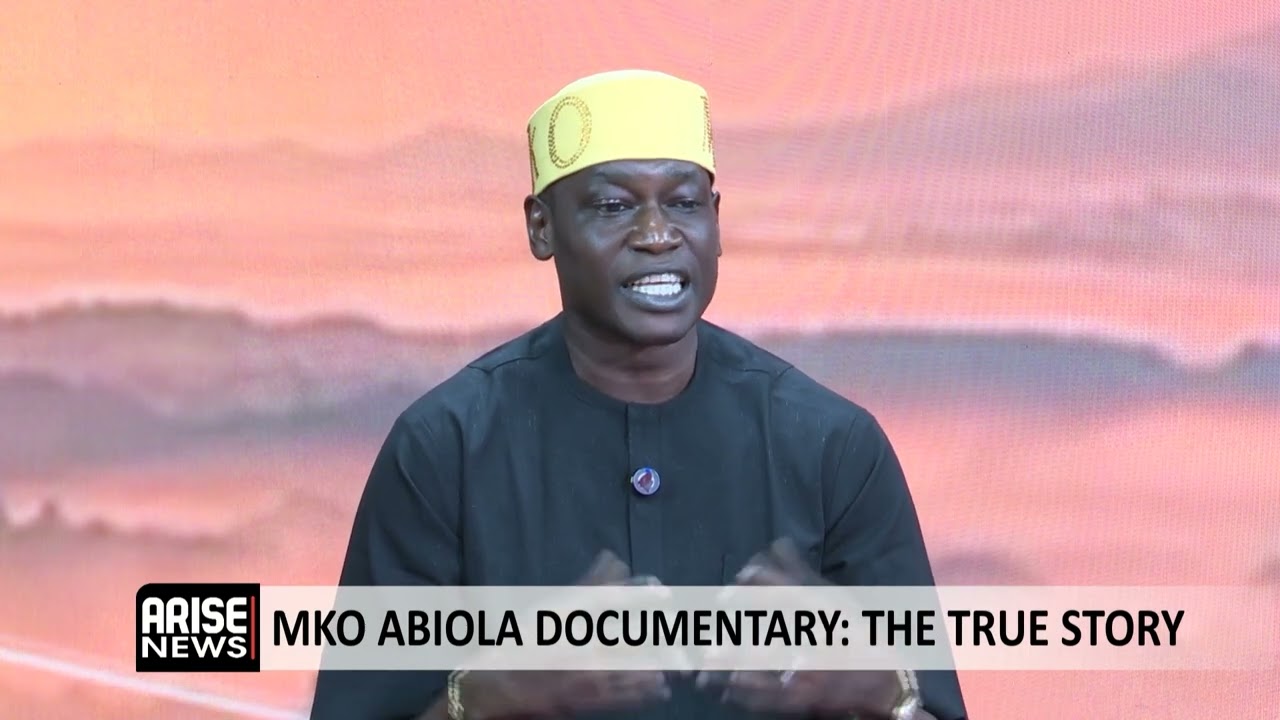
The son of the late Chief Moshood Kashimawo Olawale Abiola GCFR, also known as M. K. O. Abiola, Abdulmumuni Abiola, has described a documentary on his father and Nigeria’s democratic history as an important effort to preserve a chapter of the country’s history that he said was removed from the school curriculum.
He said this while speaking in an interview on ARISE NEWS on Wednesday.
According to Abiola, the documentary, which will premiere on October 1 after 13 years in production, brings together diverse voices and perspectives to chronicle the life of MKO Abiola and Nigeria’s democratic struggle.
“First of all, you have to understand that history wasn’t being taught at the time. After Abiola was killed and democracy was created, they stopped teaching history. They were trying to rewrite history.
“When people watch it, they will find that it is not just one perspective; it’s a diverse group of people telling different things. I want Nigerians to watch it so they can make up their own decisions and know what it took to get us to where we are today.
“History was removed from our curriculum, so this is a way of preserving it,” he said.
Speaking on the challenges faced when producing the documentary titled ‘MKO’, Abiola disclosed that the documentary’s production was marked by numerous setbacks, including closed doors, disappointments and failed promises, but praised Nigerian-American filmmaker Ose Oyamendan, who directed and produced MKO, for remaining committed to the project.
He noted that almost 800 hours of footage were recorded and edited down to create the documentary.
“When the producer started seeking support for this documentary, he found so many closed doors. So many people didn’t want to hear about it or wanted to forget about it.
“One thing I want to congratulate the producer for is that after all the disappointments and failed promises, he kept pushing. Now, we have a documentary with almost 800 hours of film time edited down.”
Abiola urged Nigerians not to lose hope, stressing the importance of understanding the country’s history and learning from the events that shaped its democratic journey. He encouraged citizens to watch the documentary to better understand where Nigeria is coming from and what needs to be done to build the future they want.
“We need to be collective in our progress and think about others before ourselves. Individually, we are our own community, so we need to understand that we are collective and need to work together.
“I encourage people not to lose hope, watch the documentary, and understand where we are coming from. That will tell us what we need to do to get to where we want to go. It’s important to know our history.”
On the dividends of democracy, Abiola said Nigerians must first examine the structure on which the country’s democracy was built. He argued that the 1999 Constitution was not designed to unite the country as one unit, but to preserve what he described as the military’s existing system of control, adding that the June 12 struggle represented the truncation of the Nigerian people’s voice.
“First things first, when it comes to dividends of democracy, you have to have the structure of democracy at the onset. We have to understand that in 1999, when we came up with this constitution, it was not geared for us to be one unit. It was just geared to maintain the status quo—the military hegemony and control over the populace.
“When I talk about June 12, I talk about it as the truncating of the voice of the Nigerian people. They wanted to suppress the masses and bring us to a position where we felt hopeless. Yet, there is so much hope. Every day, people pray and believe in a better tomorrow. After everything we’ve been through, we are very strong and resilient people. But we have to act. We can’t just talk about our problems; we have to use our actions to change our reality.”
Highlighting President Bola Ahmed Tinubu’s role as the chief host of the film’s October 1 screening, Abiola said his presence carries deep significance for his family and Nigeria’s democratic history.
He recalled Tinubu’s involvement in the pro-democracy struggle following his father’s arrest, including his support for Radio Kudirat after the assassination of his mother, Kudirat Abiola.
“After my father was arrested, my mom, Alhaja Kudirat, was leading the push for his release. I remember my mom going back and forth on strategies. I vividly remember the last time Asiwaju came to our house. He told my mom of an impending plot to assassinate both of them and that he was planning his way out of the country into exile to continue the fight from the States.
“My mom said he should go, but she couldn’t leave her husband in prison. She stayed back, and a couple of months later, she was assassinated on the streets of Lagos. He was there, and after my mom’s assassination, he was instrumental in starting Radio Kudirat and continuing the struggle from overseas.
“When we got democracy, he came back to become governor. It’s full circle—he was there in the beginning, and now he is the President. The fact that he is attending honors the importance of that part of our history to our democratic journey.”
Describing the documentary’s major achievement, Abiola said it gives Nigerians the opportunity to tell their own story, bringing together voices from different sides of the events surrounding his father and the country’s democratic struggle. He said the documentary may not answer every question, but would raise more questions and encourage people in the arts to explore different aspects of the story.
“For me, the significance is that our own people get to tell our story. This documentary won’t answer all questions, but it will raise more questions. I encourage people in the arts to look into different angles of this story. Democracy is a journey, not a destination. We must continue to strive for better. The people’s voice is the most powerful thing we have. We need to realize our internal power and project it collectively toward a common goal.”
Recalling questions he had about his father’s struggle, Abiola said the documentary explores why Bill Clinton did not meet MKO Abiola during his US trip, adding that he played his father in the film after the scheduled actor failed to show up.
“Growing up and seeing everything that happened, I remember the last time I saw my dad leaving for the US to seek support for his mandate. He wasn’t able to see Bill Clinton. I always wondered why Bill Clinton didn’t see him, especially after international organizations claimed the election was free, fair, and credible.
“I later found the answer. I won’t divulge everything because people should watch it. But I will give you one crumb: during the scene where my father was arrested, the actor playing my father didn’t show up on the day of shooting. So I actually played that role myself—you can put ‘actor’ in front of my name now!”
Describing his father beyond politics, Abiola said MKO was his hero and a proud Nigerian and Pan-Africanist who, having benefited from the country’s support during his education, believed in giving back and investing in Nigeria.
“My father was my hero. I was at that age where you idealize your parents, believing they can do no wrong. I respected him so much and was proud of how he carried himself. He was a Nigerian and a Pan-Africanist.
“He started from nothing and built himself up. Because of the support the Nigerian state gave him through his educational years, he believed in investing back into the country. He was Nigerian through and through, no matter what part of the country you were from.”
Favour Odima
Follow us on:


