


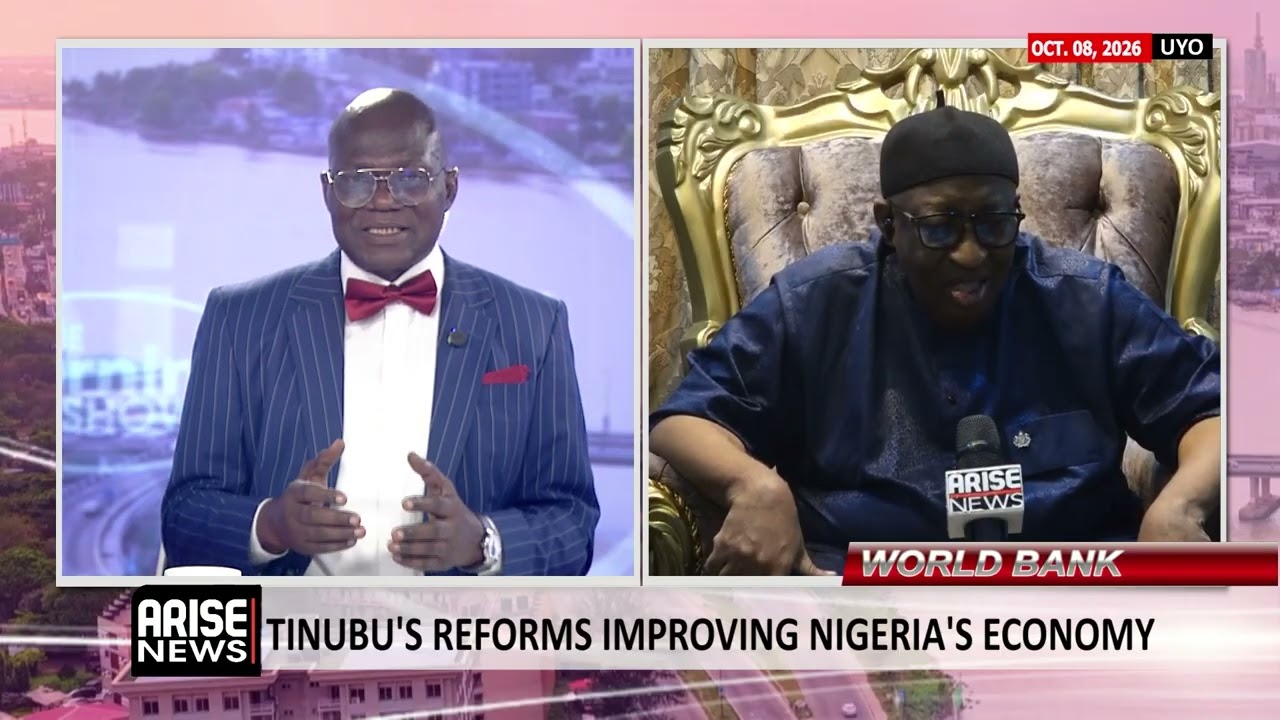
Economist, Prof. Akpan Ekpo, has described Nigeria’s projected 4.1 percent economic growth as too weak to significantly reduce poverty, create jobs or transform the structure of the economy.
Ekpo, in an interview with ARISE NEWS on Thursday, said Nigeria needed sustained double-digit economic growth for between 15 and 20 years to make a significant impact on poverty, stressing that economic growth should not be confused with development.
He said, “I don’t think we should celebrate the 4.1 percent growth. The World Bank itself knows that growth is not development. You have to grow at least double-digit, sustainable by 15, 20 years, to have a dent on poverty. Even the World Bank itself, the report says that the growth is so weak, the growth is insufficient, it’s inadequate to create jobs and opportunities.”
According to him, while the World Bank’s recommendations on electricity, reliable internet access, infrastructure and human capital development were appropriate, the current growth rate was insufficient to achieve those objectives.
He said, “I’m not a fan of the World Bank, but for the first time they are very clear about what should be done. They talked about providing electricity, reliable Internet access, infrastructure, human capital development, and so on and so forth. But the problem is that the 4.1 percent growth cannot achieve those things.”
Ekpo also criticised the structure of the Nigerian economy, saying the manufacturing sector had been neglected in the country’s growth trajectory, despite its importance to economic transformation.
He said, “If you look at the report, they claim that the growth was driven by agriculture and services. They left out the middle part, which is in the growth trajectory, you move from agriculture, mining, to industry, manufacturing subsector, and then services. They left out the issue of manufacturing. That is where the crux of the matter is. An economy has, the structure has to be transformed, where that sector called manufacturing contributes at least 40 percent to GDP.”
The economist said Nigeria’s manufacturing sector had contributed less than 12 percent to GDP over the last six decades, while manufactured exports remained a very small proportion of total exports.
He said, “In the Nigerian context, in the last 60 years, that subsector has contributed less than 12 percent to GDP. In fact, if you look at the data, it is very alarming. The trade data, the manufactured exports as a ratio of total exports is about 2 percent. Manufactured imports as a ratio of total imports is 48 percent. So you cannot say that the economy is being transformed.”
On the World Bank’s projection of 4.4 percent growth, Ekpo said, “They do claim, well, they are right that 4 percent is weak. In fact, even the projection of 4.4 percent is still weak. But how can that weak growth now provide all those things? So we need to grow at least double digit.”
He said government must deliberately address power supply, poverty and insecurity to create the conditions for sustained economic growth.
He said, “As the report said, if we fix power, and that has to be done intentionally by government, government also has to intentionally reduce poverty, and so on and so forth, that is where you can now move towards a double-digit growth that can be sustained.”
Ekpo also cautioned against describing Nigeria’s economy as having achieved broad macroeconomic stability, saying the country still faced significant challenges on the fiscal side.
He said, “When they say macroeconomic performance and stabilisation, we have to be very careful, because macroeconomics broadly is monetary and fiscal policy. On the monetary side, there is a CBN as a resource of integrity in that subsector. But the fiscal side, we still have challenges.”
According to him, “This so-called macro stability, I don’t know where it’s coming from. And then we kept saying that there’s macro performance. The issue is a micro. But any good economist knows that it is from the micro, the household and their families and the firms, that when you aggregate that, allowing for some bias, aggregation bias, that you have the macro.”
He added, “You can’t have stability on only one side of the economy. That is relative stability. And so the economy is stable. So the report, in my view, is balanced.”
Ekpo said the World Bank report should therefore be viewed as a warning rather than an achievement to celebrate.
He said, “Yes, you need to grow to develop. But you can grow and not be developed. And that growth must be double digit, 10 percent and above, and sustained for 15 or 20 years. So I don’t think the report is what we should celebrate. But it’s a warning signal that we should do more.”
The economist said this did not mean the government had done everything wrong, but cautioned against placing too much emphasis on single-digit growth.
He said, “That doesn’t mean that all what the government has done is on the negative side. But we should not put too much emphasis on single-digit growth. No question, it’s slightly above the population growth rate. But there are issues to be, there are so many fundamental issues that we should take into account before we can celebrate any reasonable growth rate.”
On why Nigeria had continued to struggle to translate decades of economic recommendations into meaningful development, Ekpo said the country’s approach to reforms and the weakness of the state sector remained major challenges.
He said, “There are a lot of issues. First, the macro movement of the economy has a lot of challenge. As I said, the reforms we are practising is a reform that you have when your philosophy is market capitalist-based, takes a long time for it to trickle down to the masses. But in the long run, we’re all dead.”
Ekpo said fixing electricity was critical to unlocking sustained economic growth.
He said, “For example, we have the question, how come all these years we cannot fix power supply? It’s not rocket science. If you fix power supply, the economy will grow double digit for a long time. How come we cannot deal with the issue of poverty?”
He argued that countries that achieved rapid economic development relied on a strong state sector working alongside the private sector.
He said, “If you look at countries that have grown fast, that are fast-track development and growth, they have a strong state sector vis-a-vis the private sector. But in our case, we have a very weak state sector.”
According to him, the government should play a more deliberate role in transforming the economy from consumption to production.
He said, “We have a private sector. And you know, private sector is an engine of good, but not an engine of development. For them, it’s the bottom line. So as I said earlier, we have to focus on transforming the structure of the economy. That is, the manufacturing sector.”
Ekpo said Nigeria must become more productive by manufacturing goods for domestic consumption and export, particularly non-oil goods and services.
He said, “If we manufacture and be productive, rather than consuming economy, it will be better for us in the medium and long term.”
He added, “If you look at our World Bank report, it said that the growth is also driven by increased domestic demand. You know, that is, we are still consuming a lot. We are not a productive economy. You have to be productive, manufacture, and export non-oil goods and services in order for the economy to make progress.”
On Nigeria’s continued dependence on crude oil, Ekpo said, “The way we are now, we are, and the economy is still very dependent, you know, on the oil sector, no matter what they say. Anytime you look at any improvement in the standard trade, look at the oil sector. It’s due to export crude oil, you know. So these are the issues.”
He said government needed to play a more active role in driving economic development by providing infrastructure and other essential conditions for businesses to thrive.
He said, “You need to have people, the government has to have a qualitative involvement in the economy and the private sector. The private sector is bottom line. It is government that should drive the major things.”
Ekpo also criticised the continued reliance on the trickle-down approach to economic management.
He said, “And the trickle-down economics is no longer in vogue. You need to be intentional in terms of how you manage the economy. That’s part of the problem.”
On the prescriptions of the Bretton Woods institutions, including the World Bank and International Monetary Fund, Ekpo said Nigeria should assess such recommendations against its own economic realities rather than adopt them wholesale.
He said, “Most of the countries that have fast-tracked growth and development have ignored, to a large extent, the Bretton Woods recommendation. Because if you follow them completely, you’ll be developing underdevelopment.”
On currency depreciation, he said, “For example, when you devalue oil, your currency depreciates. It assumes that your exports will be cheaper. You export more and earn more revenue. In our case, non-oil exports is very marginal. What we export mainly is crude oil. And crude oil, we don’t control the price. We don’t control the output. It’s an exogenous source of revenue. You can’t use that to finance your development.”
Ekpo said countries such as China, Singapore, Malaysia and Indonesia had not simply followed Bretton Woods prescriptions in their development journeys.
He said, “If you look at countries that we want to copy, China, Singapore, Malaysia, Indonesia, they ignored a lot of the Bretton Woods recommendations. Because if you stick to those recommendations, as I said earlier, you’ll be developing underdevelopment.”
He said Nigeria should instead focus on manufacturing and the production of non-oil goods and services for export.
He said, “Tiihey can advise you, but you don’t have to take their advice. You have to look at your economy and decide on what you want to do. We have to concentrate on the manufacturing subsector and produce non-oil goods and services along the value chain. Export those things and foreign exchange so the country becomes productive and create jobs.”
On the service sector, Ekpo said its current structure was insufficient to drive broad-based economic transformation.
He said, “They’ve ignored, as I said, they move us from primary sector, that’s agriculture and mining, to services. But those things don’t run the economy. Service sector in Nigeria is rudimentary. It’s not linked to industry. It’s not linked to manufacturing sector. It’s rudimentary. And it’s much more driven by this fintech, what I call financialisation.”
Speaking on monetary policy, Ekpo acknowledged some progress by the Central Bank of Nigeria but said high lending rates remained a major obstacle to investment.
He said, “To a large extent, the CBN has restored integrity. They’ve brought down the MPR by 350 basis points. But that will not translate to lowering the lending rates. The lending rate is still very high. Averagely 30 percent. Nobody will borrow at that rate, make profit and pay back.”
He urged the CBN to examine the sources of commercial banks’ profits, saying, “CBN too should look and investigate the sources of profit of commercial banks. I suspect they’re making money by investing more in financial papers rather than financing medium-term and long-term investment. But at least they’ve restored integrity in that sector.”
Ekpo also expressed concern over the lack of effective coordination between monetary and fiscal authorities.
He said, “As I said earlier, the challenge is in the fiscal side. Recently, as you are aware, the central bank and the fiscal side, they signed an MOU to coordinate. And for me, it was just optics, because the coordination should take it for granted.”
He explained, “In fact, in the central bank itself, in the board and the MPC, which I was a member years ago, the Minister of Finance is a member, and the Accountant-General is a member. So the central bank’s reaction function accommodates the fiscal side.”
According to him, “So also it should be the case where the fiscal side also accommodates the monetary side. It’s not being done. It’s unfortunate. So you don’t need an MOU to say that you have to coordinate. You take it for granted.”
Ekpo said Nigeria’s fiscal challenges included weak revenue, the high cost of governance and a rising debt profile.
He said, “You cannot talk about stability when one side of the economy has challenges. That’s the fiscal side. Revenue challenge, high cost of governance, rising debt profile. So the economy is not stable in the strict economic sense.”
He further warned that political considerations could complicate economic policymaking.
He said, “But of course, we are in a political era. A lot of things will be said left and right. And once politics takes over economics, you have a bigger challenge.”
Ekpo concluded that Nigeria’s priority should be to transform the economy from one driven largely by consumption to one based on production.
He said, “So the problem is for us to implement policies that will change the structure of the economy from consumption to production.”
Boluwatife Enome
Follow us on:


