


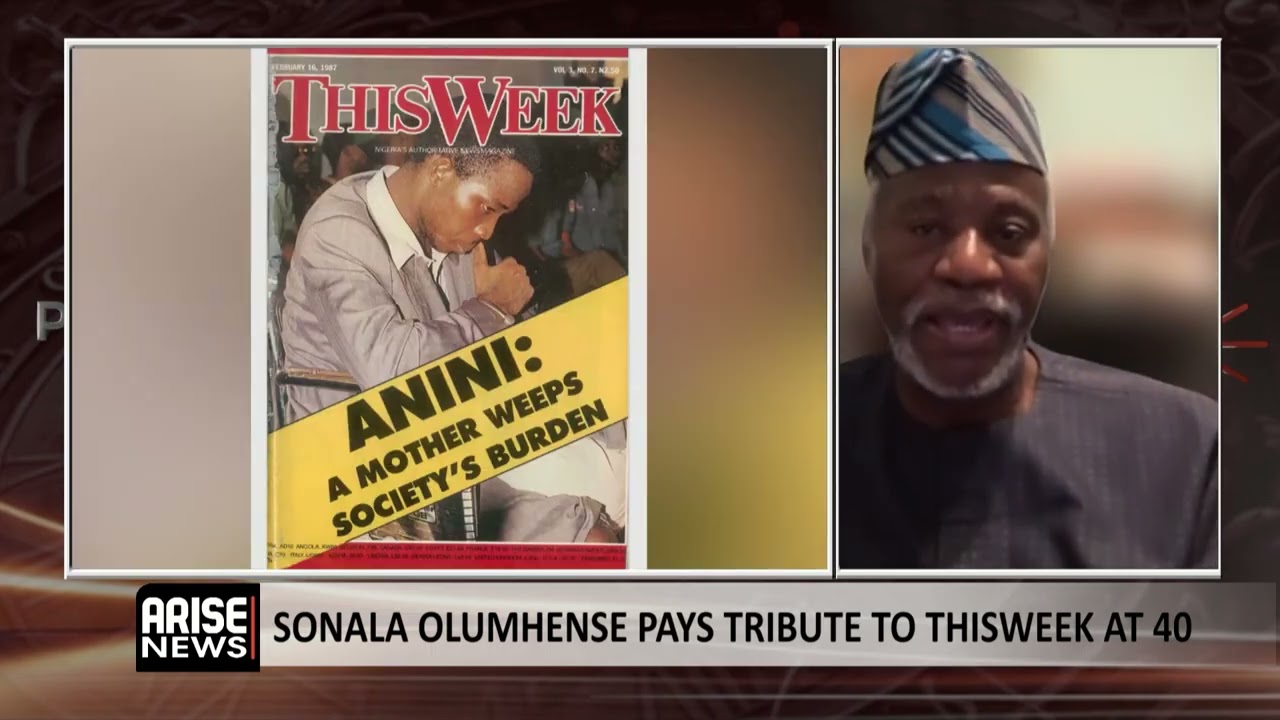
The founding editor of ThisWeek Magazine, Sonala Olumhense, has attributed the publication’s culture to publisher Nduka Obaigbena’s unwavering optimism and relentless determination, saying his “We Can Do It” spirit inspired the team to pursue bold journalism and build one of Nigeria’s most influential news magazines.
This comes as ThisWeek magazine marks its 40th anniversary while its publisher, Nduka Obaigbena, celebrates his birthday, prompting reflections on four decades of pioneering journalism and the vision behind the magazine’s enduring impact on Nigeria’s media landscape.
Olumhense said: “‘We can do it’s came came from Nduka himself. He wasn’t aware that he was saying it, but he was always coming to that point, emphasizing that nothing was an obstacle—that every obstacle could be overcome.”
Reflecting on the magazine’s early years, Olumhense said ThisWeek set itself apart by pursuing journalism that served the public interest rather than those in power. He said the editorial team was united by a shared commitment to holding authority accountable and raising professional standards, adding that their dedication helped establish the publication’s enduring legacy.
“What was different about ThisWeek is that everybody who came there was convinced that we could do something special. We could do journalism that would earn respect—journalism by the book, namely, something that would serve the public purpose. Something that would clearly not be close to merely upholding the people and structures of power. We thought we could question them, and teach the rest of the profession also to question, and to keep questioning them. That was where we were really different. I’m happy that, 40 years since then, what we tried to accomplish is still remembered,” he said.
Reiterating his argument that Nigeria is poorer because ThisWeek no longer exists, Olumhense said the magazine’s absence has left a significant gap in the country’s media landscape.
While acknowledging that social media has transformed journalism, he maintained that mainstream news organisations still provide the structure, depth and public-interest reporting that digital platforms often lack. He also lamented the sharp decline in newspaper circulation, saying fewer printed copies have reduced journalism’s reach into schools, libraries, government offices and communities across the country.
“Where we are weaker is that many of the organs that exist today by way of the newspaper trade print very few copies compared to what we were doing in those days. There was a stretch in which we were printing about 100,000 copies per week of ThisWeek, weekly. Whereas today, some of the newspapers that we see are printing just thousands of copies.
“This means that we can’t reach as many people today as we were reaching then. For people who read newspapers, it’s a test of its own; it’s a skill of its own. It’s not like glancing into a cell phone, trying to catch your news, or reading a feature story, reading an editorial, or reading a full-length feature on your phone.
“So, there are many ways in which we cannot reach the classrooms, the libraries, the government offices, the markets that newspapers were reaching then. They might reach them now by the phone, but they are not really reaching as much because that physical presence of a newspaper—that you could read and share with a child, with a teacher, with a parent, with a sick person—we don’t have that any longer. That’s what I mean by that statement,” he explained.
Assessing the current state of Nigerian journalism, Olumhense said the profession has become increasingly transactional, noting that many journalists now work too closely with government officials, compromising editorial independence.
“I think we are certainly more transactional than things were in those days. The journalists today work far too closely with governments and government officials. We depend on government advertising, and we don’t seem to realize that you can make one mistake that makes the next one year very difficult for your publication, just because of one story and the proximity between the reporter (or the editor) and the government official,” he stated.
He also criticised the lack of follow-up reporting, saying news organisations frequently publish official promises and policy announcements without returning to assess whether they were fulfilled, a practice he believes weakens accountability and public trust.
“The second area in which I think we are weaker is in the area of follow-up. Many stories appear on the front pages of our journals, on our headlines, and so on, every single day. The question is: Where is the follow-up? When you tell me that a government official said something—no matter who that government official is, and particularly if it is a very high government official—you owe the obligation to come back to tell the reader what followed what that government official said. You can’t quote him as proclaiming a new policy, You can’t quote him as declaring a new path forward, You can’t quote him as saying that a certain objective will be achieved in two days or two years, and not come back to let the reader know how that is going.
“Every day in Nigeria, we are having this failure in our profession. Today, there are hundreds—and I underline that word, hundreds—of sites belonging to our government ministries, departments, and agencies at every level, and even at the presidential level, that have collapsed. These sites are set up to inform the public, but if you go there and click on various departments or items, the site has collapsed, or the site was set up but never refreshed. So, there are many ways in which we really can and should be doing better,” he noted.
On the challenges facing journalists today, Olumhense said the dangers have changed rather than diminished, noting that insecurity remains a reality for reporters covering important stories.
“The dangers are different. Journalism, by definition, entails a certain level of danger in everything you do, particularly if the material is important. The more important the material, the more important the story, and the greater the danger to the reporter and to the editor. That is a given, and it doesn’t matter where you are in the world; that has always been the case. Things are a little more difficult for us in Nigeria today because the country is generally insecure. We have this insecurity that we haven’t really gotten any hold of.
However, he argued that the profession’s biggest weakness is its failure to ask difficult questions and pursue follow-up reporting. He criticised what he described as an overreliance on official statements, urging journalists to produce more original reporting and strengthen accountability by maintaining professional independence from government officials.
“But part of it is of our own making—a part of the problem, that is, not the insecurity itself. A part of the problem as to where the country is today is of our making because we are not asking enough questions. That is what we should be doing; we should always ask questions. But we should not ask questions only when they are right before us. As a matter of fact, it is even more important to ask when they are not before us.
“We don’t ask questions about why the oversight function that the legislature has in the Constitution is not being fulfilled. There are areas in which I feel we are ourselves creating the problem. I want to see a newsroom that’s asking questions. A newsroom that’s following up on stories, particularly stories important enough to make it to your front page. I want to see journalists who are elevating their profession through their professionalism, not through their proximity to government offices and government officials,” Olumhense said.
Responding to a question on whether Nigerians should fear politicians suppressing the press or journalism abandoning its own principles, Olumhense said the greater threat is the profession surrendering its standards and constitutional role.
“That would certainly be journalism surrendering its own standards and its own place, as conferred upon them by the Constitution,” he stated.
Describing Nduka Obaigbena as “one of the most stubborn people you will ever meet,” Olumhense said the media entrepreneur’s determination to innovate and refusal to accept “no” have driven the creation and reinvention of successful media platforms. He added that Obaigbena’s persistence demonstrates the importance of believing in one’s vision and remaining committed despite obstacles.
“As somebody who has known Nduka way back: Nduka’s secret is very, very simple. Nduka is one of the most stubborn people you will ever meet. As you said, he likes to invent and to reinvent. He doesn’t hear the word ‘no’ when you say it. This stubbornness has led him into some problems, but clearly, you can see that because he is indefatigable and irresistible, he gets things done. The lesson for me is: if you believe in something, stick to it, fight for it, and go with it,” he shared.
Concluding on a note of optimism, Olumhense said he still believes Nigerian journalism can overcome its current challenges, urging journalists and citizens alike to work towards revitalising the profession.
“I think we can. I think journalists and those who love the country need to think highly and deeply about how to reinvigorate journalism in Nigeria. That’s where our salvation lies.”
Favour Odima
Follow us on:


