


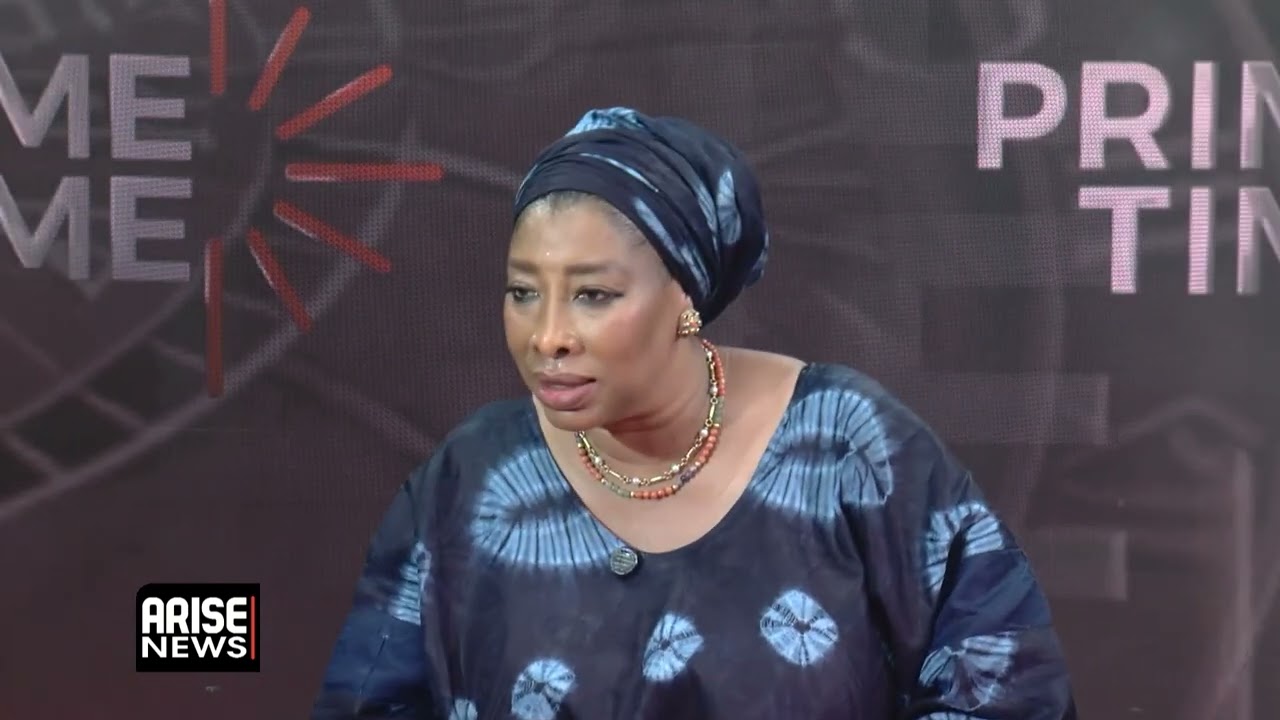
Former three-time member of the House of Representatives, and member of G100 Group, has warned that opposition parties risk making the 2027 presidential election difficult to win if they contest individually, urging them to unite against the ruling All Progressives Congress, (APC).
She made the remarks in an interview on ARISE NEWS on Monday, following the G100 Group Summit that held in Abuja on Monday, where opposition leaders agreed to continue discussions on building a united front ahead of the 2027 general elections.
“They all recognize that it’s an arithmetic situation. They all recognize that if they go into it individually, the chances of unseating an incumbent are very difficult.
“So what we’re doing is creating a platform for them to actually get back in the room and start to have the conversation. It’s not going to be a one-off conversation, because as you said, there are big wigs, big egos, and ambitions in the room. It’s going to take a lot of candor and sacrifice.”
Ukeje, a prominent member of the African Democratic Congress (ADC), said the summit was the culmination of months of discussions with leaders of various opposition political parties on the need to unite against the ruling party ahead of the 2027 elections.
“From August 7th, we came together and decided that the one way we could come together to oust the incumbent was by coming together, and all the political parties individually were in agreement.”
On the question of a single presidential candidate, Ukeje said the opposition would eventually have to confront the issue as discussions progress, stressing that the G100 was only facilitating the process and that the final decision would be left to the political parties.
“As we said, we’re going to act as facilitators to get them in the room. If everybody agrees in principle that it is imperative that they have that, and they all agree individually in principle that it is up to them to sit down in the room and decide.”
She further said the opposition’s ultimate objective was to defeat the ruling APC, arguing that the party’s own experience in 2015 demonstrated that a united opposition could unseat a sitting government.
“For the first time and for the only time in my life, the APC inspires me, because they did it in 2015, and we’ll do it in the same way that they did it.”
Speaking on the possibility of Atiku Abubakar stepping aside for another candidate, Ukeje said she would support the decision if an objective process determined that it was in the best interest of the country.
She stressed that the coalition should not be viewed solely as a contest for the presidency, arguing that its agenda must also address representation and leadership across the National Assembly and State Houses of Assembly.
“If they go into a room and decide that, in the interest of the country, they are going to come up with a single candidate, and the candidate turns out not to be my candidate, and they give me reasons as to why it should be that candidate—and I expect that for them to have turned up with a candidate that may not be my candidate—then I would be in full support of it.
“Everybody seems to think that the G100 is only about the presidential and vice-presidential candidacies. It isn’t. There is so much more that the coalition has to work on: the National Assembly, the State Houses of Assembly. So if we are going into a coalition, it’s not only about the president and vice president; it’s about the State Houses of Assembly, the National Assembly, and the leadership.”
Highlighting practical steps needed to make the opposition coalition effective ahead of the 2027 elections, Honourable Ukeje said the parties had already begun discussing key issues and would use the next four weeks to review the five-point agenda and nominate members to three committees. She acknowledged that the process started later than ideal but maintained that it was better late than never.
“It has been discussed, but they also said that in four weeks, they were given the mandate to go back, take a look at the five points, nominate people to the three committees, and come back in four weeks. I believe it’s better late than never. I know we could have started it earlier, but we started it now, and it’s a journey that we hope will come up with positive outcomes.”
Responding to comments by APC National Chairman, Nentawe Yilwatda Goshwe, over the coalition’s inability to resolve disagreements among its members, Honourable Ukeje dismissed the remarks as wishful thinking and urged the ruling party to focus on its record in government while the opposition works to build a united front ahead of the 2027 elections.
“I think it’s wishful thinking. I really think that the APC chairman has his work cut out for him in trying to convince Nigerians that they have wrecked our country, and we’re trying to take it back from them. So I’d advise that he concentrate on that and leave us to do what we must do as the opposition, which they did in 2015 with a lot of success, I dare say, and we will be successful with that.”
Addressing concerns over a repeat of the Coalition of United Political Parties (CUPP) experience, Ukeje said the three committees established at the summit would help provide institutional safeguards. She added the parties must approach the committees with sacrifice, candour and an understanding that there is limited time to deliver a workable coalition ahead of the 2027 elections.
“That’s what those committees are going to do. All the political parties are going to have people nominated into those committees. Part of it is that we have asked that they please come to the committees with sacrifice, with candor, and recognizing that we do not have that much time. They’re just saying these are the things that are likely to happen that may derail or truncate a coalition, and we need to safeguard against that as we move forward.”
Speaking on the opposition’s response to electoral disputes and the challenge of reconciling the ambitions of different presidential aspirants, Ukeje said the Legal and Media Committees would develop a coordinated response to legal and public-facing issues.
“Part of it is going to be dealt with by the Legal Department, and that’s one of the things that has been set up. Between the Legal Committee and the Media Committee, they’re setting up meetings, and in the next week or so, they’re going to come together and come up with some kind of coordinated response to all the problems that we have, especially with regards to engaging with the public as well as the legal concerns that we have.”
Addressing concerns over how the opposition would resolve competing presidential ambitions, she maintained that the eventual decision on a consensus candidate must be driven by the aspirants themselves, expressing confidence that the opposition would ultimately prioritise the national interest over individual ambitions.
“The G100 is not its moderators. We’re facilitators. So ultimately, it would have to be the candidates themselves that would come up with the work. They will eventually come together because the numbers are clear, the arithmetic is clear, and more than that, the commitment to rescue this country is there. I believe that eventually, it’s going to have to be country over ambition.”
Acknowledging the uncertainty over whether supporters of NDC presidential candidate, Peter Obi, and those of other presidential aspirants would back a consensus candidate, Ukeje said she could not predict their decisions but expressed confidence that the candidates would eventually put the country’s interests ahead of their personal ambitions.
“Do I know what Peter Obi’s supporters will do? I’ve never had a conversation with Peter Obi’s supporters. I couldn’t sit in this chair and conjecture what Peter Obi’s supporters would do.
“But I’m hoping that if indeed all the presidential candidates realize—again, as I put it—that it is delegated authority in the interest of the Nigerian people, if they believe that. If indeed the leadership that they seek is over a people who have faith in what they do, and it is indeed in the interest of the people, then I think that sacrifice would be one of the easiest things to give up.
“If indeed they care about the future of this country, about the outcome, if they care about the fact that the country is adrift, then I believe that, more than anything else, they will get to the point where they put country before ambition, and they will do what is right by the Nigerian people. This is not about any particular individual. This is about rescuing the country from the consensus that we all have that our country dances dangerously on the brink. I think that it’s imperative that whatever ambition it is, if indeed they have love and faith in this country and the future of this country, then they would be willing to put set aside their ambition in the interest of the country.”
On the timeline for reaching a concrete agreement, Ukeje said the committees would report back in four weeks, while the opposition had until mid-October under Section 31 of the Electoral Act to make necessary candidate substitutions. She expressed optimism that the ongoing discussions would produce a concrete outcome, describing the summit as a good beginning.
“In four weeks, we’re going to come back. But more importantly, Section 31 of the Electoral Act says that you have 90 days before the elections within which you can make substitutions and do all of that, and that gives us until mid-October. So I’m hoping that by then we’ll have something concrete. But in the interim, the conversations continue.
“I’m hopeful, I’m optimistic, and we’re going to continue to work at it. If the commitment that we saw in the room today is anything to go by, then I go to bed thinking that it was a good beginning, and I think it’s something.”
With Nigerians increasingly pessimistic about the possibility of political change, the former lawmaker said recent developments within the opposition had created an opportunity for citizens to hope again. She pointed to the willingness of opposition leaders to sit together and engage as a sign of commitment, urging Nigerians to give the process a chance as the coalition works towards presenting a credible alternative ahead of 2027.
“Nigerians are pessimistic because they’ve taken a beating. Nigerians have taken a beating, and you can’t blame them. But several things have happened in the last couple of weeks that have given hope and created an opportunity for Nigerians to start to hope again.
“I think seeing the opposition in a room—yes, we talk the talk, and I know people are going to say this is politics speak again—but the truth of the matter is that there was commitment. I saw commitment, and I know that eventually, Nigerians are going to have something—there’s going to be some kind of silver lining.
“I think that even in starting to do something, it’s a move in the right direction. I’m just hoping that Nigerians are going to see that as a pledge of good faith, at least come along with us with a bit less pessimism, and hopefully we will get to the point where we present them with something that creates some kind of change in the political spectrum,” she concluded.
Favour Odima
Follow us on:


