


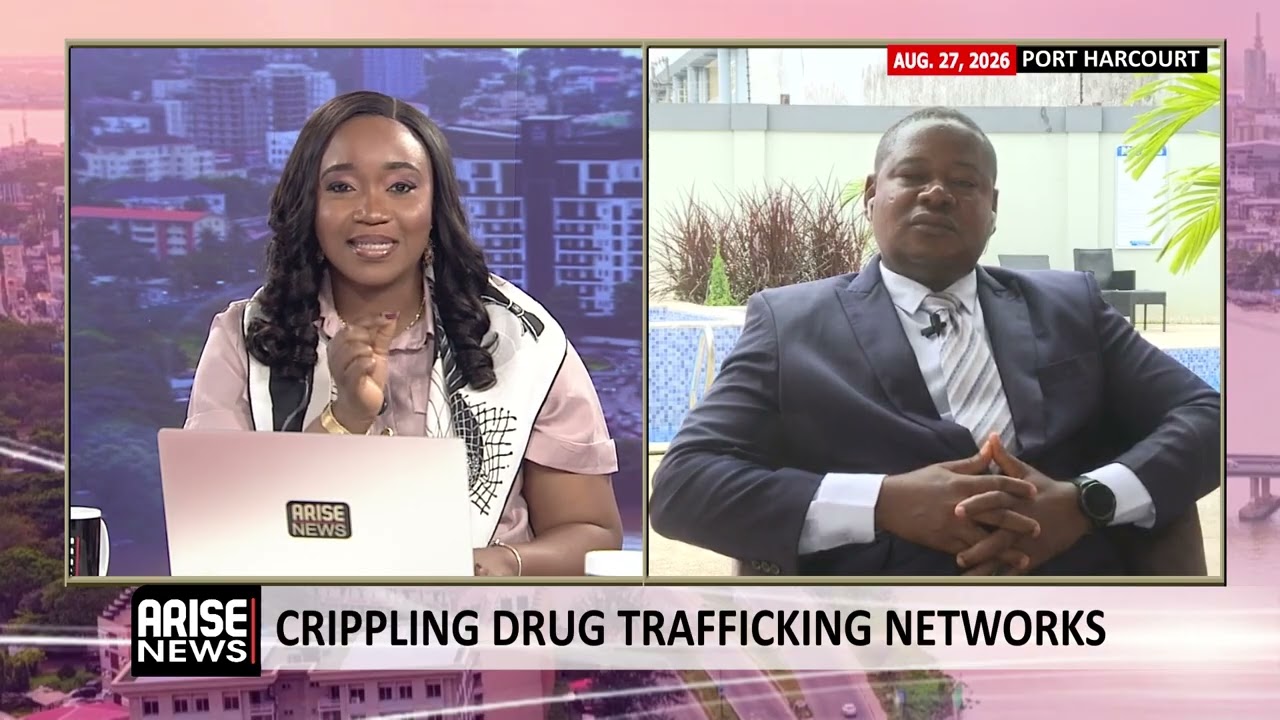
A Senior Advocate of Nigeria, Magaji Mato, has urged the National Drug Law Enforcement Agency (NDLEA) to operate strictly within the law in its fight against drug trafficking, saying the agency cannot take judicial powers into its own hands.
Mato, who spoke in an interview with ARISE NEWS on Thursday, said calls for tougher measures against drug barons were understandable but must be backed by appropriate amendments to existing laws.
Reacting to comments attributed to NDLEA Chairman, Brigadier General Buba Marwa (Retd.), on the need for stronger measures against drug traffickers, Mato said the fight against illicit drugs remained necessary because of its damaging impact on Nigerians, particularly young people.
“When we are discussing this kind of issue, I think what matters is to look at the legal framework that brought about the NDLEA itself, and then what it hopes to achieve by setting up such an agency to fight against illicit drugs, and fake drugs, and other drugs that are contraband in the country.
“But most importantly is, when you are discussing issues like this, you look at what the law says about it.
“When you are advocating a situation where you go beyond the provisions of the law to carry out some actions that probably will cause more harm than the repair of the evil that you think you are trying to stamp out in society, then I think we have to put a halt here and look at the issue holistically.
“Now, it is a good action to continue to fight illicit drugs in Nigeria, because we know the harm, the injury it has caused on the Nigerian populace, especially the youths, which is the stronghold of the nation, part of the population that gives hope to the country, to the nation.
“To advocate issues of extrajudicial activities and punishments, that will not go well for us.
“I also have to create or make this excuse for the General, because I know he means well for the nation, and I do not think he will advocate a situation where we abandon the law and begin to follow the law of man.
“I also believe, strongly that the call is for the institution to be strengthened more, the law to be amended in such a way that it will include other sanctions that will probably make illicit drug business in Nigeria not to be lucrative as it were.
“To call for extrajudicial, this is not the way forward to stamp out illicit drugs in Nigeria, but I would believe that when you advocate a situation where the law is amended and certain sanctions are included, and that is that the work is on the agency, to make proposal of those areas, out of experience, where they feel, ‘Oh, this issue, if it is done this way, it will be better, or if it is done that way, it will be better.’
“They approach the National Assembly with a proposed bill to say, can you kindly include such punishment, such sanctions, because if the wealth that the individual acquires are threats to the illicit drug business, then there is nothing wrong in advocating for inclusion in the law.
“To say, having acquired this, because what is not is not, you cannot put something on nothing and expect it to stand.
“If the illicit wealth are gotten from illicit drug business, then I also support strongly that the National Assembly should have a rethink over the NDLEA law, to see where and where they can strengthen the agency.
“But obviously, the strengthening of the agency lies with them working hand-in-hand with the courts, because the power to punish, the power to convict, all lies in the court, their judicial functions, as clearly stipulated under Section 6 of the 1999 Constitution.
“It is not even for the National Drug Law Enforcement Agency to take the law into their hands by deciding which wealth to confiscate, which property to take over, which accounts to freeze, and other things like that.
“These are judicial functions, but obviously, if these are included in the law, it will strengthen them to approach the court at every point in time, when such situations arise, to approach the court and ask that certain illicit wealth should be confiscated, should be frozen, or should be given back to the government, for the government to use it for the general good of the public.
“They can approach the National Assembly for amendment of the law to include all this.”
Mato also rejected suggestions that the urgency of the drug crisis should justify measures outside the existing legal framework, insisting that Nigeria was governed by the rule of law.
Responding to a question on whether tougher interim measures should be introduced to cut off the financial lifeblood of drug cartels, he said such actions must still have legal backing.
“Nigeria is a constitutional nation. It’s governed by laws. It’s governed by the rule of law, not the rule of man.
“Now, you have fantastic ideas. But no matter how fantastic those ideas are, they need the support of the law, lest we begin to go into problems, creating more problems for ourselves than solving them.
“No matter how beautiful the ideas are, like I said, I do not think there is any right-thinking Nigerian that will not support fight against illicit drugs, because we know the harm it has caused.
“And we know the harm it is still causing to Nigerians. So, obviously, it’s a fantastic idea. And it’s also a clarion call, like I defined it.
“But no matter how urgent the situation may look, and no matter how terrible the situation may also look, we need the support of the law to do whatever we want to do, and to do whatever we know, so that we will keep a record of a country that’s ruled by the law, of a country that has some level of sanity.
“Because the most conflated organ of a man’s being is his heart. What makes you happy today can tomorrow make you unhappy.
“That is why it is better to be ruled by law, and not by what we think is the right thing.
“Our ideas may be good, may be fantastic, may be on point. But once there is no support of the law, I do not advocate that situation, where no matter the urgency of the situation, you do that.
“Like I said, I can suggest that there are other types of crime that have been committed, that must not directly find their culpability from the National Drug Law Enforcement Agency Act.
“There are some other types of crime that will be committed in line with the issue of dealing with illicit drugs, such situations can be dealt with appropriately, even under other laws, not necessarily the NDLEA Act.
“If there is the issue of importation of illicit drugs, or production of such illicit drugs within the country, there are other criminal laws that can cover for those issues.
“And then, such situation can be handled temporarily, before, of course, the advice that they should approach the National Assembly to consider such issues to curb the issue of drug crime in Nigeria.”
The SAN also disagreed with the suggestion that Nigeria’s courts had failed to deliver meaningful convictions in major drug cases, noting that the NDLEA itself had reported several convictions and sentences secured through the courts.
“On the contrary, Mr. Rufai, I think, while I agree that in Nigeria, we have a lot of structural problems all over, but I also beg to differ, as far as the issue of drugs are concerned, relating to our courts in Nigeria.
“And I think the last report I listened to, even by the NDLEA, they were celebrating several convictions by the courts. They were celebrating also several sentencing by the courts, which they got from the courts.
“And I know practically, though, I have not been participating in any such, I’ve never had the privilege of prosecuting or defending any illicit drug case in any of our courts, but I have also found myself several in courts where such cases are being prosecuted.
“And I have, particularly in the area where I practice most, I have seen a lot of conviction on drug-related issues.
“We may have one or two grievances about our court system in Nigeria and how the system is failing the people gradually, but when it comes to the issue of drugs, I think everybody frowns at it, because there is not any pecuniary interest that the judge will have in not convicting somebody who has been found and proven to be guilty of an offence of illicit drug trafficking or any other related offences.
“I want to believe we have made tremendous efforts, though I do not have the data readily on ground, on hand, but I believe from the report I listened to by the NDLEA, I think they themselves, they are not really complaining about the compromises in court and other things.
“I think what they are saying is that the problem is becoming proliferated so that everywhere this issue of drug is becoming a general menace to the nation.
“That is what actually necessitated that we should go beyond the mere convictions in court, because they are not saying they are not getting convictions in court.
“All they are saying is that they need more beyond the conviction, what else can be done?
“Because if you allow a drug trafficker, and then you just maybe put a sentence in—”
Mato also backed calls for Nigeria to consider legislation targeting unexplained wealth, saying the country’s traditional, cultural and religious value systems had failed to adequately discourage individuals from displaying wealth they cannot legitimately account for.
Asked whether Nigeria had reached the point where it needed an unexplained wealth law, Mato said the situation had become serious enough to warrant legislative action.
“Eva, we’re missing you here because I know you’re supposed to be here, but it’s like you value this journalism more than the legal profession.
“So thank you very much, Dr Abate, for this. It’s unfortunate that we have found ourselves in this situation now, where the value system of our culture, our tradition have failed us.
“Otherwise, we do not need to even begin to contemplate issue of unexplained assets on Nigerians.
“If the value system that was handed over by our great-grandparents is working and is functional, the society itself will checkmate all these unexplained wealth that we’re talking about.
“Myself, I am a serious advocate of this issue. We cannot continue in this manner.
“And I have said it, even this morning, I never knew I was going to run this interview, but I was saying to somebody very close to me that if we continue like this, honestly speaking, we’re heading towards a doom.
“Because you have a situation where somebody you know today who cannot afford to pay his house rent, but tomorrow he’s just joined a political party or another system in the country or another business, and the next thing, the story is changing.
“And you will have a billionaire out of a very poor man who has no foundation, who cannot explain his wealth, his source of wealth, and the nation celebrate it.
“So assuming the value system is working, we do not need to approach the National Assembly for this.
“But in the absence of the value system, which has failed us, the various religions that we practice also have failed us.
“So we have no option, honestly speaking, than to begin to think in that direction.
“Somebody who is known to be a pauper in the community, just to borrow the story about him in terms of wealth changes, and no explanations, the government is not worried.
“In fact, he’s celebrated even by the community, he’s celebrated by the government, he’s invited to great functions of honour and given a place of honour, and he’s being celebrated, and he makes public donations of monies that you know he had no any explanations for.
“I advocate and I align myself with your position that the National Assembly, truly so, should begin to look at that direction and see what they can do in the society.
“Because this wealth, I have also understood in this situation, and I noticed that wealth, no matter how you keep stealing people’s money, people don’t get satisfied.
“Because this wealth can never satisfy human needs are insatiable, there is no continuity of the necessary development and infrastructure, all on the altar of selfish interests of our few individuals in the country, whether those involved in drug trafficking, whether other people who are involved in various businesses, that sometimes even the government compromises,”he concluded.
Boluwatife Enome
Follow us on:


