


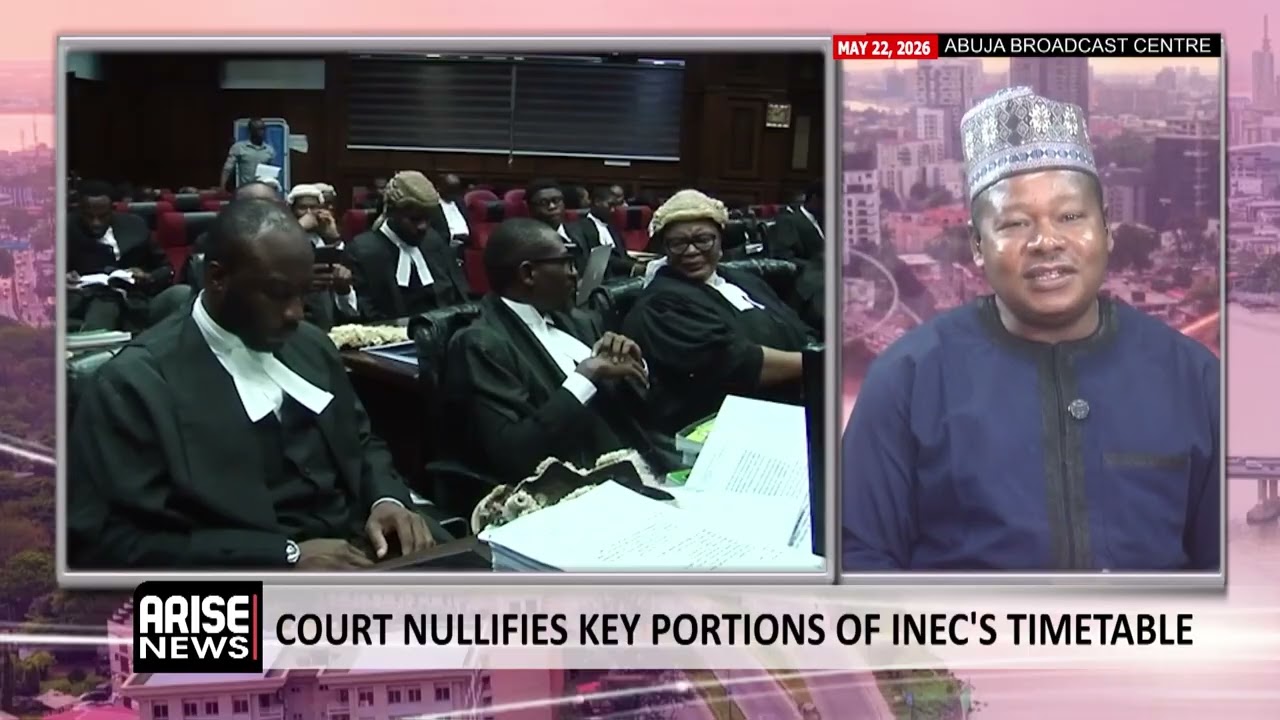
Senior Advocate of Nigeria, Magaji Mato, has stated that the Federal High Court judgment nullifying the revised timetable and schedule of activities issued by the Independent National Electoral Commission for the 2027 general elections is binding on all political actors and represents a strong reaffirmation of constitutional supremacy over administrative discretion.
Speaking in an interview with ARISE News on Friday, Mato said the ruling, which set aside INEC’s adjusted electoral timeline, goes beyond the immediate dispute and affects all political parties, insisting that electoral guidelines must strictly comply with the Electoral Act.
He explained that the court’s decision is not limited to the parties before it but has general effect on the electoral process. “This judgment, as handed down by the Federal High Court sitting in Abuja, is a judgment in rem. It is a judgment based on the issue and subject matter. And what that means is that it affects everybody, because the timetable has been set aside by the judgment. And by implication, every other political party has been affected.”
On INEC’s regulatory powers and the controversy surrounding its interpretation of the Electoral Act 2026, Mato acknowledged that the Commission is empowered to issue regulations but stressed that such powers are not unlimited.
“To be fair to both sides, INEC, by the Electoral Act 2026, has the power to make rules and regulations for the conduct of elections and in preparation for elections. That power is given to it by section 151 of the Electoral Act 2026. But what is important is that the power of INEC to make rules and regulations must be subject to the provisions of the Electoral Act.”
He said the court merely compelled compliance with existing law rather than creating new obligations. “What the party went to court to seek was to mandate INEC to comply with the extant provisions of the Electoral Act. Yes, they have the power to make rules and regulations, but that power must be guided by the provisions of the Electoral Act.”
According to him, INEC cannot lawfully alter statutory timelines fixed by law. “If INEC, in the exercise of its powers under section 151, makes rules that infringe any section of the Electoral Act, then an aggrieved party is entitled to go to court. The court is right in saying comply with the Electoral Act. The Electoral Act is a product of INEC itself and the National Assembly.”
He added that the ruling, while potentially inconvenient for the electoral body, reinforces the principle of rule of law. “I do not think there is anything wrong in that kind of decision. It might be an inconvenient judgment to INEC, probably because of the hectic task it faces in conducting elections nationwide. But the law is the law, and it must be obeyed. It is only in obedience to the law that the country will move forward.”
Mato also addressed concerns about whether INEC’s shortened timetable could trigger further litigation ahead of the 2027 elections, insisting that disputes arise mainly where there is non-compliance with statutory provisions. “While we are talking about compliance, litigation will always come when there is non-compliance. That is the position.”
On political party membership, internal registers, and campaign timelines, he noted that the judgment restores statutory timelines provided under the Electoral Act. “By the import of the judgment, it means political parties can resubmit or amend their register already submitted. If they have additional members who are willing to join, they can still accommodate them and leverage the judgment to approach INEC to amend their register or add to it, because they are still within time.”
He further referenced statutory provisions on campaign timelines, insisting INEC cannot override clear legislative prescriptions. “The judgment has even condescended to the level of the day campaigns must stop, section 98, which says campaigns start not later than 150 days before the election and end 24 hours to polling day. INEC in its wisdom decided it must end 48 hours. The court says no, it must be 24 hours as provided clearly by section 98 of the Electoral Act.”
Mato also criticised provisions of the Electoral Act relating to political party movement restrictions, arguing that they may be inconsistent with constitutional rights. “People have been complaining that the Constitution gives them the power to associate. That is their fundamental right. But the Electoral Act decided to condition it.”
“In my view, section 77 of the Electoral Act is faulty. The Constitution is the supreme law of the land, and it does not tolerate rivals. Any law that comes in conflict with it is null and void.”
He argued that restrictions on political movement could be struck down by the courts in future litigation. “Very soon, we are likely going to have another judgment in respect of that provision. You may likely have a situation where the courts will have to set aside or expunge that provision from the Electoral Act.”
Reflecting on broader concerns about the increasing judicialisation of Nigeria’s electoral process, Mato aligned with former President Goodluck Jonathan’s concerns that excessive litigation is unhealthy for democracy. “I share the same sentiment with His Excellency, former President Goodluck Jonathan. It is not the best for our democracy that every single act ends up in court. It inundates the courts with too many actions and makes judgments less impactful.”
He, however, maintained that such disputes are ultimately the result of failure to adhere strictly to the law by regulatory institutions. “When the law says this and you do otherwise, people have the right to go to court. If we are ready, we should ensure we act in line with the law, especially those saddled with public responsibility.”
Erizia Rubyjeana
Follow us on:


 says INEC must fully comply with Electoral Act after court nullified revised 2027 election timetable.</p>
)