


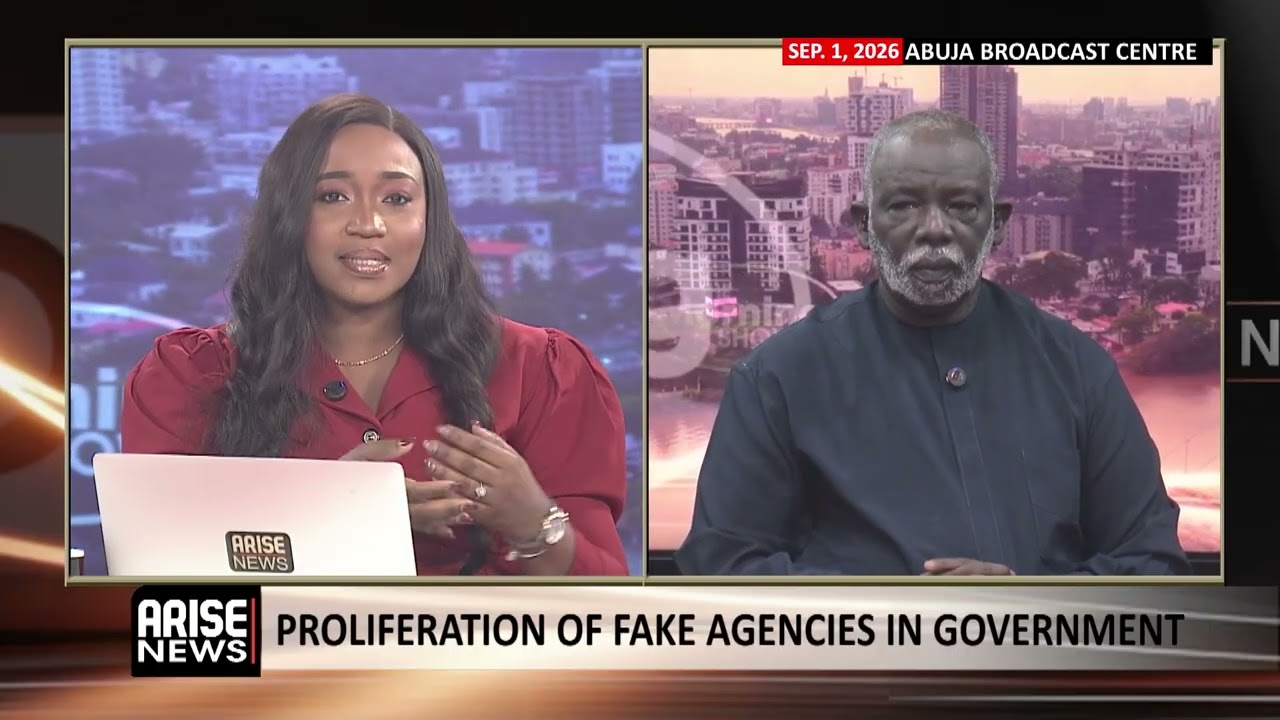
A political scientist, Dr. Kunle Fagbemi, has called on the federal government to strictly enforce existing legal and policy frameworks governing public institutions, warning that the proliferation of government entities is being driven by political interests rather than development.
Fagbemi, who spoke in an interview with ARISE NEWS on Tuesday, said the recurring discovery of fake agencies, ghost workers and questionable government entities was a symptom of deeper dysfunction within the country’s governance system.
He said the government must stop selectively implementing investigative reports and instead follow due process by studying reports submitted to it and issuing white papers before taking action.
“It’s very unfortunate that we are discussing the subject matter of the dysfunctionality in our system. The dysfunctionality has occurred primarily because we have a situation where people who ordinarily should have transitioned from partisan politics into governance delivery roles are not doing so.
“When you transition into governance delivery roles, you have a series of legal and policy frameworks to follow and adhere to, in such a way and manner that it will bring about effectiveness and efficiency.
“Unfortunately, I do not want to be a bit harsh this morning by saying the crop of people that we’ve been having in the last couple of decades-plus are only interested in state capture.
“And when you have a group of people that are interested in state capture, they just want to occupy office and will not pay very detailed attention to the things that they are doing and dishing out. They only roll out based on emotive sentiments of what will appeal to the people and what will make them look good.”
Fagbemi was responding to concerns over the proliferation of government agencies and development commissions, as well as the status of the Oronsaye Report and other government investigations.
He said the creation of regional development commissions had become politically attractive despite questions over their effectiveness and funding.
“You just talked about the development commissions. It is something that politically it is expedient and sounds catchy and interesting,” he said.
He noted that legislative investigations had also raised concerns over the operations of some development commissions, particularly the South East Development Commission.
“It is on record that ranking senators are openly challenging the executive team of that particular commission. And it is a crossbar, like you’ve rightly said.
“And where we are really is a situation where it is very unfortunate that we are no longer following the age-long tradition of saying there are reports.
“Once you have a report submitted to government, you are supposed to go through it and consider it and issue a white paper and not do selective disclosure like we have been having.”
Fagbemi said the same principle should apply to reports submitted by the Independent Corrupt Practices and Other Related Offences Commission, ICPC.
“You mentioned ICPC earlier on. ICPC submitted an interim report.
“The correct procedure in public service is for you now to receive the report like it was publicly done. And then you now get a study team to take a look at it. And then you now present a council memo to the Executive Council of the Federation.
“And once it is disclosed, you now approve some few things. And then you can now come back to the public.
“You’ll discover that what has been said about the ICPC report, for instance, is painful that you just hear that the president has approved.
“Where is the white paper that led to the approval of the president that we are talking about? We do not have that.”
On the Oronsaye Report, Fagbemi said the failure to decisively implement recommendations on government agencies reflected the broader problem of state capture.
“When you now take a look at, you mentioned the Oronsaye Report. It is unfortunate that when you have a system where you are dealing with state capture and people are only excited about fleecing,” he said.
He cited civil society advocate Owei Lakemfa’s description of the situation as the “democratisation of corruption through establishment of entities”, saying new institutions were sometimes created primarily to serve political interests.
“You’ll discover that they are doing this primarily only for one purpose. The purpose is just to appeal to the political class and to have an opportunity and a candidate for fleecing.
“Meanwhile, what we are supposed to be dealing with is development. How many of these agencies have translated in their service delivery to meeting the Sustainable Development Goals or contributed to Nigeria meeting the Sustainable Development Goals?”
Fagbemi said he expected the forensic audit authorised by President Bola Tinubu to be conducted thoroughly, noting that previous discussions had already raised concerns that more questionable agencies could be uncovered.
“I am hoping that the audits that Mr. President, Commander-in-Chief, has authorised will truly be done the same way on this table.
“We discussed it and recommended that we needed to do a thorough audit. And you’ll recall that you challenged that morning and said, definitely, we will have more than this one fake agency.”
Fagbemi also questioned whether the government’s proposed forensic audit would be sufficiently comprehensive, arguing that a genuine forensic exercise must trace personnel, salaries, government establishments and public funds.
“Like I said, this administration, the information management system is a bit defective. You do not use the phrase forensic audit when you know that definitely you are not going to do a thorough job.
“You realise that if you want to do a forensic audit, the implication is very simple and straightforward.
“It means that they will have to use magnifying glasses. They will have to carry a comb. They will have to look for toothpicks to go through everything.
“The implication of a forensic audit will mean that everyone that has ever received a salary, drawn a salary, will have to be investigated and tied to an establishment.
“And you recall that all we said on this table was for them to do an audit. If they do an audit, they will see.
“But the moment you call it forensic audit, it means that you must trace all the money, the IPPIS. You must trace the manpower disposition. What is the establishment?”
Using the structure of a government agency as an example, he said its approved staff strength, budget and actual personnel must all be reconciled.
“I’ll give you a good example. An agency has been created. You are supposed to have what is called establishment, which we’ll talk about the manpower disposition, the officers that they’re supposed to have.
“Then they will have a budget. You will now have to start correlating all this.
“As it is, they do not have the sincerity of purpose to be able to do a forensic audit.
“Let’s be very clear with that. By adventure, they even attempt to do it. The moment they start discovering some few things with the kind of corrupt system that they are running, they will not be able to do a thorough job.
“So we will be happy to have just proper audits done.”
On measures to prevent the creation and operation of fake agencies and ghost workers, Fagbemi called for a comprehensive re-audit of government employees and manpower structures across ministries, departments and agencies.
“The way forward is very simple and straightforward. What are they expected to do ultimately?
“There will be need for each entity that is a ministry, department or agency to now resubmit and re-audit the employments, this manpower disposition.
“They may need to now ensure that they develop another identification and access control system to access the offices of these MDAs.
“And then all the establishments occupying federal structures must now be properly documented and the spaces allocated to them.”
He also criticised the occupation of official government premises by businesses and other entities without proper documentation.
“When you go to the Federal Secretariat, you will discover that there is an aberration. And that aberration has more to do with what is currently happening.
“You will see some business centres occupying official spaces in the Federal Secretariat.
“All that will need to be reviewed.”
According to him, integrating staff identification with biometric verification, national identity numbers and payroll information could significantly reduce ghost workers.
“If they can do new identification and access control with biometrics for the staff in such a way that it will contain their National Identity Number and the IPPIS of their salary scheme is already properly integrated, then we would have dealt a decisive blow to block the unfortunate issues of ghost workers.
“The audit of the establishments occupying the spaces in the Federal Secretariat will equally help us to do this.
“And then subsequently, the standard way of establishment promotions and the cycle of ensuring that the principles of discipline and all those matters are now reviewed.”
Responding to suggestions that some forms of corruption could be tolerated where state capacity is weak, Fagbemi said such an approach would only work in a system genuinely focused on citizen-centred development.
“[Anderson] belongs to the school of thought that says corruption can facilitate development if well harnessed.
“That only occurs in a system and will only be effective in a system where citizen-centred, integrated national development is the focus.
“Painfully, in Nigeria, like a number of African countries where corruption has become endemic, we no longer concentrate on citizen-centred or citizen-focused development agenda.”
He said the misallocation of government resources was evident in sectors such as health and agriculture, where officials could have access to official vehicles while basic equipment needed to provide services remained inadequate.
“When you look at what happens that we are talking about, let us take the health sector.
“You have in the Federal Ministry of Health officers who are enjoying the privileges of, say, they have gotten to a particular level and they believe that they need to have an official vehicle.
“And you realise that they have more official vehicles in the Federal Ministry of Health attached to individual officers.
“But we do not have corresponding ambulances that can provide services to support the healthcare delivery system.”
He said a similar problem existed in agriculture.
“When you go to the Federal Ministry of Agriculture or to the state ministries of agriculture, they have what used to be called pleasure cars rather than having tractors and the farm-related vehicles that will allow for development.
“Those are the critical issues.”
Fagbemi urged public officials to return to the country’s established legal and administrative frameworks and comply with them.
“We are hoping that those who are at the receiving end today in terms of deciding the authoritative allocation of values in government will now say enough is enough.
“This has been happening. But under our watch, we must put a stop to it.
“And how do you put a stop to it? It’s very simple and straightforward.
“Go back to the legal and policy frameworks. The Constitution is definitive. The Public Service Rules are definitive.
“The financial rules and regulations are definitive. Just obey those provisions.
“You now have the Procurement Act. The Procurement Act says you need to have a procurement plan before you start doing any form of procurement.
“But most times you’ll discover that some of these things are done by whims and caprices.”
He warned that failure to improve the effectiveness of government agencies in delivering development to Nigerians could ultimately affect those responsible for running the system.
“And we want to plead with those who are in public office today to understand that if they do not improve the effectiveness of the MDAs in providing development agenda to the people, they will be on the receiving end.
“We have seen situations. There’s some particular high-profile politically exposed person who had the opportunity of contributing to improving the health sector.
“And when she ended up having a medical crisis, an emergency, she could not get services because they did not do what they needed to do in that jurisdiction.
“I’m hoping that everybody will begin to understand that if we don’t want to do it for the common good, we should do it for self-preservation,”he concluded.
Boluwatife Enome
Follow us on:


