


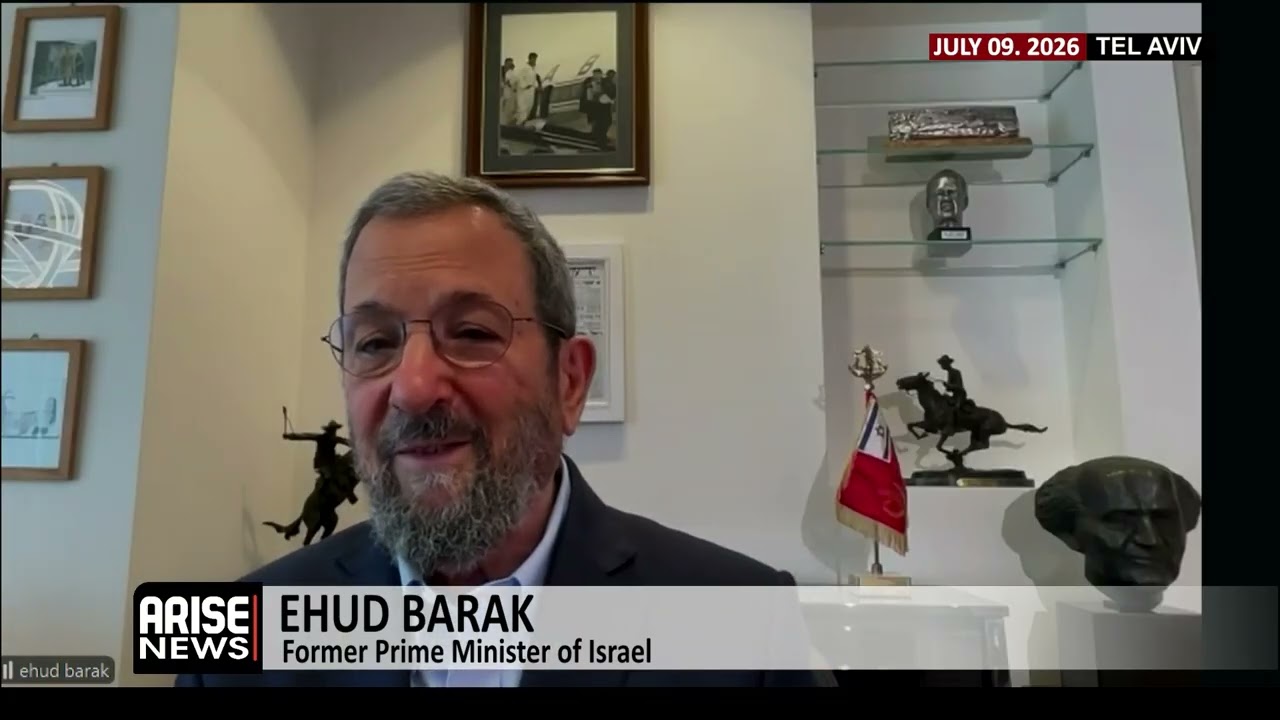
Former Israeli Prime Minister Ehud Barak has argued that military action alone cannot eliminate Iran’s nuclear ambitions, warning that expectations of completely destroying Tehran’s nuclear programme through force were based on unrealistic assumptions rather than strategic reality.
Speaking during an the ARISE NEWS Townhall on State Police, Barak said while Iran’s nuclear programme posed a major threat to the Middle East and the wider international community, some of the objectives pursued during recent military operations against Tehran were founded on “illusions” about what military power could realistically achieve. He stressed that Iran’s resilience had been underestimated despite suffering significant military setbacks.
“There were certain illusions in the minds of those who ordered it, both on our side and on the American side, that probably we are going to topple down the regime, probably we are going to eliminate, obliterate the nuclear military programme, probably we are going to end up, to eliminate their ballistic missiles or their proxy system. And it was illusion.”
He described Iran as a major source of instability in the Middle East through its nuclear programme. “I think that Iran is a major threat to the stability of the Middle East and indirectly the whole world through their nuclear military programme, through their effort to establish a very heavy ballistic missile source, and through their proxies all around the region, mainly the Hezbollah and the Houthis in Yemen and the Hamas in Gaza, which they financed and supported.”
While defending the initial military campaign against Iran’s nuclear facilities, Barak questioned the rationale behind subsequent operations. “So, I think that the original attack on the nuclear plan of Iran a year ago, the Twelve Days War, was justifiable and I could agree. But the second war in February is much more questionable because there were certain illusions in the minds of those who ordered it.”
He cautioned against underestimating Iran’s national resilience, saying the country’s history, strength and capacity to absorb military pressure had been overlooked by planners.
“Many people were sober, following the events and the capability, and knew all along the way, you should not underestimate a country like Iran. They are strong people and strong country with history that goes back for thousands of years.”
He also argued that perceptions of victory differed sharply between powerful states and their adversaries. “For us, for the Americans to win, we should win in a way that every teenager in any country understands that we had won… For the Iranians or Hezbollah or Hamas, it’s enough to survive. If Iran can survive an attack by the most powerful air force in the region, the most powerful air force in the world, and still after a week, still stand on its feet, still ready to fight, for them it’s a victory.”
According to Barak, Iranian retaliation was always likely to extend beyond direct confrontation with Israel or the United States and instead target strategic interests across the Gulf region. “The first thing that Iran will do when it is attacked is to cross the Hormuz Straits.”
He added that military planners should have anticipated such consequences from the outset.
“You cannot explain any war game in any capital in the Middle East or in the world in regard to Iran, always started that.”
Barak emphasised that Iran’s regional influence had been significantly weakened over the past three years following military operations against Hamas and Hezbollah. “It suffered major blows in the last year, especially in the last three years, when we hit very strongly on Hamas and then Hezbollah so they suffered major blows.”
Barak concluded that while military pressure remained necessary in confronting Iran’s security threats. “There were certain illusions that probably we are going to eliminate, obliterate the nuclear military programme and it was illusion.”
Erizia Rubyjeana
Follow us on:


