


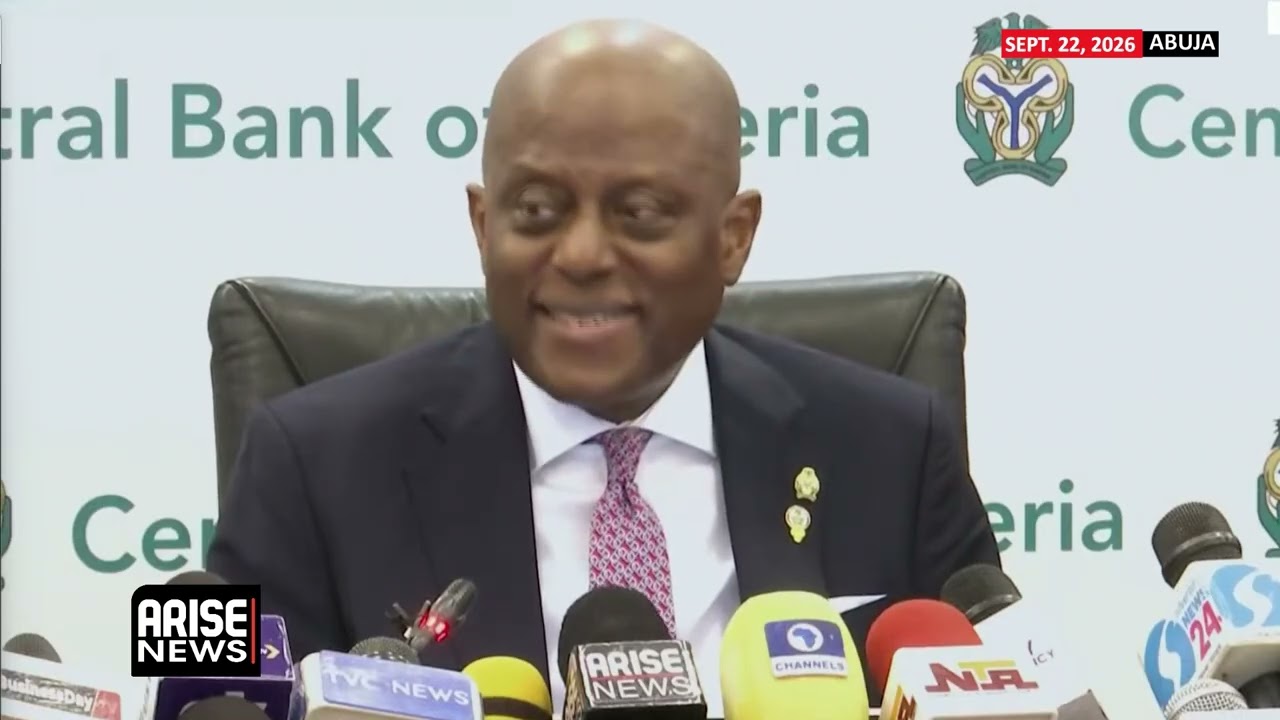
Central Bank of Nigeria (CBN) on Tuesday slashed the Monetary Policy Rate (MPR), the benchmark interest rate, by 350 basis points to 23 per cent, from 26.5 percent. CBN Governor Olayemi Cardoso announced the decision at the end of the two-day meeting of the Monetary Policy Committee (MPC) in Abuja, raising expectations of cheaper credit among private sector operators.
Analysts and the Organised Private Sector (OPS), welcomed the CBN decision.
The experts, including real sector operators, however, expressed shock at the unprecedented CBN move, as none had pre-empted the sheer magnitude of the rate adjustment in one fell swoop.
Lagos Chamber of Commerce and Industry (LCCI); Managing Director/Chief Executive, Financial Derivatives Company Limited, Bismarck Rewane; Chairman, Alliance for Economic Research and Ethics Ltd/GTE, Dele Kelvin Oye; and Professor of Capital Market/pioneer President, Capital Market Academics of Nigeria, Professor Uche Uwaleke, all welcomed the central bank’s policy direction.
Equally welcoming CBN’s new policy path were Chief Executive Officer of Centre for the Promotion of Private Enterprise (CPPE), Dr. Muda Yusuf, and Director-General of Nigeria Employers’ Consultative Association (NECA), Mr. Adewale-Smatt Oyerinde, and among others.
They believed the decision to lower the benchmark rate would positively impact the real sector by encouraging cheaper credit to manufacturers as well as boosting jobs.
Rate Cut a Reset, Not Policy Easing
Addressing journalists after the two-day meeting of the Monetary Policy Committee (MPC) in Abuja, CBN Governor Olayemi Cardoso also explained that the reset was principally aimed at repairing the transmission mechanism through which monetary policy decisions influenced money-market rates and the broader economy.
The central bank’s move signalled a major recalibration of its monetary policy framework as inflationary pressures eased and external buffers strengthened.
Cardoso described the downward rate amendment as a “reset and recalibration” of monetary policy rather than a shift to an easing stance.
MPC also recalibrated the Standing Facilities Corridor to +250/-300 basis points around the MPR, while retaining the Cash Reserve Requirement (CRR) at 45 per cent for Deposit Money Banks, 16 per cent for Merchant Banks, and 75 per cent for non-Treasury Single Account public-sector deposits.
Cardoso stressed that the corridor adjustment should not be interpreted as a shift in the underlying monetary policy stance.
He said the move constituted an “operational realignment” designed to strengthen monetary policy transmission, improve the effectiveness of the framework, and reinforce MPR as the principal signal of monetary policy.
MPC observed that the divergence between MPR and prevailing market rates had weakened the transmission of its decisions to the financial system.
CBN also said the ongoing overhaul of its monetary policy implementation framework, including the adoption of Nigerian Overnight Financing Rate (NOFR) as a transaction-based benchmark, had improved transparency in money-market operations.
NOFR was introduced by CBN and Financial Markets Dealers Association earlier this year to provide a standardised, transaction-based benchmark for overnight funding and strengthen policy transmission.
Cardoso said, “The committee decided to reduce the MPR and recalibrate the policy corridor as an important operational realignment aimed at strengthening monetary policy transmission and reinforcing the primacy of the MPR.
“The MPC emphasised that the recalibration of the corridor does not constitute a change in the underlying monetary policy stance, but rather an operational reset to enhance the effectiveness of monetary policy and support the transition to an inflation-targeting framework.
“Members were of the view that the current macroeconomic environment remains supportive of such a recalibration without undermining the disinflation process.”
Cardoso said the committee “considered the reset of the MPR and recalibration of the corridor appropriate to better align the monetary policy implementation framework with market realities”.
He said that “would strengthen policy transmission and restore the MPR as the principal signal of monetary policy”.
The CBN governor said, “Members emphasised that the recalibration represents an operational realignment of the framework and should not, in itself, be construed as a change in the underlying policy stance.
“The MPC broadly observed the increasing resilience demonstrated by the Nigerian economy, reflected in moderating inflation, robust external reserve buffers, improved external sector fundamentals and strengthening investor confidence.”
Inflation, External Buffers, Balance of Payments as Policy Trigger
Cardoso, who read the committee’s communique, stated that MPC decided to reduce the MPR and recalibrate the policy corridor as an important operational realignment aimed at strengthening monetary policy transmission and reinforcing the primacy of the MPR.
MPC emphasised that the recalibration of the corridor did not constitute a change in the underlying monetary policy stance, but rather an operational reset to enhance the effectiveness of monetary policy and support the transition to an inflation-targeting framework.
MPC broadly observed the increasing resilience demonstrated by the Nigerian economy, reflected in moderating inflation, robust external reserve buffers, improved external sector fundamentals, and strengthening investor confidence.
The committee acknowledged the considerable improvement in the balance of payments surplus to $3.51 billion in the second quarter of 2026, compared with $2.38 billion in the first quarter.
Similarly, the current account surplus increased by 67.92 per cent to $7.54 billion in the second quarter of 2026, from $4.49 billion in the first quarter.
The committee particularly underlined the progress in the disinflation process, evidenced by three consecutive months of decline in headline inflation, despite lingering geopolitical tensions in the Middle East and associated increases in global energy prices.
Members observed that the moderation in inflation indicated the effectiveness of previous policy measures, sustained exchange-rate stability, and improved inflation expectations.
Fiscal-monetary Coordination
MPC welcomed the presidential initiative on national affordable care programme, which is expected to lower transportation costs and support the continued decline in inflationary pressures.
Furthermore, the committee acknowledged the renewed commitment to policy coordination following the signing of the Memorandum of Understanding on fiscal-monetary coordination between the federal government, represented by the Federal Ministry of Finance, and CBN.
It stated that the development, among others, will provide a structured framework to strengthen policy harmonisation towards the achievement of low and stable inflation.
Tightening Cycle Has Achieved Its Objectives
Answering questions from journalists, Cardoso said the tightening cycle had achieved its primary objectives. He said the effectiveness of monetary policy now required attention to the transmission mechanism.
According to him, the disconnect between MPR and prevailing interbank rates has weakened the transmission of monetary policy to the wider economy.
“The tightening that we have done, in our view, has done its job. It has worked,” he said, stressing that CBN would remain on a restrictive path for as long as necessary.
He stated, “We should not see this as an easing. This is a reset and a recalibration.”
Three Years of CBN Reforms: FX, Banking and Reserves
Cardoso, who marked three years in office, also used the occasion to highlight the reforms undertaken since 2023, saying he inherited an economy characterised by currency instability, multiple foreign exchange rates, high liquidity, and weakened confidence.
He said CBN had been brought back to its core mandate of maintaining price and financial stability, pointing to the reduction of Ways and Means financing from the previous regime of monetary expansion as part of the adjustment.
He also defended the unification of the foreign exchange market, stating that the former multiple-rate regime created distortions and effectively amounted to a subsidy that imposed substantial costs on the economy.
Cardoso said the FX reforms, together with tighter monetary policy, had helped restore stability and improve investor confidence.
He identified the recapitalisation of the banking industry as another major milestone, stating that the exercise has attracted substantial domestic capital and positioned banks to support the ambition of a $1 trillion Nigerian economy.
He said the strongest indicator of the changing external position was the rebuilding of the country’s reserves, disclosing that gross external reserves have risen above $55 billion. He described the level as the highest in more than 18 years.
Diaspora Remittances as Key FX Buffer
The CBN governor attributed the improvement, partly, to stronger diaspora remittances, saying inflows have risen sharply from about $200 million monthly, when the campaign to increase remittances began, to nearly $1 billion monthly by July.
He said CBN would intensify engagement with Nigerians abroad, including during forthcoming international meetings, to sustain the growth in remittances.
Cardoso also linked Nigeria’s return to major global investment indices, including developments involving FTSE Russell and JPMorgan, to renewed international confidence in the country.
He said increased participation by international investors could deepen the capital market, improve foreign exchange liquidity, and strengthen monetary-policy transmission.
Fiscal-Monetary MoU to Institutionalise Coordination
On fiscal-monetary coordination, Cardoso said the recently signed Memorandum of Understanding between CBN and Federal Ministry of Finance was designed to institutionalise cooperation rather than depend on individual relationships.
He said the arrangement would be particularly important as Nigeria moved towards inflation targeting, which, in his view, could not be successfully implemented by monetary policy alone.
“We have been talking about our journey to inflation targeting,” he said, adding that fiscal and monetary authorities needs to operate “on the same road”.
CBN Prepares for Election-Year Liquidity Pressures
Ahead of the political and electoral cycle, Cardoso said CBN was preparing for possible changes in currency demand and liquidity.
He said the bank would closely monitor currency in circulation, banking-system liquidity, monetary aggregates, and foreign exchange demand, while deploying liquidity-management tools where necessary.
He assured Nigerians that currency would remain available, but warned that CBN would enforce existing limits and intensify surveillance against currency abuse in collaboration with law-enforcement agencies.
Cardoso maintained that the reforms had placed the economy on a more stable footing, saying CBN would prioritise policy consistency to preserve the gains achieved over the past three years.
The governor said the combination of improved reserves, FX stability, declining inflation, stronger remittances, banking recapitalisation, and closer fiscal-monetary coordination provided the foundation for the next phase of economic management.
James Emejo, Nume Ekeghe and Omwuamaeze
Follow us on:


