


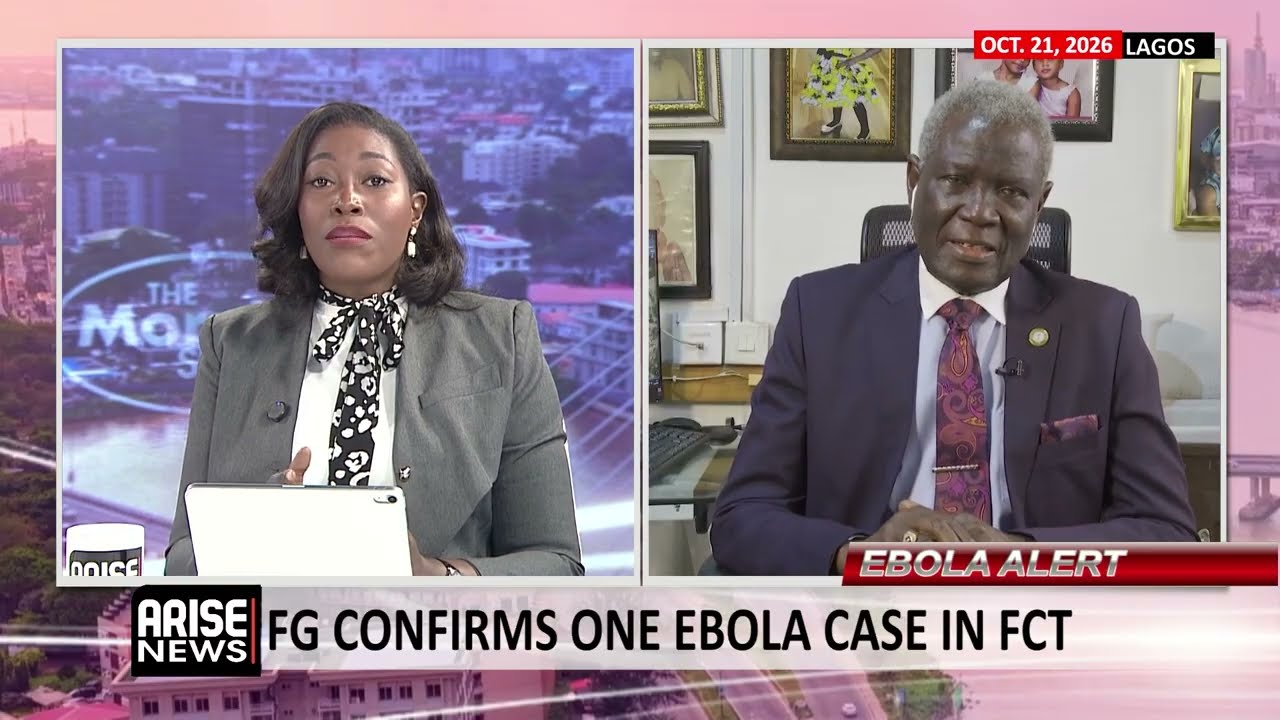
Foundation President of the Academy of Medical Sciences, Professor Oladapo Ashiru has called for mandatory Ebola contact tracing for all travellers, regardless of their political or social status, and the establishment of permanent disease surveillance facilities across Nigeria’s 774 local government areas.
Speaking during an interview with ARISE NEWS on Wednesday, Ashiru said Nigeria must strengthen its response to infectious diseases beyond temporary emergency measures as he called for sustained funding of disease surveillance systems and warned against exempting influential individuals from airport screening protocols.
“They must recognise this and they must make it mandatory for every single person, no VIP, going to the airport to have that form done,It should be for communicable diseases, and there should be installations across the local government, not even state, to recognise this and maintain it.”
He explain that universal contact tracing was essential to preventing the spread of Ebola emphasising that Ebola has an incubation period of between two and 21 days. “For example, at the airport now, we must have temperature scanners, because the incubation period for Ebola is between two to 21 days before it manifests in the clinical signs and symptoms. So somebody can escape through the airport, and 20 days after show the signs. So the contact tracing must be universal. There can be no exception to that issue.”
Ashiru also called for a 21-day monitoring period for potentially exposed travellers. “But we have to have a 21-day window in which we can say that those people are now safe.”
Beyond airport surveillance, the professor said Nigeria needed a permanent public health response system that would cover communicable diseases rather than focus on Ebola alone. “I know there is a presidential task force on Ebola. This is a constant situation. It should not be for Ebola. It should be for communicable diseases, and there should be installations across the local government, not even state, to recognise this and maintain it.”
Ashiru criticised Nigeria’s failure to maintain the public health infrastructure developed during previous Ebola and COVID-19 outbreaks. “That is something that the government needs to work on. The last time, we had a lot of preparation for Ebola and then also for COVID, but those things were not maintained. They have to be kept constant.”
“We need not to be a machine gun approach. We need to prepare things and make them ready and fund them regularly.”
Ashiru described the reported Ebola case in Abuja as serious but manageable. “The situation is very serious but it can be managed and the way we manage this depends on how we respond to this situation.”
“Now, so the level of preparedness, I can only give kudos to the fact that at least we’re able to recognise and diagnose these incidents in Abuja, because if they were not able to even recognise and isolate it, there would be more problems than we have today.”
On preventive measures, he advised Nigerians to avoid handshakes, hugging and unnecessary physical contact. “So this is a time for Nigerians as the Academy of Medical Science has stressed to refrain from shaking hands and hugging. It is time to start greeting people like this, how are you, good morning, thank you, like the Indians do.”
“Once you get to your house, wash your hands, have alcohol-based sanitisers, but majorly avoid contact. You don’t need the mask, but you need to avoid contact with infected persons.”
Ashiru warned that Nigeria’s large population and frequent social gatherings could make contact tracing more difficult. “Because Nigeria is a very highly populated country, we have parties, we are a mixed society. So if you go to such places and you begin to shake hands with somebody that has just travelled, it will be difficult for us to do contact tracing in that situation.”
He also called on hospitals and private clinics to remain vigilant and take immediate precautions when attending to patients with symptoms associated with Ebola. “And the next thing is that the hospitals, the private clinics must be on high alert in terms of once you recognise a case with fever or you suspect it, you have to be proactive in suspecting such cases.”
“One of the ways, especially to the health workers, they get infected by this is when they remove those protective garments. There are standard ways to remove them. So they must be careful to remove them, not touching the outside of those protective equipment.”
He said public awareness and the ability of healthcare workers to recognise suspected infections were central to Nigeria’s preparedness. “But the level of preparedness of a country depends on the level of information awareness to the public and to the health workers. Every health worker now should recognise this.”
Ashiru alled for more confirmatory testing centres across Nigeria’s geopolitical zones to improve early detection and strengthen the country’s response capacity. “Not just to be in Abuja, we need to multiply those confirmatory test centres in the same geographical zones. But it is a reliable test and it is something we can depend on.”
He identified public awareness as one of the most important tools in preventing transmission.
“The most important thing for us in Nigeria is awareness. When Nigerians are aware of a disorder or a disease like this, they take caution.”
Ashiru called for handwashing facilities in public places and proper sanitisation before entering buildings. “So I’m advising that we, in the various public places, we instal a washing basin to wash your hands and do proper sanitising before going into such buildings and maintain proper hygiene.”
Erizia Rubyjeana
Follow us on:


