


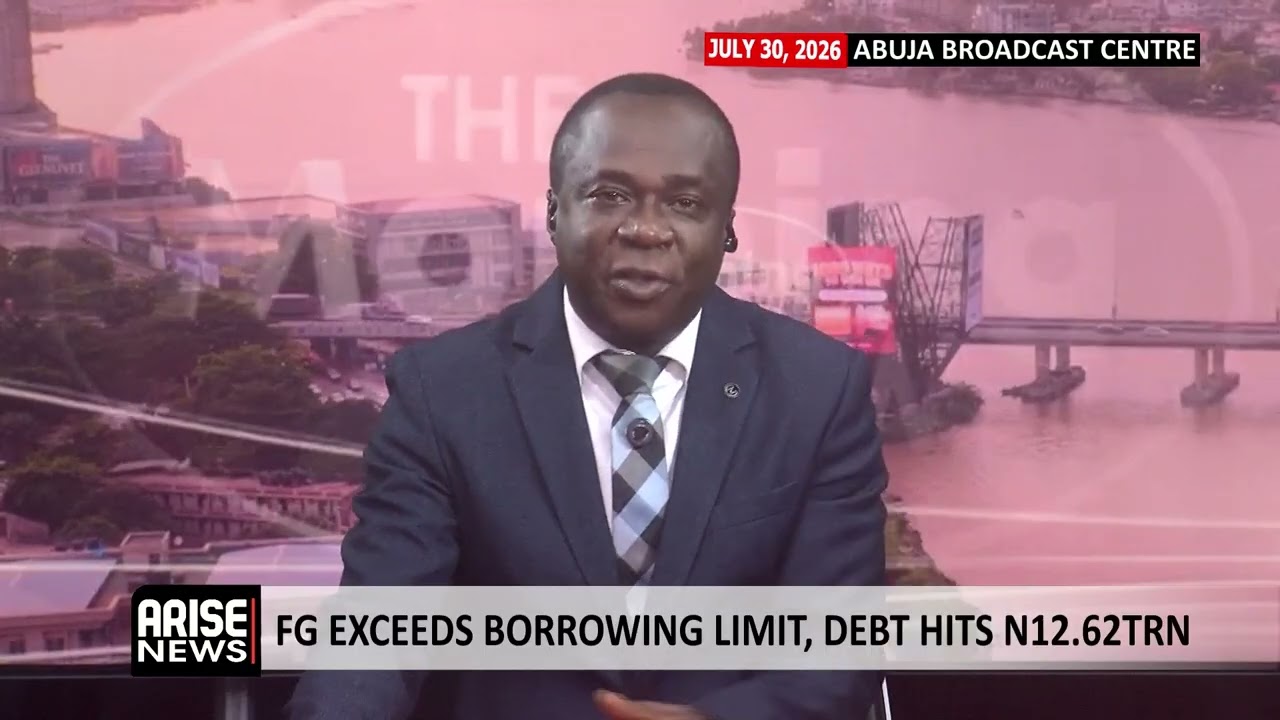
Director of the Institute of Capital Market Studies at Nasarawa State University,Professor Uche Uwaleke has said Nigeria’s growing public debt is not inherently a cause for concern, but the country must urgently reform its spending practices, strengthen fiscal discipline and ensure borrowed funds are tied to productive projects,
Speaking in an interview with ARISE NEWS on Thursday, Uwaleke said public concerns over the country’s rising debt profile were legitimate, even as he defended the government’s position that borrowing itself is not a bad economic policy when properly managed.
He said the central message conveyed by the Minister of Finance at the recent Biennial Conference of the Capital Market Academics of Nigeria was that the value of borrowing depends on how the funds are deployed.
“Borrowing is not bad. It’s something that, especially when it needs to happen, what’s important is the application of the loan.”
Uwaleke noted that comparisons of Nigeria’s debt profile should take into account factors such as the securitisation of the Central Bank’s Ways and Means advances and the impact of naira devaluation following exchange rate unification.
According to him, although Nigeria’s debt stock has risen to about ₦159 trillion, part of the increase reflects accounting adjustments rather than fresh borrowing alone.
He explained that Nigeria’s external debt stood at about $108 billion in December 2023 and remained around $110 billion by the end of 2025 despite additional borrowing, illustrating the effect of exchange rate depreciation on debt valuation.
Despite this, Uwaleke acknowledged that the pace of debt accumulation remained worrying.
“The concerns being expressed by members of the public are valid when you look at it from the point of view of the pace of debt accumulation over the years.”
He noted that Nigeria’s total debt stock increased from about ₦11.2 trillion in 2014 to approximately ₦159 trillion today.
Even after excluding the effects of naira devaluation and the securitisation of Ways and Means advances, he said debt had climbed from about ₦97 trillion in 2023, representing an increase of nearly 80 per cent.
Uwaleke argued that Nigerians have not seen infrastructure or human capital investments commensurate with the scale of government borrowing.
“When you look around you, you may not see tangible things that match the level of loans that have been taken, especially against the backdrop of Section 41 of the Fiscal Responsibility Act, which clearly says borrowing should be for long-term concessional financing and for capital and human development.”
He attributed recent borrowing pressures largely to revenue shortfalls caused by unrealistic budget assumptions, particularly crude oil production benchmarks and exchange rate projections.
According to him, governments should adjust spending plans when revenues fall instead of expanding expenditure.
“When you have a budget and in the course of implementation you’re noticing shortfall in revenue, you don’t continue to increase the size of your spending. What you need to do is prioritise and cut down on expenditures that can be moved to the next fiscal year.”
The professor also called for tighter control of revenue leakages and criticised what he described as the high cost of revenue collection by government agencies.
He argued that agencies such as the Nigerian Revenue Service, the Nigerian Upstream Petroleum Regulatory Commission and the Nigeria Customs Service retain significantly higher collection costs than global best practice.
“I’ve recommended reducing those cost-of-collection ratios by at least 50 per cent. Whatever we’re giving these agencies should be based on need, not simply on a fixed percentage.”
Uwaleke said Nigeria had made significant progress with revenue reforms but stressed that comprehensive spending reforms must now follow.
He also called for amendments to the Debt Management Act of 2003 and the Fiscal Responsibility Act of 2007, arguing that existing legislation lacks sanctions for violations of borrowing provisions.
“The Fiscal Responsibility Act has not provided consequence management. There are no sanctions, and that is why, in my view, the laws are weak.”
On debt composition, Uwaleke recommended reducing Nigeria’s exposure to foreign borrowing.
He said the current debt structure—about 53 per cent domestic and 47 per cent external—should gradually shift to a 70:30 ratio in favour of domestic debt to minimise foreign exchange risks.
He also proposed diversifying external borrowing through instruments such as Panda Bonds denominated in Chinese yuan to support trade with China and reduce pressure on dollar reserves.
To improve transparency, Uwaleke urged the government to rely more heavily on infrastructure-linked borrowing instruments such as Sukuk and Green Bonds rather than conventional Federal Government bonds.
“We should tie borrowing to projects. We have to increase the issuance of infrastructure bonds. When you borrow using instruments like Sukuk and Green Bonds, you’re sure where the money will be used.”
On investor sentiment, the capital market expert said confidence in Nigeria remains relatively strong because of improving macroeconomic indicators and the country’s consistent record of servicing its debt obligations.
“Nigeria is always meeting its loan obligations. We have not defaulted, and I don’t see Nigeria defaulting in the near future.”
Responding to concerns over the securitisation of the Central Bank’s Ways and Means advances, Uwaleke described it as a necessary response to extraordinary economic shocks, including the 2016 recession and the COVID-19 pandemic.
He said converting the overdrafts into long-term debt reduced the government’s financing burden by lowering the interest rate to nine per cent and spreading repayment over 30 years.
Uwaleke added that the Central Bank had discontinued Ways and Means financing since 2023, a development he said has strengthened confidence among investors and international financial institutions.
“What’s important now is that no additional Ways and Means loans are being advanced to the government. That has helped build confidence among rating agencies, the World Bank and the IMF.”
He concluded by reiterating that while borrowing can support economic development, government must ensure every loan is deployed efficiently and in strict compliance with fiscal laws.
“What’s important is that when you borrow, make sure that you apply it wisely and in line with the provisions of the law.”
Boluwatife Enome
Follow us on:


