


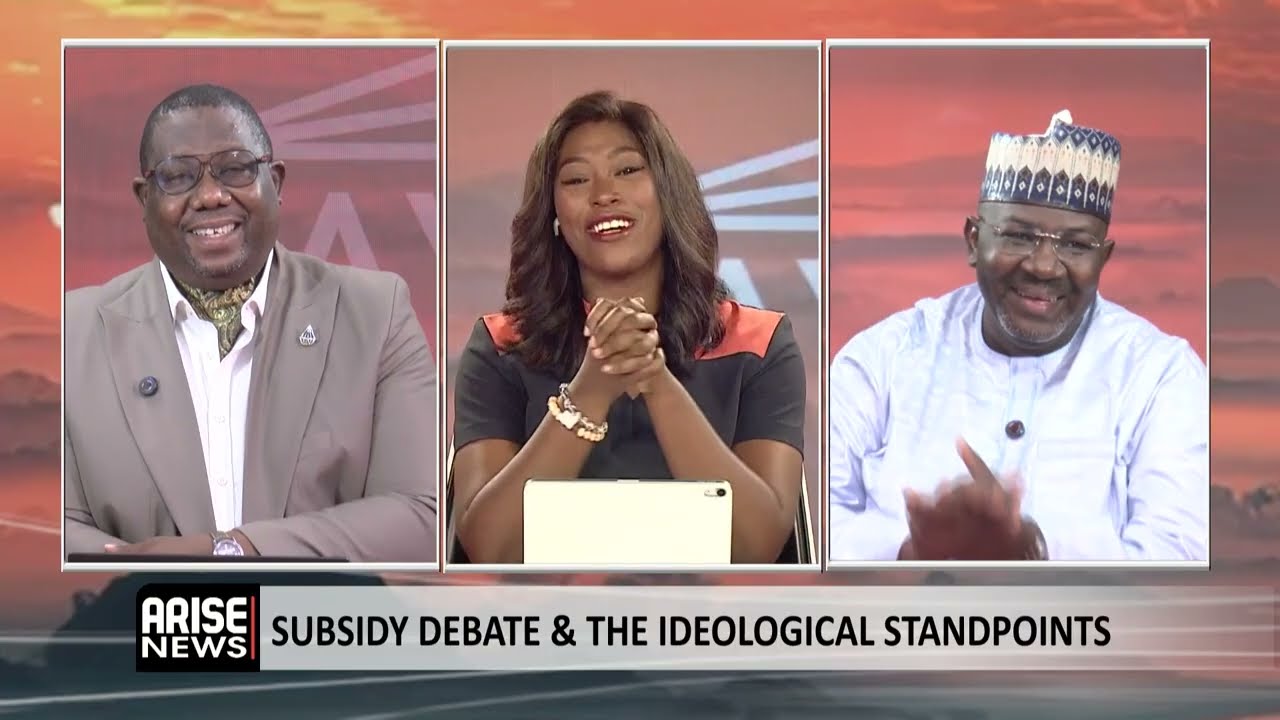
A chieftain of the All Progressives Congress, (APC), and an international commerce expert, Dr Sule Iko-Sami, has defended the removal of fuel subsidy by the Bola Ahmed Tinubu administration, insisting that the policy has delivered benefits to Nigeria while challenging the opposition to present a workable framework for reinstating it.
In an interview with ARISE NEWS on Friday, Iko-Sami said the opposition should move beyond criticism and provide a clear policy framework for reinstating the subsidy. He noted that virtually every presidential candidate in 2023 had openly supported the removal of fuel subsidy, arguing that the huge sums spent on subsidies were growing to a point where Nigeria could go bankrupt.
“I want the opposition to present a working framework—a policy for reinstalling the subsidy, how they intend to handle it for the country’s economy, and what would happen to our macroeconomic space. That should be done, not just talking points on TV.”
Continuing, he said: “With all due respect to the opposition—just go back three or four years ago and look at the talking points of the opposition concerning the fuel subsidy regime. You’ll realize that virtually every presidential candidate in 2023 came out openly and supported the option that the gargantuan sum of money being paid for subsidies was growing incrementally to a point where this country could go bankrupt. They were all out to remove it. They needed a leader with a bold step to come out on day one of his election and declare that the subsidy would be removed.”
Highlighting the positive impact of fuel subsidy removal on Nigeria and its economy, Iko-Sami said the policy had improved the country’s fiscal space, supported crude oil production, helped address some of the macroeconomic imbalances affecting the economy, and enabled initiatives such as the CNG programme.
“Let’s look at the positives. What has the fuel subsidy removal done for our savings, for the production of crude oil itself, for our economy, for the fiscal space, and for the macroeconomic imbalances that would have affected this country?
“Let me refer to my state and tell you some of the positives of the subsidy removal. We are an agrarian state. At the moment, you might be hearing about a policy on crop moisture, residual moisture for seeds, and climate adaptation crop programs. It is already a national policy. What that does is that you can plant a seed and get a dividend yield within 60 to 80 days. That was not known to most agrarian states in this country. The federal government has adopted it as a national food security program.
“Look at what the state has done with intra-state transport: bringing in different vehicles across all 21 local governments in the state. Women drivers are also being subsidized, and cars are moving. Roads are being constructed in most of these local government areas within the state.”
On the CNG programme and government’s response to the hardship caused by the reforms, Iko-Sami said the initiative had been ongoing for two years and was being implemented in phases, noting that virtually every state had received bus allocations. He also pointed to the planned 500 CNG stations across the country, saying the number would “go a long way” in expanding access, while stressing that he did not consider it sufficient.
“The CNG program, CNG buses, and cars have been underway for the last two years. The program started. You don’t set up such a palliative program within two days and expect it to work overnight; it happens in phases. You and I know that across this country, virtually every state has received most of its bus allocations, and it’s happening.
“Look at the numbers statistically. You mentioned about 500 CNG stations. We have 774 local governments in Nigeria. 500 CNG stations is a big step. When you have 500—how many municipalities do we have in Abuja, four or five? We’ll be able to have five, three, or four in key locations. That will go a long way. I didn’t say it’s enough; I said statistically, it will go a long way.”
Addressing concerns over the pace of CNG vehicle conversions, Iko-Sami said conversion was optional for Nigerians and urged critics to focus on the investments being made by the government.
“Remember, conversion is optional for every Nigerian. You could have 100 cars, and only four or five people might intend to convert. We’re looking at what the government itself is doing. What I’m insisting on is this: look at the investment the government is making with these numbers. Go through ministry by ministry.”
He also highlighted recent security gains, including military action against bandits along the Sokoto-Kebbi road, and called on states to adopt climate adaptation and residual moisture programmes to boost agricultural production and strengthen food security.
“Take the last five days I’m talking about. Five days ago, there were security challenges around our borders. Within 7 to 8 hours, the military was able to crush bandits along the Sokoto-Kebbi road. That was not something discussed openly in our media. We should talk about the positives.”
“What are our states doing in agriculture? This is the investment the state is making. I am calling on all our states around the country to copy this adaptation climate program and residual moisture program in agriculture. It will go a long way in providing a significant percentage of our food production in our localities. That is our strength and asset in northern Nigeria.”
Responding to concerns over poverty levels in Kebbi State, Iko-Sami urged Nigerians to focus on the latest National Bureau of Statistics figures and the government’s 2026 scorecard. He said the assessment should consider what the government had achieved with palliatives and other interventions during the period.
“Look at the NBS figures of 2026 and the government scorecard as of July this year. That will be the discussion we should be having. We’ll look at what the government has been able to do with palliatives within that period. I would like to talk about that because that’s what matters.”
On the planned reduction in transport fares in Kebbi State, Iko-Sami urged Nigerians to assess the number of palliative buses provided by the state government across its 21 local governments and the impact on transport costs. He said the initiative had been ongoing for more than two years, with buses periodically provided to local governments and transport unions to ease movement, particularly for residents in agrarian communities.
“That started in Kebbi State more than two years ago. Almost every six months or every quarter, buses are being rolled out—not just for each local government; transport unions in the respective local governments have also received them. The state government understands that most of our areas are agrarian and farmlands; people need to move.”
On the opposition’s alternative policies, Iko-Sami called for more specific proposals and timelines, urging opposition politicians to clearly outline how their policies would work rather than simply criticising the government’s actions. He said Nigerians deserved concrete alternatives and detailed explanations of how such policies would be implemented.
“If the opposition has a policy, let them bring it out, give it a timeline, and state the specifics. We should be talking about specific policies.
“It is important for us to speak about specifics across every stratum of government and in every state. I’m taking a brief as a Nigerian: we have a right to get specifics from the opposition and specific criticism of government policy, not just commentary on the situation of the day.”
Speaking on Atiku Abubakar’s campaign promise to diversify Nigeria’s ports and open up the South-South and South-East corridors, Iko-Sami said the federal government had already begun implementing similar policies. He cited investments in the Lekki Deep Sea Port and ongoing developments in Imo State, insisting that the initiative was already within the framework of the government’s policies, rather than an Atiku Abubakar policy.
“Mr. President has already started that. What Mr. President is trying to do today is provide security across the local architecture of this country. He started creating these divisions with the support of our National Security Adviser and the security team. They are increasing these divisions and increasing our manpower in the Armed Forces. Once you secure the borders better than before, you’ll be able to open these up.
“Already, there is a lot of investment in maritime—look at Lekki Deep Sea Port and many other ports. Even in Imo, they are galvanizing one right now. So it’s an open process. He is only singing praises that should already be sung. But as I said, it’s a talking point. States can generate power and make money on their own.
“These are positives, my sister. So it’s already within the framework of this government’s policy; it’s not an Atiku Abubakar policy. It is the government’s policy, and if you read the specifics, you will see what the government is doing.”
Highlighting Kebbi State’s approach to local development, Iko-Sami said local contractors in each local government are mandated to execute projects within their communities. He said the policy, under which contracts are not awarded centrally, was designed to increase local employment and should be replicated by other states.
“You will even find out that our local contractors in every local government are mandated to do jobs within their local government. The Governor doesn’t award contracts centrally; he awards contracts to local government contractors to increase jobs locally. That’s a policy most of our states should copy.”
Favour Odima
Follow us on:


