


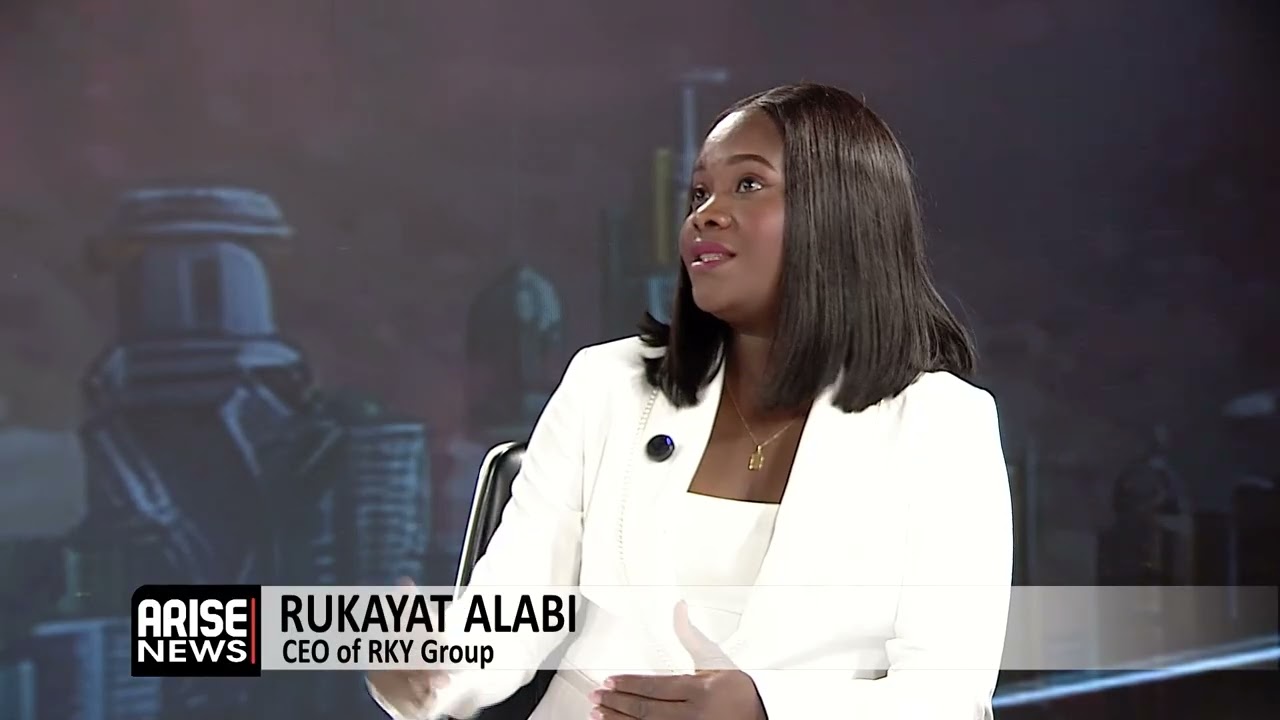
Chief Executive Officer of RKY Group, Rukayat Alabi, says learning globally relevant skills is key to building successful careers, accessing international opportunities and creating wealth.
Speaking during an interview with ARISE NEWS on Friday, Alabi said Nigeria’s people, talent and growing businesses remained among the country’s most underestimated resources, noting that more Nigerians were building scalable businesses capable of accessing global markets and attracting funding beyond the local economy.
“Nigeria is blessed with lots of resources, as we all know. But I would say one of the most underestimated resources Nigeria has is the people, the talents and wealth being built by businesses.”
Alabi said the growth of scalable Nigerian businesses was creating new opportunities for wealth creation, as entrepreneurs increasingly accessed international markets and funding.
“A lot of Nigerians now are building scalable businesses that are thriving beyond the local markets, accessing global markets as well, raising funds beyond the local space and building wealth.”
She said professionals whose incomes were not keeping pace with inflation and declining purchasing power needed to develop skills that could create opportunities beyond the domestic market.
“If your salary, if your income is not growing at the same rate as your purchasing power, basically, then you definitely need to do something about it.”
Alabi advised professionals to develop skills that remained relevant beyond their current country and employer, particularly skills that could open access to international opportunities and foreign-currency income.
“What you can do about it as a professional is to build for global relevance. And that is building relevance beyond your current country, beyond your current employer.”
She stressed that global relevance should not be viewed simply as a strategy for earning foreign currency, but as a broader approach to career development and wealth creation.
“Positioning for global relevance is not a currency strategy. It should rather be a career and wealth-building strategy.”
According to Alabi, professionals seeking international opportunities should focus on transferable skills, competence and evidence of their capabilities rather than relying solely on academic qualifications.
“The global markets require your ability to have the skills that are relevant across borders, as well as positioning, building evidence of what you are able to do, because the global markets does not reward certificates, it rewards competence and what you’re able to do and demonstrate.”
She said some professionals were stuck in career paths that were primarily marketable within their local economies, making continuous learning and adaptation essential for competing internationally.
“We have a lot of professionals now that are stuck in career paths that are only marketable in their local economy.”
Alabi said her experience supporting professionals moving to the United Kingdom had shown that even experienced workers sometimes needed to reskill, relearn and unlearn to compete effectively in global markets.
“In the last five years, I’ve supported professionals moving to the UK to navigate the global job market.”
She added that experience alone was no longer enough, as professionals needed to continuously update their skills and adapt to changing demands in the global labour market.
“A lot of people, even after 10 to 20 years of experience, have had to relearn a skill, reskill and even unlearn some things to be able to thrive in the global market.”
Alabi said global employers increasingly valued transferable skills and the ability to solve problems relevant to the markets where professionals sought to work.
“In the global market space, what’s more rewarded is how transferable your skills are, how it solves their own immediate problems in that economy as well.”
On the skills professionals should prioritise, Alabi identified technical expertise, human skills, visibility and commercial awareness as key areas.
“I would lead with the technical skills, technical skills from AI literacy, right, to being able to use the tools that are relevant beyond Nigeria.”
She also highlighted communication and stakeholder management as important human skills for professionals seeking to compete internationally.
“The second would be human skills, stakeholder management skills, communication skills.”
Alabi said visibility and commercial awareness were equally important, as professionals needed to demonstrate their capabilities and make themselves discoverable to potential employers and clients.
“And then the third would be visibility and commercial awareness, ability to demonstrate what you have because a potential that no one knows about would not be considered for opportunities.”
She encouraged professionals to leverage digital platforms such as LinkedIn, networking and industry events to showcase their capabilities and connect with opportunities beyond their immediate workplaces.
“So are you putting yourself out there, leveraging platforms like LinkedIn where talents can be sought after from across borders, from across the globe?”
On professional visibility, Alabi said individuals did not necessarily have to appear on camera or constantly post online to attract opportunities.
“There are so many platforms. So not everybody needs to set camera to actually drive or to get seen and valued.”
She said professionals should choose visibility channels that suited their personalities and preferences while deliberately building strong professional networks.
“Professionals just need to choose the one that aligns with their own personal preference. Whatever works best for you and aligns perfectly.”
On whether wealth creation was limited to entrepreneurs, Alabi said the distinction between professionals and entrepreneurs was becoming less rigid as more people developed multiple income streams.
“Everybody is trying to build income through multiple streams.”
She said professionals were increasingly building businesses on the side, while entrepreneurs were also monetising their expertise through speaking engagements and other activities.
“We have professionals that are also building on the side. We have entrepreneurs that are also using their skills to earn on the side through speaking engagements and all of that as well.”
Alabi said the focus should ultimately be on continuously developing valuable skills, monetising expertise and building scalable sources of income.
“No one can take your skills away from you.”
She said professionals could monetise their expertise while developing businesses and other income streams.
“While you are positioning yourself to earn from your skills, monetizing your skill sets, you are also building scalable business on the side.”
Alabi concluded that wealth creation was not restricted to a particular professional category, but depended on how individuals developed, positioned and monetised their capabilities.
“I think it’s more about individual building on what they have and monetizing it accordingly.”
Goodness Anunobi
Follow us on:


