


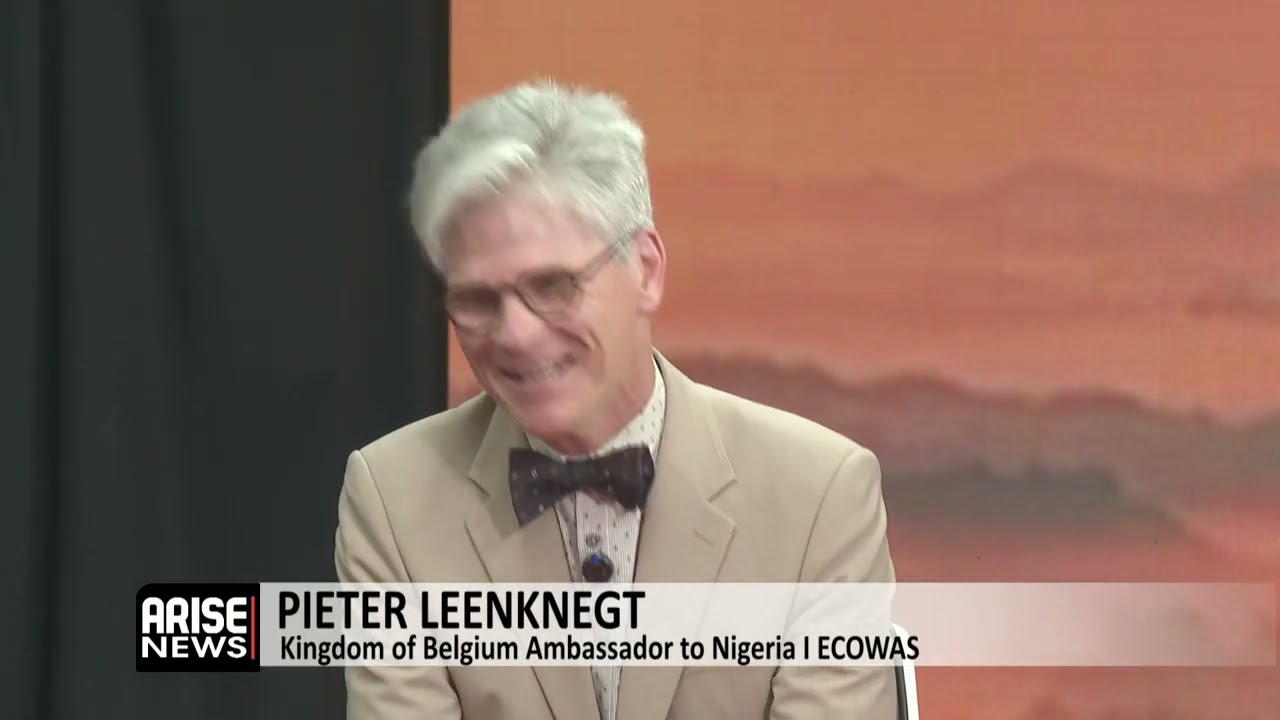
The out-going ambassador of the Kingdom of Belgium to the Federal Republic of Nigeria and to ECOWAS, Pieter Leenknegt, has reiterated that Belgian and Nigerian relations have remained strong over the past 65 years and are now entering a transformative phase, driven by economic diversification, increased investment, and expanding bilateral cooperation beyond oil.
Leenknegt, who is also a lawyer, art historian, and international relations analyst, said this while speaking with ARISE NEWS on Tuesday, noting that the longstanding practice of exporting Nigeria’s crude oil to Belgium for refining before shipping it back to Nigeria is changing as both countries deepen cooperation in agriculture, manufacturing, investment, and other non-oil sectors.
“Belgian and Nigerian relations have been strong. They are also in a very transformative phase, because you mentioned oil—that indeed at some point made Belgium the biggest exporter from the EU to Nigeria with refined oil. Of course, that story is completely changing nowadays, and I think for the better. It was a bit of an absurdity also to have all this crude oil coming from Nigeria to Belgium and then to be shipped back refined to an oil-producing country,” he said.
He said economic diversification is gathering pace, with Belgian businesses optimistic about Nigeria’s investment prospects and some considering production in the country.
“The diversification is getting there; you can feel it. We had these agricultural-focused trade missions coming in, even from my home province in Belgium. There are lots of business people who have very upbeat expectations about the coming years in Nigeria, what’s going to be possible—people who build square silos, factory halls, palm oil producing installations, and all of that. All these people are actually quite upbeat about the future of their investments. Some of them are actually also considering producing from Nigeria, either from the free zone or from elsewhere,” he revealed.
He also highlighted what he described as the first major Nigerian investment in Belgium—a Saro Africa majority stake in a horticultural firm near Ghent—stressing that investments in the 21st century “should not be a one-way street anymore.”
“There’s also recently been a first Nigerian investment in Belgium near my birthplace of Ghent. There is now a Saro Africa investment, majority ownership in a horticultural firm, and I think that’s also something that deserves to be mentioned, because investments in the 21st century should not be a one-way street anymore.”
Beyond trade, Ambassador Leenknegt said he has worked to strengthen cultural ties, describing Nigeria’s visual arts, literature, and music as some of the country’s greatest exports and calling Nigeria “one of the artistic powerhouses of Africa.”
“Other than that, as an ambassador, as you pointed out in the introduction, I’ve also tried to strengthen cultural ties. Because after all, one of the big export products of this country is in the fictional realm—the visual arts, literature, music—and there is much to explore. Yes, it helps to be sent to one of the artistic powerhouses of Africa, of course, and so that definitely helps,” he stated.
Speaking on Nigeria’s political landscape, Ambassador Leenknegt described the Tinubu administration as “undeniably a reform government,” saying several measures were necessary to address past economic challenges.
He singled out the tax reforms as one of the administration’s most significant initiatives, arguing that they could boost government revenue, promote a fairer tax system where “the biggest shoulders also bear the biggest burdens,” and play a crucial role in moving Nigeria forward, even if their full impact is yet to be felt by citizens.
“I think it’s undeniable that this is a reform government. Now, there were what I would call some emergency break measures—reforms that needed to take place anyhow to prevent catastrophe from happening based on dealing with some of the serious issues of mismanagement of the previous government.
“But I think one of the more interesting reforms is one that has escaped that logic, and that’s the tax reform. Because on the one hand, one of the main goals there was to raise this government revenue-to-GDP ratio, which was one of the lowest in Africa and lowest in the world. And on the other hand, also to even things out in a progressive way, so that the biggest shoulders also bear the biggest burdens.
“For instance, I recently spoke to the Minister of Finance again about the VAT reform that is still coming up. Some of these measures are still in the pipeline; probably not all of it is felt yet by Nigerians, but I think the importance of these tax reforms and fiscal reforms in Nigeria cannot be overstated in terms of the potential it has to help move the country forward,” he maintained.
Comparing Belgium’s political system with Nigeria’s, Leenknegt said Belgium is a “full-fledged parliamentary democracy” with a largely ceremonial monarchy and noted that both countries operate federal systems with significant devolution of powers, which can foster competitive democracy but also create governance challenges when responsibilities overlap.
“Let me first perhaps dispel a possible potential misunderstanding: the monarchical element in Belgium isn’t very strong. We have a ceremonial head of state who is the king, but except in very limited instances, the political clout or weight of the king is very minimal or non-existent. So it is a full-fledged parliamentary democracy; let me make that clear.
“I think there’s an interesting parallel between Belgium and Nigerian democracy: we’re both federal systems. There’s devolution of powers—serious, actual devolution of powers—which means that in Belgium, communities and regions have exclusive powers vis-à-vis the federal level, and in Nigeria, you also have very strong state powers. In certain ways, this can be an enormous help and an enormous lever—this kind of what we call competitive democracy, where different states, or in our case federated entities, can compete and show what is the most apposite in their context. In the worst case, it can also lead to situations, as in the Belgian press they call it, where in a certain policy area, everybody is competent, but nobody feels responsible. And of course, that is something that both of our countries from time to time need to tackle,” he explained.
On Nigeria’s push for state police, Leenknegt said Belgium did not adopt a state policing model despite being a federal system, arguing that community policing works best at the local level while national police provide overall coordination. He cautioned that in ethnically diverse federations like Nigeria, state police could create conflicts of loyalty and should only be introduced with robust legal safeguards.
“Let me start by saying that we had a big police reform at the end of the 90s in Belgium ourselves, after a series of scandals that basically led us to believe that there was a disconnect between the national police and local police. Therefore, we spelled out those competencies better. But important to know is, although we already had a full-fledged federal system, we did not opt for a state police model.
“We strongly believe in Belgium that proximity policing—community policing—doesn’t happen at the level of an entity of several million inhabitants, but rather at the level of several ten-thousands, a hundred-thousand perhaps. The contrast you create is one between a national police that holds everything together and also has competencies for very specific files, and then community policing that is really local.
“Why do I say that? In federal states that are delineated across ethnic lines or other identity-based lines, I think there are quite a number of risks involved with the notion of state police. That doesn’t only hold for Nigeria, but I think it generally holds for what I would call ‘Old World’ countries—everything except for Oceania and perhaps the Americas.
“What happens if a national government forbids the holding of a referendum that a state-level government holds legitimate? The national police is going to follow the national authorities, but the devolved state police is probably going to be very torn between possible levels of supremacy and hierarchical levels in the country, but also, of course, its role as state police being dependent on state authorities. Now, I hear many politicians in high places bring up the notion that the one who should police the creeks in the Delta is the one who knows the creeks in the Delta and who speaks the language of the creeks in the Delta. Yes, definitely, there’s a bit to that—that kind of positive ethnicity—but it’s also a bit of idyllic thinking. I wonder whether it’s not a fantasy that would not stand the test of a first Catalan-referendum-type incident.
“If you create police at the level of a state, then of course the one in charge of that state—a governor—will probably have the last word about it. I understand that the state police legislation is still in the making in the pipeline, and people speak of guarantees that would be brought in to avoid that, like safeguards. But of course, it would be interesting to see how that all will pan out—how will these safeguards be drafted, crafted, and also how will they play out in practice?”, he quizzed.
Speaking on Nigeria’s electoral process ahead of the 2027 general elections, the ambassador said INEC’s mandate as an impartial umpire is clear and expressed hope that it would fulfil that role, while describing Nigeria’s democracy as “a work in progress” and urging political actors to uphold ethical standards, including ensuring that candidates facing serious allegations step aside.
“The mandate of INEC is very clear: it’s supposed to be an impartial umpire. Of course, as an international community, as much as the Nigerian citizenry, we would expect it to play that role.
“It’s a democracy, and it has its failings and its good elements. Of course, it’s definitely still a work in progress. We’ve seen a primary process that shows how vivid the political landscape here is. There’s always going to be efforts to pull things in one or another direction.
“There’s not much I should actually assess here. It’s just you cannot help but notice that there is indeed quite a multiplicity of opposition parties. That’s a landscape that pits a party with a two-thirds majority in each house against quite a number of opposition parties. So that makes a number of us make some forecast about what kinds of probabilities of outcomes exist. And then, of course, what happens at the state and local level is yet another one.
“As an international community, as Belgium, and as the EU, we would just hope that standards of ethics will also play out—that candidates who are still under investigation for quite serious allegations, in our systems, such people would take a step back,” he said.
Addressing illegal mining in Nigeria, Leenknegt said the country must strengthen transparency and establish a comprehensive mining code to attract credible international investment, adding that formalising gold mining and improving governance of the extractive sector would help unlock its vast mineral potential.
“This country still doesn’t have a mining code. That’s a bit of a stumbling block in terms of creating confidence towards these important international investments. I should also point out, because Belgium is the only observer embassy in the NEITI (Nigeria Extraction Industries Transparency Initiative) stakeholders board, that Nigeria this very month of August is undergoing a very important international validation of the transparency in its extractive sector. That is both for oil and gas and for solid minerals.
“The last one that Nigeria underwent in 2023 only gave quite a mitigated score. So, I’ve been telling all my Nigerian interlocutors that, precisely to stimulate confidence from international mining groups and international investors generally, this validation is very important. Consumers of certain minerals, of gold, and of other things in Europe and in the Global West are increasingly sensitized about the labor conditions and other factors in these mining activities that you would like to see transparency about.
“But there is, of course, a lot to do. Let me conclude by saying that when I talk to colleagues from countries that have traditionally been very big mining countries like Australia and Canada, they tell me: ‘Our companies have mined all over Africa, but not yet in Nigeria.’ So it looks like the game needs to step up a little bit in order that we get to where we need to be,” he advised.
On his assessment of the Tinubu administration’s economic reforms, Leenknegt maintained that the removal of fuel subsidy and the unification of the naira are “emergency break reforms,” saying they helped avert a potential economic crisis and that abolishing fossil fuel subsidies was a prudent policy that also supports environmental goals.
“As I hinted at the very beginning of our conversation, I would call these reforms ’emergency break reforms.’ If they wouldn’t have happened, then Nigeria overnight would have found itself with a Zimbabwe or Argentina-style hyperinflation and all of that, so that was averted.
“In and of itself, of course, the abolition of a fossil fuel subsidy is a very wise measure in its own right,” he reiterated.
Favour Odima
Follow us on:


