


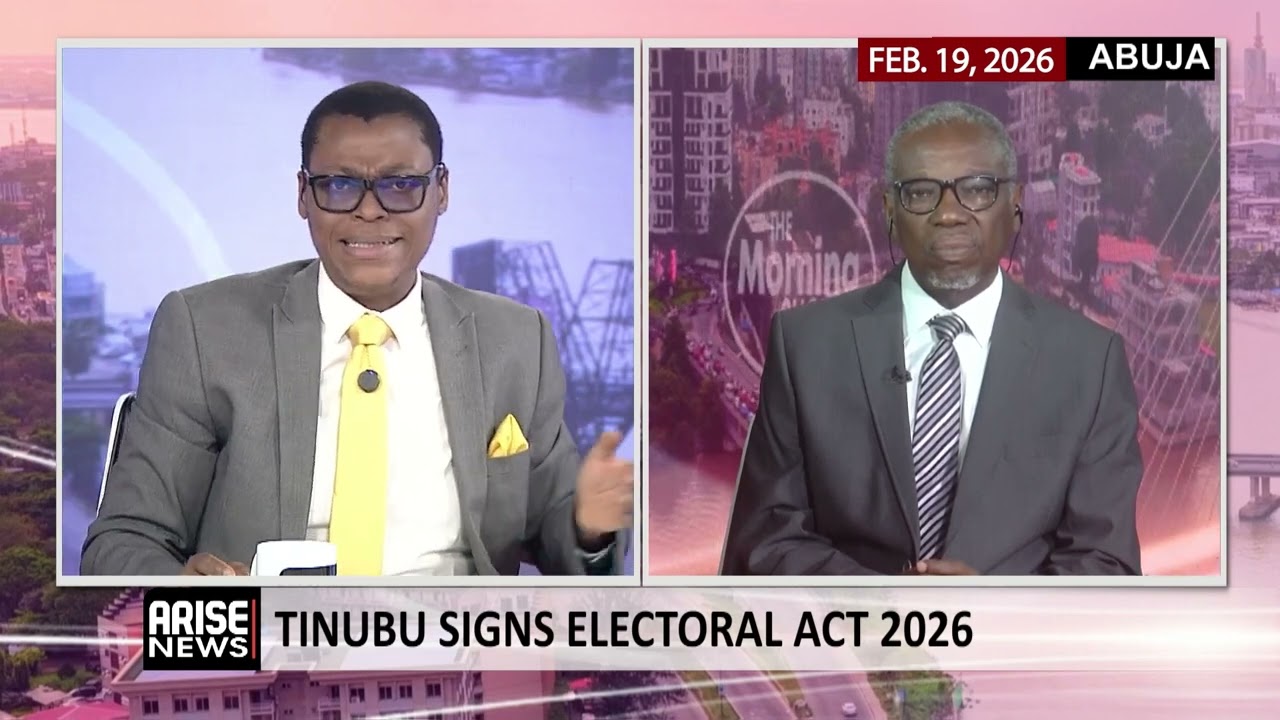
Former INEC Voter Of Education, Oluwole Osaze-Uzzi emphasisied that Nigeria’s newly passed Electoral Act 2026 has sparked concerns over operational readiness, potential election manipulation, and the safety of polling, stating that Analysts and former officials are questioning whether the law has addressed past challenges or simply repeats them under a new name.
In an interview with Arise News, Osaze-Uzzi warned that gaps in the legislation, rushed timelines, and inadequate preparation by the Independent National Electoral Commission (INEC) could jeopardise upcoming elections, highlighting historical weaknesses in election administration and expressed doubts about whether the commission can meet the new demands imposed by the law.
“Well, I can also agree more with my Commissioner, Mikey Guinea, because we have been in the trenches, we have done this whole thing before, we have been through this whole hog. And without wanting to be sounding like a prophet of doom, this is, I don’t want to come back in a year’s time and say, well, this is a chronicle of a story foretold. Sadly, we are going to be haunted by the ghosts of the past because there hasn’t been any significant change.”
Uzzi recalled previous election experiences where card readers often failed, and provisional incident forms became the norm. “So rather than disenfranchise any registered voter with a valid card, we said, fill the form, the incident form, and you are allowed to vote. Now that became the norm. That became the norm because people just ignored the card reader completely and then decided to use the provisional, decided to use that lacuna in the law.”
He warned that the reliance on electronic transmission could put polling officers at risk. “Otherwise, if an honest presiding officer tries to transmit and as it’s alleged to have happened in 2023, the signals are jammed or they change the code and he cannot transmit, people might, the community, people around there might pounce on him and say, no, you are being funny. His life, therefore, is actually at risk, his life and the life of all those young Nigerians that are put out on that patriotic duty to conduct the elections, they are now at risk.”
Uzzi said public expectations for the law remain low. “I don’t, my expectations and expectations of many Nigerians are not particularly high. The expectations are that if people would do the right things, but we don’t, we assume that because of our history, people may just not do the right thing. Some people may not do the right things, and because of that, there cannot be a different outcome. We still don’t know what happened in 2023 with the presidential results, the National Assembly was fairly okay with the presidential results, we still don’t know what happened. So, what kind of expectations? We don’t expect anything different than what happened in 2023, sad enough. Sadly, what we expect is lack of transparency, shenanigans, stealing elections, stealing votes.”
He criticised the speed at which the law was passed and questioned whether INEC could prepare in time. “I’m not part of INEC. I’m not part of the presidency, but let us look at the circumstantial evidence to draw certain conclusions. As for INEC, no, INEC could not have written guidelines for a law passed less than 24 hours ago. I don’t think we have that kind of efficiency. I’m not even too sure whether a certified copy of the law has been forwarded to INEC. I don’t know about that, and I’ll be very, very surprised because it must go through a process. It must go back to the National Assembly, and the clerk has to certify that what was transmitted to the president is the same thing as what he signed. So what was transmitted is now the law. He now certifies that and then presents it. That process, nobody, with the speed with which the president assented to that, I’m sure they can do that in 24 hours. Yes, the speed worried me. Some people might say it was undue haste. We want laws to be passed with some certainty, with some speed. But when it’s done, you make haste slowly. With the controversies that surrounded the passage of that bill, I thought the president should have referred that bill as passed, as harmonised, to his attorney-general. It is a very distinguished lawyer. He’s been involved in some of the most controversial, some of the most important pre-election and election petitions in this country. So well-versed. And I think the team in the Federal Ministry of Justice is well-grounded. I think they should have used the tools to go through that bill as passed before the presidential assent.”
Uzzi also highlighted the compressed funding and preparation timelines. “So one of the things that was raised is that the funding timeline has been reduced from 12 months to six months, and we have an election, a very important election to prosecute in January, now it seems, based on also the timetable of elections, so it’s even been brought back. Do you think that INEC would be ready enough to give Nigerians a free, fair, credible election based on this new legislature and based on the timeline, the limited now timeline that they have? They have thrown a big challenge to the commission, a really, really big challenge. We keep talking of a big election, general elections. Let’s not forget that we do have elections in a couple of days’ time. We have elections in the FCT, FCT Area Council elections, and usually they depend on the electoral act for that. So what law will be applied? Is it the 2022 law or the 2026 law? There’s a law in place now, 2026. So, for example, this transmission, I don’t know how prepared the commission is to deal with the new law. They have to study that law. It will take more than a couple of days to really study the law, to see the differences and the disparities between the 2022 act and the 2026 act. And I’m very worried about the efficiency of the commission, and especially regarding those timelines. For example, procurement. Procurement takes a process. And under the Procurement Act, not only must you have a budget for any budget head you wish to expend, but you must also have the funds in your possession. They should be in your account before you award a contract. So I see no rationale for reducing the one year in advance to the six months that the National Assembly did. That did not come from INEC. It was not. I saw some of the submissions presented by INEC to the National Assembly. The reduction in timelines was not part of it. So I don’t know why, in their wisdom, and whether they actually consulted with INEC to say this is what we intend to do. I, quite honestly, do not understand the logic.”
He noted confusion over which law applies in upcoming elections, particularly the Area Council elections in the Federal Capital Territory. “So, for example, this transmission, I don’t know how prepared the commission is to deal with the new law. They have to study that law. It will take more than a couple of days to really study the law, to see the differences and the disparities between the 2022 act and the 2026 act… The elections, the Area Council elections, municipal elections in the Federal Capital Territory will be a litmus test for the new law.”
Uzzi also analyzed the role and limitations of electronic transmission under the 2026 Act. “The first governorship widespread use of e-transmission and the IREV was done in, I think, the adult governorship election of 2020. So it has had a lot of practise. And the law still says you should transmit. The difference is it provides so that if you transmit and it fails, it does not get to the portal, then you are allowed to use the form. So I expect that it should be prepared. There should be no excuse to say that the law was only just passed.”
He explained that IREV is partially integrated and its limitations could create confusion. “IREV was not designed as part of the collation system. There’s a portal, all right, and the portal viewable from the back end by the collation officer, by the returning officer, by the INEC officials. Not to the public, but the INEC officials who first see it before it actually goes on to IREV. But it’s taken off by that ECAT manual transmission that has eroded against that IREV or the other portal. Collation portal as part of the collation system would have given us, would have benefited us.”
Uzzi concluded that the law gives with one hand but takes with the other. “The difference is it provides so that if you transmit and it fails, it does not get to the portal, then you are allowed to use the form. So I expect that it should be prepared. There should be no excuse to say that the law was only just passed. Because it’s still the same basic thing. The difference is that the law seemed to suggest, gave with the right hand, and that is that use e-transmission, now recognises e-transmission. But it’s taken with the left hand that in case that does not work, then this is a fallback position. So it has. It’s a veneer portal. So whatever is shown on the portal will not be mentioned. Whereas the law says the primary thing is from ECAT, manual collation. I haven’t seen what was signed by the president, so I’m circumspect about commenting too much about that.”
Erizia Rubyjeana
Follow us on:


