


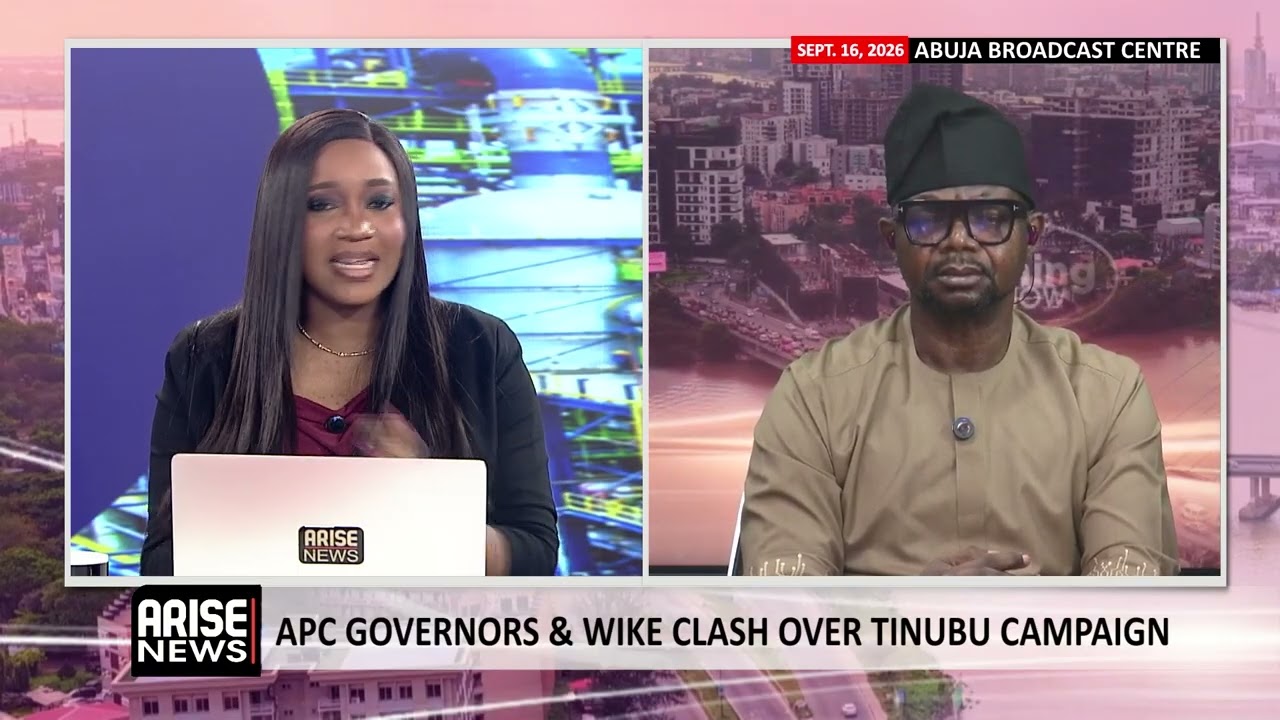
Ima Niboro, Spokesperson for the All Progressives Congress (APC) Presidential Campaign Council, has urged political leaders in the party to stop trading words and focus on building their political bases ahead of the 2027 elections.
Speaking during an interview with ARISE NEWS on Wednesday, Niboro said political leaders should spend less time on public exchanges and more time engaging voters directly in their communities, markets and streets.
“But if you are a political leader, stop talking, go and walk. That is my point.”
He said toning down the rhetoric does not mean political leaders should surrender their territories or stop defending their interests. “I’m not saying that let’s recede your territory to anybody. No, that’s not political. But if you are a political leader, stop talking, go and walk. That is my point.”
Niboro urged political leaders to establish stronger authority within their political bases and engage directly with voters. “Go and establish authority on your political base. That’s what you need to do. Get all the TV cameras, go to the people, go to the streets, go to the marketplaces, go and win the people.”
He criticised the public exchanges between the political camps, describing them as unproductive and unnecessary. “Stop all this high sounding grammar that is, they are blowing everywhere. It’s not leading anybody anywhere. Go and walk.”
His comments came amid disagreement between APC governors and political figures associated with the Rainbow Coalition over the group’s role in the 2027 presidential election. “I would prefer to take somewhat middle ground of all this because I consider these as quarrels among political siblings, quote-unquote. They are all working in the same direction, but there are differences in the details.”
He said APC governors had reasons to be concerned about state and local government elections, while other political actors were also concerned about their political interests.
“Because, yes, of course, you have these natural worries on both sides. APC governors naturally will worry that, OK, we are working for the president.”
“But then the PDP is fielding candidates against APC at the state level, at the local government level. And then you have Dike himself worried about his own stake in this, the whole calculation, the whole movement going forward.”
Niboro said the competing groups should work out a common strategy rather than allow their disagreements to dominate the political conversation. “So I think what we need to do is for everybody to put their heads together and work out a common direction, a common plan.”
He said the groups supporting President Bola Tinubu have one major point of agreement despite their differences. “Dr Nyesom Wike, the minister, he is of the PDP. Most of the men and the rest of them are of the APC. But they all agreed that President Bolot Sinubu must return in 2027.”
Niboro said the priority should therefore be to focus on securing the president’s re-election.
“So we need to find a way to tone down this rhetoric. We need to find a way to reduce this big battle that are flying from all directions and then walk in a specific direction, which is to re-elect the president. That is the most important assignment.”
He also rejected the description of APC governors as politically lazy, arguing that governors remain powerful political actors under Nigeria’s constitutional system. “If Wike, without due respect to him, his position and his experience as a two-term governor, if he says the governor is lazy, then was he lazy as governor of a state?”
“Governors are very, very powerful people. Governors are people who actually, because of the nature of our constitution, governors can sometimes really bring changes to even the centre.”
He said the criticism of APC governors was part of the heated rhetoric surrounding the dispute.
“So I do not consider anybody saying the APC governors are lazy. I don’t think so.”
Niboro also argued that the political situation facing Tinubu in 2027 is different from the circumstances of the 2023 election, pointing to what he described as the president’s work since taking office. “Sure, that was then. That was candidate Tinubu, but now this is president Tinubu, you understand, who has done substantial work, especially in the southeast. He has done quite a great number of interventions in the area.”
He said political leaders should therefore focus on the work needed to win support rather than continue with public exchanges. “And I think that it is not the candidate Tinubu of 2023 that is the candidate Tinubu of 2027. So again, I will say, let us tone down this rhetoric. It’s not leading anybody anywhere.”
On how Tinubu should manage the competing political blocs backing him, Niboro said the dispute was not necessarily a direct challenge to the president but required his attention as the leader of the political process. “I do not see it as a direct challenge to the president himself, beyond the fact that he’s a leader and it’s in his interest for him to maintain the peace.”
He said the tensions were already filtering down to state and local government politics, despite agreement on the presidential election. “The quarrel we are talking about is required as percolating down to states and local government areas. But both camps are agreed on re-electing the president.”
Niboro also drew a comparison with the PDP’s experience in power, warning that internal disagreements can turn a large political party against itself. “You know, we used to be in PDP. Sometimes a party gets so big, it becomes its own opposition.”
He recalled that internal divisions eventually led to breakaways from the PDP and contributed to the end of its period in government. “But PDP became its own opposition. That’s how you had the breakaways from PDP and all those issues that now led to the demise of PDP governance in this country.”
Niboro said such disputes are common within large political parties but must be managed. “So these are the issues that happen when you have big parties. It is inevitable. So they have to be managed.”
He expressed confidence that Tinubu has the political experience to manage the competing interests within the groups supporting his re-election. “And we have a leader who I think is competent enough to manage these things, and he will. Take my word for it.”
Erizia Rubyjeana
Follow us on:


