


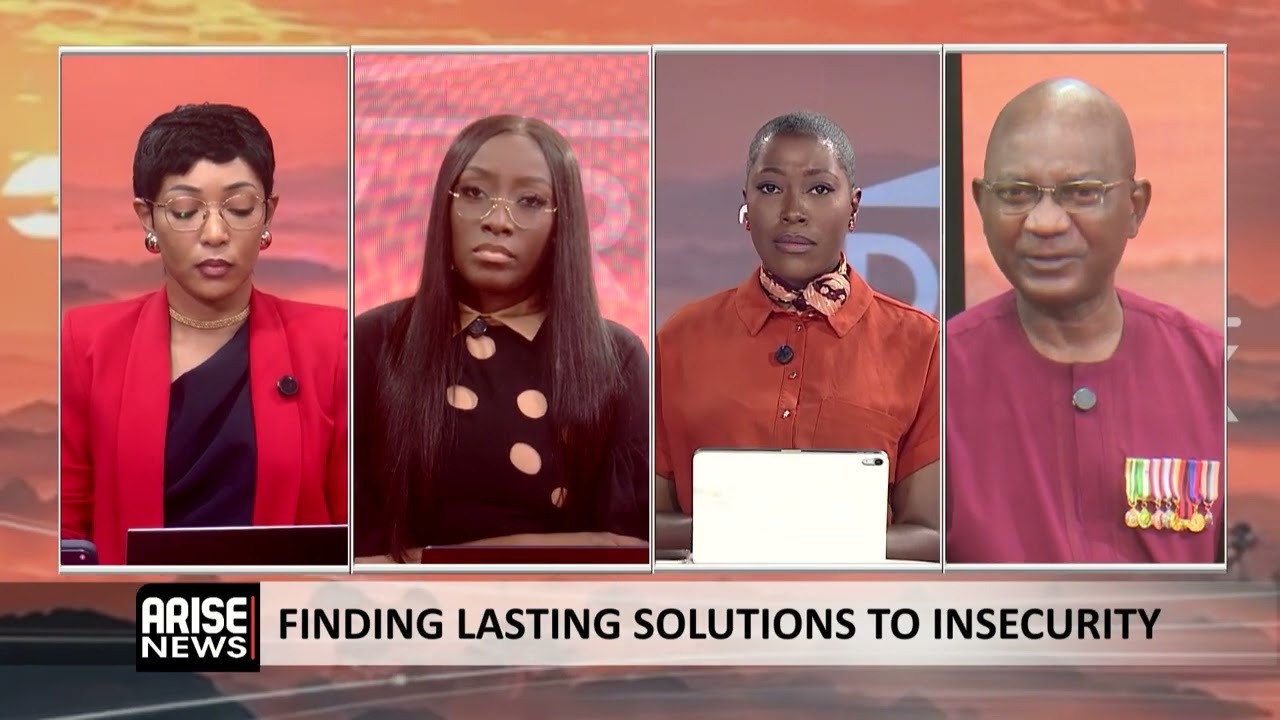
The former coordinator of the Defense Media Operations at the Defense Headquarters, also a former Director of Defense Information, and a senior officer of the Nigerian Army, Major General John Enenche, (Retired), has raised fresh concerns over Nigeria’s worsening security situation, describing the country’s current state of insecurity as a “super emergency” that has been building up over the years.
Speaking during an interview with ARISE NEWS on Tuesday, General Enenche said Nigeria’s security challenges did not emerge suddenly but have evolved over time due to inadequate proactive measures, warning that the escalating wave of banditry, kidnappings and violent attacks across different regions signals a crisis that has reached a critical stage.
“Yes, we are facing a national security emergency. But as it is now, reflecting through to the past, I think it’s an understatement to say we are facing a national security emergency. It has been an emergency, I think, for long but underplayed. What we are seeing now, to me, is an escalation because of not being proactive, as it were, as it’s supposed to be, or what was supposed to be up till now. So, for us to begin to say we are facing an emergency now is like we are forgetting about the buildup of the various situations across the nation—from the Northwest, Northeast.
“Of course, I want to remind us that this what we are seeing in the Southwest now didn’t use to be like this in the last ten years, five years, even as recent as three years. So, how can we now come and say we are experiencing—no. It is not an emergency in the strict sense of it. It’s a super emergency,” he insisted.
Responding to concerns over the recurring mass abductions across the country, General Enenche argued that the problem is not necessarily a complete failure of intelligence but rather the inability to act decisively on available information.
“From my experience in the sector, because I was at the management level when I was in active service at the Defense Headquarters, interfacing, talking with commanders in the field, getting intelligence back, and all that, I will not say that it is strictly a failure of intelligence. Because some of the times—most of those times—they will even give information that these people are coming, and they will still come.
“Why are we not able to stop them? Why can’t we stop them? Because we are at the level that we were three or four years ago. And now, we are supposed to upgrade the standard of our intelligence monitoring, information gathering, beyond what we have now. And that is why, for those of us who are retired and outside, still fighting, working for this country, all we need to do is to have a blanket of information confirmation, information gathering, than what we have now. So, what I have seen is that clearly, we have to go beyond what we have now as per intelligence gathering and monitoring to stop them,” he advised.
Acknowledging that internal sabotage exists within many organisations, including security institutions, General Enenche said the challenge is neither unique to Nigeria nor easy to eliminate. He stressed that while infiltrators and collaborators may be difficult to identify, the solution lies in strengthening intelligence operations, enhancing surveillance capabilities and ensuring security agencies remain a step ahead of criminal networks and other threats.
“Internal sabotage will always be there; it has always been there, even from creation. Let us not deceive ourselves; they will always be there. But it’s difficult to pin them down, to say this is it. But what we need to do is that we have to, like I said, up our game to beat them to it, and we can do it,” he maintained.
Highlighting the growing threat posed by internal sabotage, Gen. Enenche said the issue can no longer be ignored and requires urgent attention from military leadership and relevant security agencies.
“No, we cannot sweep it under the carpet. And that is why we must all sit up, right from the various services. Right from the various chiefs, right to the branches that are responsible. It is a reality that is facing us squarely now. We cannot run away from it because, like I’ve already illustrated, it has been there, it will always be there, whether we like it or not.
“And that is why we do what is called war gaming, scenario painting, to be countering them. And that is what we are doing, as I speak with you, I’m appealing, reaching out to the various service chiefs, the appropriate superior authorities, on things that we have in place to be countering these attacks.”
He also cautioned against blaming security challenges solely on changes in military leadership, arguing instead for a comprehensive review of existing strategies, the adoption of more effective approaches capable of reversing the current trend.
“So, we have it, and that is why I’m happy because people may be thinking the service chiefs are not working. I can tell you, if you change service chiefs every six months, every one year, it is not the solution at all. I don’t joke with security at all. And I encourage every other person to do that. So, what we are doing is that we must, as a matter of fact, take it seriously. It is not beyond what we should do, because if we don’t act now, it will continue and be rolling over. They will say from this administration to another, and that must stop,” he urged.
Expressing strong support for the establishment of state police, Enenche described it as one of the practical measures needed to tackle Nigeria’s security challenges.
“It is one of the solutions, and I support it. I am an advocate of state policing,” he stressed.
Drawing from research he conducted at the National Defense College, he argued that a properly funded, trained and managed state policing system would strengthen grassroots security, improve response times and reduce the operational burden currently placed on federal security agencies.
“I wrote my paper—term paper—at the National Defense College several years ago, around 2011, for my master’s degree, and I proposed it. Because I did the research. And now, it is going to help because that is a good level. If you talk about state policing now, you are now reducing the burden on the military—the Army particularly—down to the police to take their responsibility.
“State policing is good if it is well-funded, well-managed, and well-trained. And I support it because it’s going to help in reducing the workload, the pressure on the Army, the Civil Defense, and all the other security agencies,” he added.
Referencing remarks by former Chief of Army Staff General Tukur Buratai, Enenche said security forces possess significant knowledge of the threats confronting the country but are often constrained by operational challenges, resource gaps and limitations in intelligence capabilities. According to him, security agencies must be adequately equipped and empowered to identify, track and neutralise criminal elements before they strike, while also addressing institutional shortcomings that hinder effective responses to security threats.
“General Buratai (Retired) is my boss in every ramification. I look up to him, and I will make a reference. He told us long ago that if we don’t tackle this issue, it will take us over 20 years.
“We talk about equipment. Now, the worst of all is that, like the intelligence system that we use—like if I say we know where they are—these people, we have gone above the level of facing them one-on-one with weapons. No, we need to tackle them from the air. Not even the Air Force type of thing I’m talking about now. We need to geolocate them. We need to go to those locations and remove them. When we know where they are, let us now empower, equip ourselves.
“The Nigerian army knows where these people are. Of course! Why won’t you know? And then we have detectors—heat detectors—and know where they are. Let us eliminate them. The elimination now, sometimes we are constrained almost by political decisions and all that. They say ‘collateral damage.’
“So, if now the army, the military may be constrained—I use probability because when you want to go, they say don’t go and all that. What about the equipment? What about the table of our equipment, state of readiness? What is the standard of the army? What is our strength? What is the strength of the army? Is it rational to the space we have? That is why we have come in now. And if we can be consulted, superior security services, we come up, work together them,” he said.
Critiquing calls for auditing military expenditure, General Enenche questioned the practicality of scrutinising certain operational funds such as ration cash allowances, which are directly disbursed to troops in the field. He argued that such demands often fail to consider the realities of military operations, where frontline commanders manage funds in fluid and high-risk environments without conventional documentation systems.
“Now, the people that are saying you go and audit military spending, I also want to ask them: can you audit ration cash allowance? What is ration cash allowance? That is the bulk money a commander will carry and be giving troops. Their 1,500 Naira, which we have now increased to 3,000 Naira. How do you audit that? Where do you get the receipts for that? So, for me, it’s an ingratitude to say you call service chiefs or the people to start auditing,” he said.
According to him, while accountability is important, some aspects of military spending cannot be treated like standard civilian financial audits due to the nature of combat operations and immediate troop welfare needs.
“I don’t support that at all. It is, it is a talk without the knowledge and without the, the idea of how it works. If you don’t know how it works, let them go meet the service receptors, and then let them educate them on how, how our accounting works. If you want to audit other things, good and fine. But to tell us to say auditing them is out of the way. There is nowhere in the world where you audit military expenditure. No,” he insisted.
General Enenche further said the federal government has taken major steps on insecurity, including declaring a state of emergency, and that responsibility now lies with all stakeholders to intensify action against criminal groups. He stressed the need to go beyond current methods by adopting more advanced, technology-driven intelligence and surveillance systems, with stronger coordination and improved operational capacity to effectively tackle Nigeria’s security challenges.
“I don’t think the apex government has avoided any major decision. But now in the whole country—what else do we need? What else do you expect the Commander-in-Chief to do, or the apex government? And then they, I think to an extent, the National Assembly is supporting it. So, that, for them, it is no longer in their court.
“The Commander-in-Chief cannot go down to become a foot soldier. No. And whatever other person in the National Assembly, they have done that. And I believe that some state governments have done that.
“So, for me, the ball is left in the court of all of us who are involved now. I can’t say I’m retired, so I’m going to relax. Now, like I said, in summary, we need to go up higher than what we are doing. Let us go into space, locate them, put all our stations, which we have a robust plan to cover the whole nation,” he urged.
Favour Odima
Follow us on:


, says Nigeria’s insecurity has worsened through years of inaction, describing the situation as a super emergency.</p>
)