


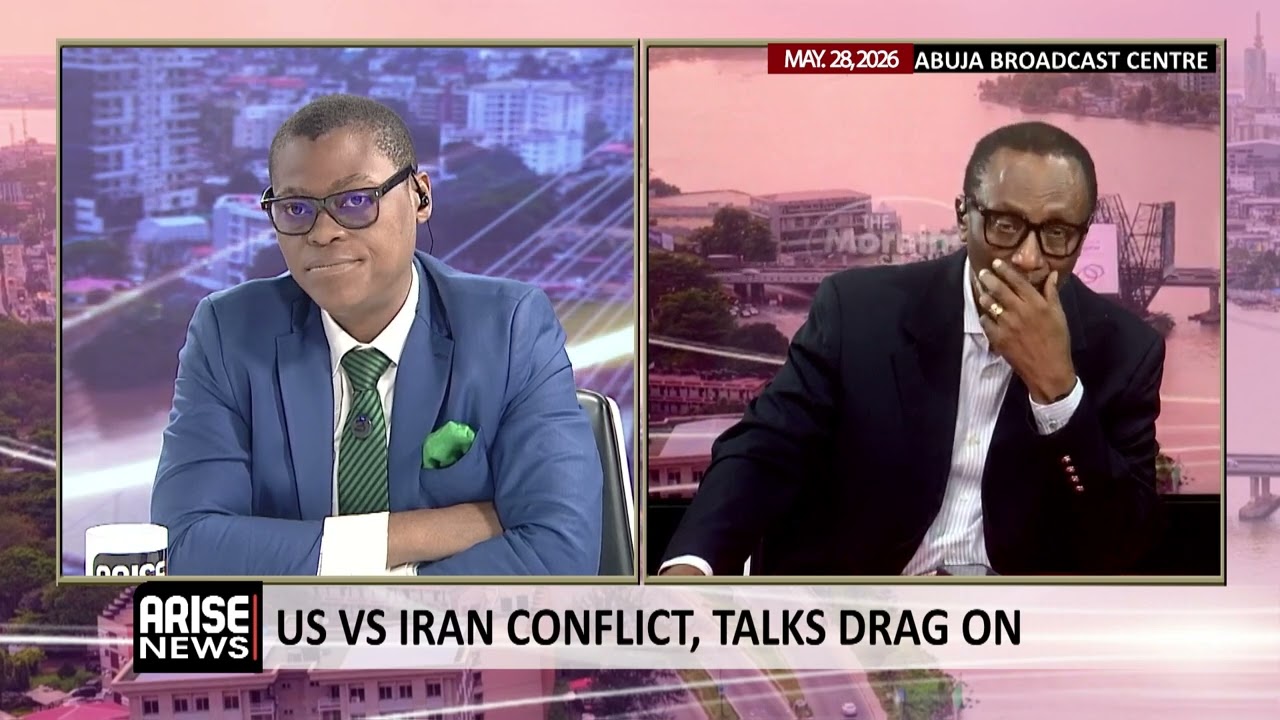
Former Nigerian diplomat, Joe Keshi, has called for a comprehensive and lasting peace agreement in the Middle East, warning that recurring ceasefires without addressing core issues will only prolong instability in the region.
Speaking in an interview with ARISE News on Thursday, Keshi said diplomacy remains the only viable pathway to resolving global conflicts, stressing that even wars in history ultimately end at the negotiating table.
“I also remember I told you that we still do not have an alternative to diplomacy. All wars all over history, even when someone has been vanquished, they’ve always ended up in the negotiating table to sign an agreement, a peace agreement that defined the terms of the peace that has been won or lost,” he said.
He argued that the current tensions in the Middle East reflect the difficulty of defining what constitutes victory for either side, adding that diplomatic language must evolve to accommodate mutual acceptability.
“I just think that the same situation will continue as long as both sides remain committed to diplomacy. I think the only problem really is that they’ve not been able to find words or sentences that will give or do not term somebody come of victory,” Keshi said.
The former diplomat noted that recent geopolitical developments show attempts to narrow the conflict towards more immediate priorities, including global trade stability and economic recovery.
“At the end of the day… they’ve decided to isolate and solve perhaps the easiest of the challenges that ensure that the portal for most is opened and our global trade is restored and then things can again economically go back to normal around the world,” he said.
Keshi further argued that diplomacy is not failing, but struggling to produce language that satisfies all sides, including political expectations in Washington.
“Diplomacy does not have a challenge in finding ways that are suitable to both sides. But I think that the problem is finding something that will be pleasing to Donald Trump and that he can sell to them that he has achieved something,” he said.
On the broader Middle East crisis, Keshi warned that the region is missing an opportunity to pursue a permanent settlement anchored on both security guarantees for Israel and statehood for Palestinians.
“I personally think that the Arab states or the Arab world itself, and in fact the Middle East, is losing a golden opportunity to find a lasting solution to the crisis in the Middle East,” he said.
He added that the Palestinian question remains central to any sustainable peace framework.
“At the heart of the Middle East crisis is the Palestinian question… let’s have the comprehensive peace that guarantees the security of Israel and gives a homeland to the people of Palestine,” Keshi said.
According to him, failure to address the issue comprehensively will only perpetuate cycles of violence.
“There will be no need for Hezbollah to be striking Israel… gradually all of this will disappear,” he added.
Keshi also warned that partial agreements driven by fear or narrow interests would not resolve the underlying conflict.
“Because of the fear of Iran, the selfishness or self-interest of the Arab states, they have insisted on making this little peace agreement rather than go for the bigger one that will guarantee lasting peace in the Middle East,” he said.
Responding to questions on the feasibility of broader regional frameworks such as the Abraham Accords, Keshi argued that external pressure and domestic political considerations are shaping diplomatic calculations.
“Donald Trump is looking for how to get out of this war. It’s very easy to start a war, but very difficult to get out in situations like this,” he said.
He added that domestic political dynamics in the United States also influence foreign policy decisions.
“He’s under pressure left and right in the United States today… the truth of the matter is that he does,” Keshi said.
On Iran’s role in ongoing negotiations, Keshi noted that even military escalation would not eliminate the country’s long-term presence in regional politics.
“The reality of where we are today is that yes, you might succeed as it is today to decapitate the capacity of Iran to respond. But another reality is that Iran is not going to disappear from the surface of the earth,” he said.
He cautioned that leaders must choose between continued conflict and negotiated settlement.
“A time comes in the life of nations where they have to buy the bullets to make peace or to continue in war,” Keshi said.
Keshi concluded by urging global actors to seize what he described as a critical opportunity to push for a durable settlement in the Middle East.
“The world has an opportunity to compel the antagonists to move towards finding a lasting solution to the Middle East crisis… it is an opportunity that they should explore,” he said.
Boluwatife Enome
Follow us on:


