


Former Lagos State Governor Babatunde Fashola has said President Bola Tinubu does not own Alpha Beta Consulting to the best of his knowledge, dismissing longstanding allegations surrounding the company as claims that should be supported by evidence.
Speaking in an exclusive interview with ARISE News, Fashola also defended Alpha Beta’s role as a revenue consultant to the Lagos State Government, saying the company introduced technology and systems that helped the state improve tax collection and tackle revenue leakages.
Asked directly about allegations that Tinubu owns Alpha Beta, Fashola said allegations should not be treated as established facts without evidence.
“Our problem…like many allegations, talk is often cheap,” he said.
“When you ask people to give you the evidence…”
When the question was put to him directly: “The President does not own Alpha Beta?”
“Not to my knowledge,” Fashola replied.
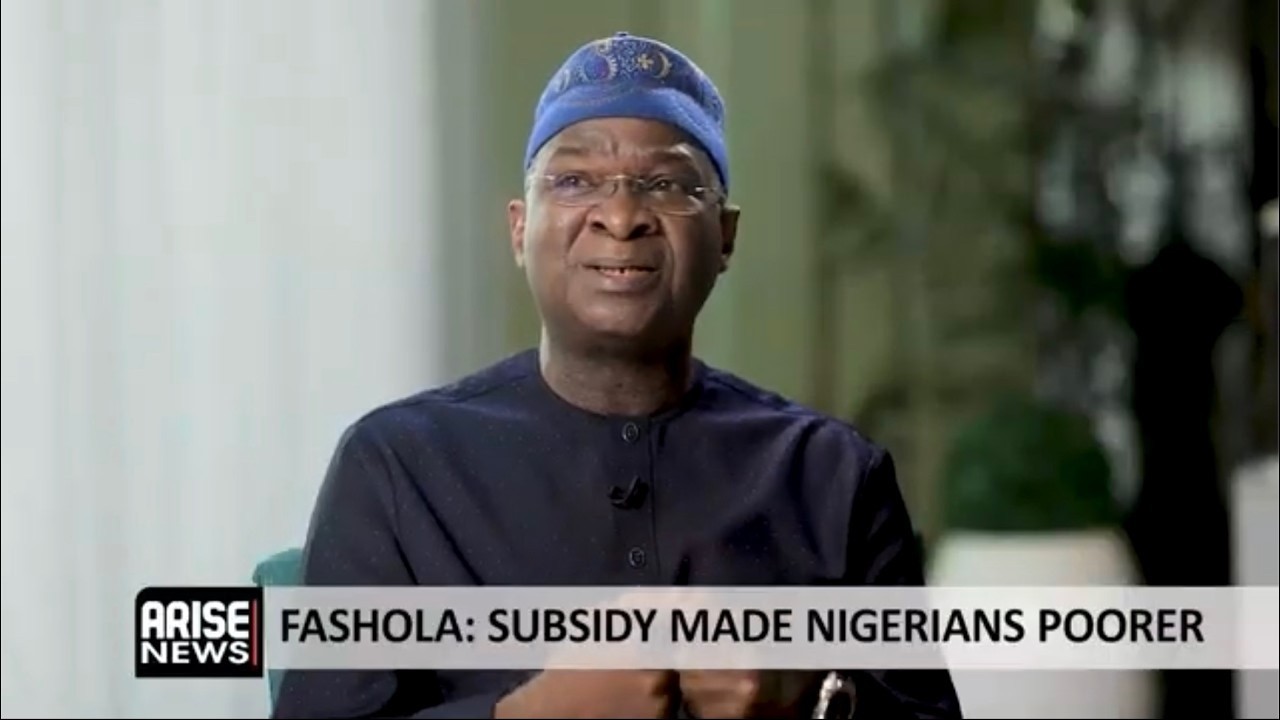
Fashola said Alpha Beta’s involvement in Lagos revenue collection emerged from weaknesses in the state’s ability to assess and monitor its revenues.
“The problem of revenue collection is assessment,” he said.
“At the time, the state didn’t know what the daily balances across banks were. That’s where it started from.”
He said the state also faced problems with fraudulent tax receipts, creating opportunities for revenue that should have reached government coffers to be diverted.
According to Fashola, Alpha Beta responded by regularly changing receipts to stay ahead of fraudsters while deploying technology and personnel to improve revenue administration.
“That company, Alpha Beta, used to change receipts every three months to keep ahead of the fraudsters and take them out of business,” he said.
“It had its own staff helping to do that. It deployed electronic and digital tax tools… and it brought technology.”
Fashola said the company also employed personnel and operated actively as a consultant while Lagos State’s internally generated revenue increased.
“It employed people. And our revenue was going up. It was active as a consultant,” he said.
The former governor linked those revenue reforms to Lagos State’s expanding capacity to finance development, saying revenue had increased significantly by the time Tinubu left office and he succeeded him as governor.
Fashola also spoke about the Lagos-Calabar Coastal Highway, defending the wider economic case for infrastructure while declining to endorse aspects of the project’s procurement process without having the relevant information.
Asked about controversies surrounding the award of the contract, including questions over the procurement process, Fashola said those questions remained legitimate and should be answered by the Minister of Works, David Umahi.
“I don’t have the facts to even comment,” he said.
“If I don’t have the facts on the matter, it’s grossly irresponsible to attempt to express an opinion on the facts that you don’t have.”
But Fashola said he could speak about the economic effects he had personally examined.
He said a survey he commissioned along the coastal highway indicated that property values had appreciated, creating economic value for landowners along the corridor.
Fashola also pointed to his own experience travelling towards the Lekki port area, saying a journey that previously exceeded an hour had fallen to approximately 40 minutes.
“Whilst all the questions you have about procurement remain legitimate for the minister to answer, the impact in travel time, cost of petroleum products consumed, savings into the citizens’ pockets, I can tell you about that, because I speak factually,” he said.
Fashola said the economic impact of major infrastructure projects extended beyond motorists and property owners to contractors, truck drivers, suppliers and other small businesses participating in construction.
He said that while serving as works minister, he was interested in measuring how many trucks were contracted to transport construction materials, how many drivers were employed, how much diesel construction sites consumed and which businesses supplied those operations.
“Those are the small businesses we keep talking about, but that is what puts food,” he said.
For Fashola, such activity demonstrated why infrastructure spending could transmit public resources through the wider economy.
“Infrastructure is the most legitimate way by which a government distributes money,” he said.
Demola Ojo
Follow us on:


