


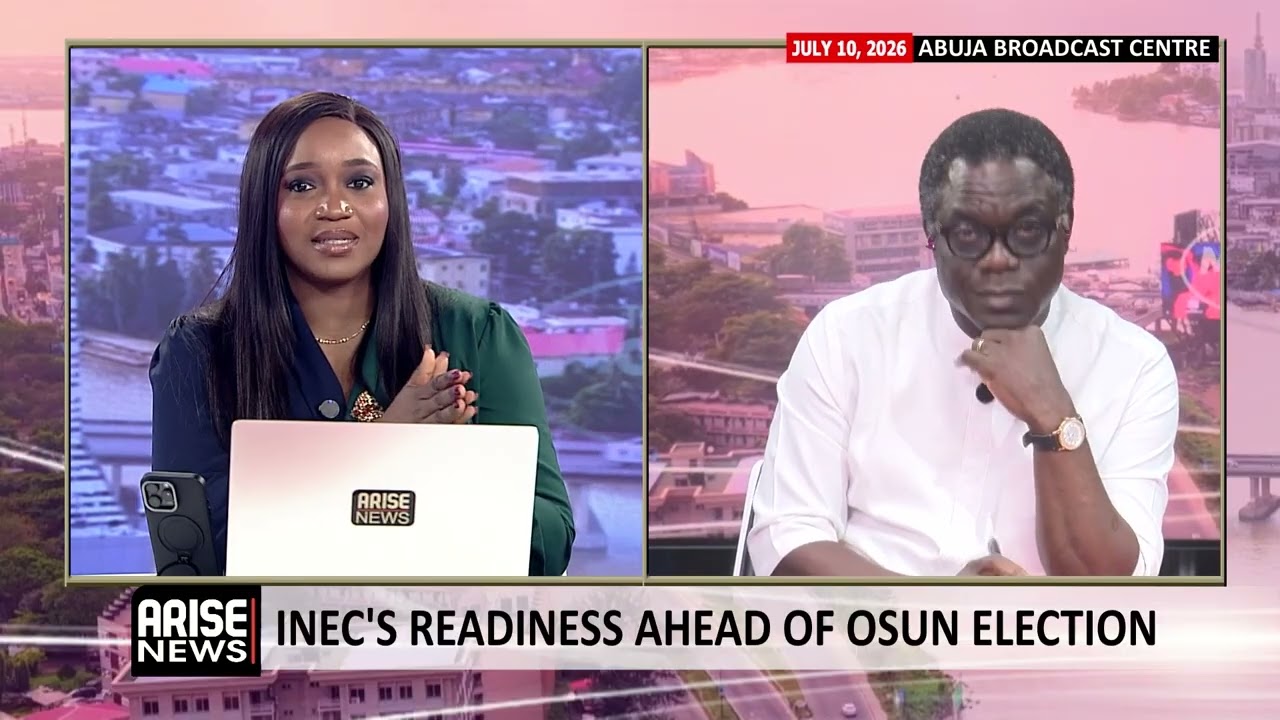
Director of Information and Communication Technology (ICT), Independent National Electoral Commission (INEC), Dr. Lawrence Bayode, has defended the security of its Bimodal Voter Accreditation System (BVAS), saying additional security measures have been deployed to protect the election technology despite concerns over the device’s Android operating system.
Speaking in an interview with ARISE NEWS on Monday, Bayode said the BVAS devices currently operate on Android version 10, the same version deployed when the machines were procured in 2021, but stressed that INEC was not depending solely on the security features of the operating system to protect the system ahead of elections.
“We are not relying solely on the security of the operating system. We’re also deploying our own security on the BVAS that ensures that our BVAS is secured.”
Bayode responding to concerns raised over the operating system used by BVAS following observations from civil society organisation. “It is currently running on Android version 10. And that was the version that it was deployed with when we first procured the BVAS. So, our BVAS has never run on Android 3, 2, 6 or 7. It is currently running on Android version 10.”
Bayode acknowledged that the BVAS machines were deployed with Android version 10, but dismissed concerns that the operating system was exposing the technology to security risks. “Apart from the security that came with Android 10, we are also deploying our own security to secure the BVAS system. Apart from the security that comes with that version.”
He explained that upgrading the BVAS operating system was not a simple process, as moving to a newer Android version would require significant adjustments to other components of the devices, including hardware upgrades.
“It’s not just easy for us to begin to upgrade from the version that we deployed on the BVAS when they were first procured in 2021. Yes, we procured those BVAS with Android version 10. And you know, the specification then was for you to run on Android version 10. And at the time, we were comfortable with that version.”
Bayode said upgrading the operating system would require changes to the devices’ capacity to avoid affecting their performance. “So, if you want to upgrade now to a higher version, then a lot of things, it means that you have to upgrade a lot of things. You have to upgrade the RAM. You have to upgrade a lot of things so that it does not slow down the system.”
The INEC official also clarified that the BVAS machines had never operated on older Android versions, stating that the devices had always remained on Android 10 since deployment.
“It is currently running on Android version 10. And that was the version that it was deployed with when we first procured the BVAS. Our BVAS has never run on Android 3, 2, 6 or 7. It is currently running on Android version 10.”
He said the challenge experienced during the exercise was caused by the facial recognition similarity threshold used for some voters whose registration data had not been revalidated, rather than a failure of the BVAS technology.
“The mock did not fail. What happened on that day was a threshold. The similarity score of those who registered or who received their BVAS in 2011, the similarity score was the threshold
that we said was too high for them.”
Bayode explained that the exercise was designed to collect data and allow INEC to adjust the system before election day. “We needed data to ensure that we set the correct threshold so that nobody will bring, for example, your PVC and the system will just accredit there. Nobody will bring my PVC and the system we’re accrediting.”
According to him, once the necessary adjustments were made, the system continued to function properly during the mock exercise.
“As soon as that was achieved, we pushed it to the system on that day, and the exercise continued seamlessly.”
Bayode further assured Nigerians that the two major applications used on the BVAS devices voter accreditation and result uploading were functioning properly. “The two key application runs on this system, the BVAS on election day, the accreditation system that is used to accredit voters and the app that is used to upload results to the IREV. They’re working fine.”
He maintained that the mock accreditation exercise achieved its purpose by helping the Commission identify and correct issues before actual elections. “The mock did not fail. It worked fine. And that is what is expected when you carry out a mock exercise. You are carrying out a mock exercise to test the system, preparing it for the day of election.”
Erizia Rubyjeana
Follow us on:


