


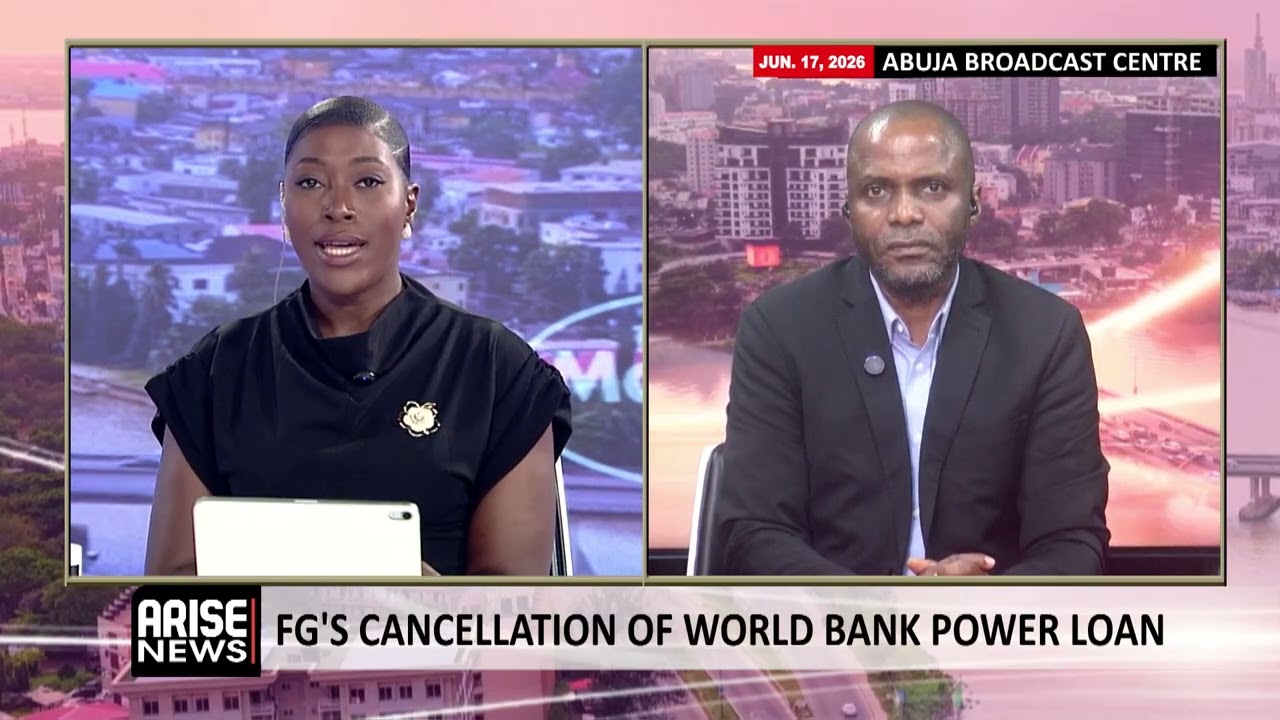
Energy Expert, Nick Agule has blamed Nigeria’s persistent electricity crisis and the collapse of a $750 million World Bank power sector loan on what he described as incompetent operators running the country’s electricity value chain, urging President Bola Tinubu to intervene decisively.
Speaking in an Interview with ARISE NEWS on Wednesday, Agule said that the cancellation of the second tranche of the World Bank-assisted Power Sector Recovery Operation (PSRO), a programme designed to improve efficiency, boost collections and reduce deficits in Nigeria’s electricity sector.
“The power sector is in the hands of incompetent operators. Look, as we speak today, I heard you were talking about the telecoms who are now trying to switch to renewable for power. Nobody has launched a presidential programme to help the telecoms deliver services. Nobody has launched a presidential programme to help Dangote Refinery deliver petrol. Businesses source for funding, and they deliver their businesses and make money. The power sector operators are incompetent, they are not able to do this.”
He said the cancellation of the World Bank facility was a major setback. “The cancellation of the World Bank facility was a major setback for a sector that remains deeply troubled, noting that the challenges, go beyond financing.”
According to him, the PSRO was initially launched in 2020 with a $750 million facility and later expanded with another $750 million tranche in 2023. “The PSRO was a World Bank-assisted programme signed in 2020 worth $750 million, second $750 million tranche was signed in 2023, bringing it to about $1.52 billion and the goal was improving efficiency, collections, and reducing deficite but it ran into problems due to forex devaluation and rising costs which led to doubts about viability and eventually cancellation.”
Agule explained that the second tranche became difficult to sustain following the naira devaluation and foreign exchange reforms. “With the deregulation or the unification of the forex market, the foreign exchange jumped from 460 Naira to $1 to over 1,000. It’s 1,300 now. So that automatically increased the cost of generating power.”
He said the resulting increase in costs and mounting deficits raised concerns about the viability of the programme. “The deficits continue to mount, and then collections were not improving. So the World Bank was asking questions about the viability of this second tranche.”
While acknowledging the impact of the loan cancellation, Agule argued that the deeper problem lies in the structure of the electricity market and the performance of power sector operators. “The real issue here is that why would the World Bank in the first place come to support businesses to do their business?”
He questioned why electricity distribution companies continue to rely on government-backed interventions. “Imagine a business like disco. You need World Bank to come and buy metre for your customers. You need World Bank to come and buy transformers. You know, how can you be a proper business?”
Agule specifically blamed electricity distribution companies for the liquidity crisis in the sector. “The discos are the ones that are causing all of the problems. Why? Because they are the ones that sell the power, they are the ones that make the money. So if they don’t make enough money, then transmission doesn’t get funded, the genkos don’t get funded, and that’s why they can’t pay for gas.”
He called on President Tinubu to take decisive action against underperforming operators. “For me, the president should just go and remove the cancer. What is the cancer here? The cancer is that the power sector is in the hands of incompetent operators.”
Agule called for a review of the 2013 power sector privatisation programme. “So for me, that 2013 privatisation needs to be revisited.”
On the issue of gas supply, He argued that Nigeria should not be experiencing shortages. “It is terrible for us to be discussing gas shortage to the generating companies, because Nigeria is a gas nation.”
Agule emphasised that government action could quickly address the challenge by compelling producers to harness gas currently being flared. “If Nigeria says you are an oil company, we are no longer taking money from you to flare gas. If you ever produce gas, you need to package this gas and inject it in our economy. That will solve the gas problem.”
He argued that the country’s electricity pricing challenges are being worsened by low output despite installed generation capacity.
“You have a 13,000 megawatt capacity. By the time you sell the power to obtain money, you are selling barely 3,000.”
According to him, consumers are being forced to bear higher tariffs because available capacity is not being fully utilised.
“At the end of the day, that’s what we are paying and we are not seeing the power.”
Agule expressed support for the decentralisation of electricity regulation under the Electricity Act. “What the states need is to domesticate the Electricity Act, set up a strong regulatory and competent regulatory regime, create an enabling environment for the private sector to come in.”
He added that power remains a profitable business and that competent operators would be able to generate. “Power is a profitable business, especially in a country of 200 million people who need power.”
Agule warned that unless government addresses the quality of operators managing the sector. “If we don’t go back and improve them and replace them with competent operators, we can continue to do these presidential power sector initiatives. We can continue to do these World Bank projects. It’s not going to really resolve anything.”
He concluded by insisting that meaningful reform would remain elusive without fundamental. “Until President Tinubu deals with the operators, I don’t think we are going to make any way forward.”
Erizia Rubyjeana
Follow us on:


