


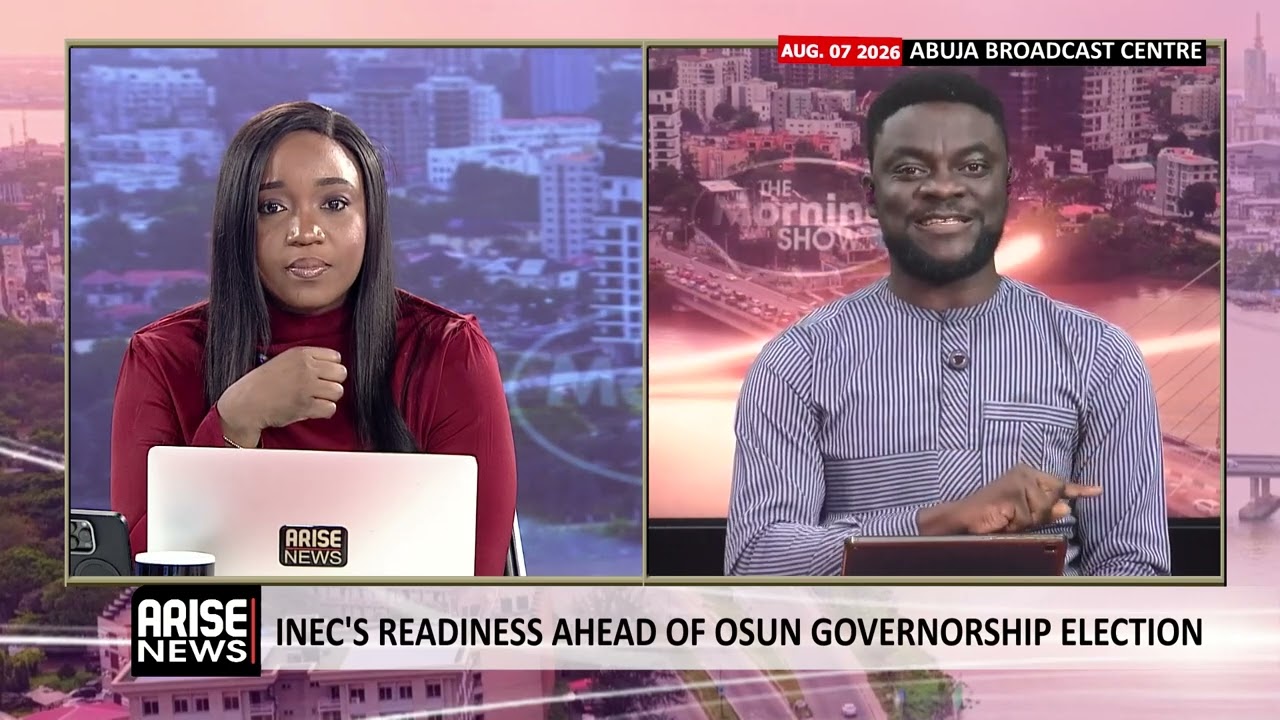
Head of Research and Strategy, Kimpact Development Initiative, Oluwafemi Adebayo, has raised concerns over the readiness of the Independent National Electoral Commission (INEC) for the Osun State governorship election, questioning the operating system powering its Bimodal Voter Accreditation System (BIVAS) and calling for an independent audit of the accreditation process.
Speaking in an interview with ARISE NEWS on Friday, Adebayo said the problems recorded during the August 1 mock accreditation exercise raised questions that could not be adequately addressed by INEC’s explanation that old Permanent Voter Cards were responsible for some of the failures.
“It then caused a question about actually the operating system that BIVAS is running on, which is a major concern.”
He said Kimpact’s concerns were heightened by the possibility that BIVAS could be operating on an outdated Android system, although he stressed that the organisation had not independently confirmed the exact operating system. “But if you look at everything that is available in INEC document, one of the things that is pointing about is that BIVAS may likely, some people said, because we asked for workers that BIVAS is operating between OS, Android version between two and three. But I don’t want to agree with that. I don’t want to believe that.”
Adebayo said an analysis of screenshots of BIVAS contained in INEC’s official documents suggested that the device could be running on an older Android version. “If you look at the customisation from even the icon, the layout, if you look at some of the widget, if you look at some of the iconography on BIVAS, it is leaning towards BIVAS may be operating between Android six, Android seven or Android seven, version seven.”
He noted that Android 6 and 7 were released several years ago and questioned whether security updates were still available for an operating system of that age. “And if you look at the timeline from that time to now, that’s about 10, 11 years. And I don’t know of any known Android version that security patches were released beyond five or seven years.”
According to Adebayo, the age of the operating system could have implications for how efficiently and securely BIVAS processes voter information. “It then caused a question about actually the operating system that BIVAS is running on, which is a major concern because if we’re still running on Android six or Android seven with BIVAS, then it’s a concern about how processing are done accurately, smartly with BIVAS.”
He also questioned whether BIVAS has the necessary biometric processing hardware to complement its fingerprint sensor and ensure faster and more reliable accreditation.
“We’re also not sure if BIVAS has that component because that is what also increases the reliability, the smartness, and now processing is done pretty fast, right?”
Adebayo said the relationship between the operating system, hardware and software used by BIVAS also required closer scrutiny. “The problem again would be, or could be rather, or may have been the fact that the process of retrieving the data from beavers, which is still a conversation of also software now, the software being used, is it compatible with the Android version that is also there, knowing fully well that beavers may be running on a lower Android version, and if you have a software that was built and designed actually for a higher version, that might be a problem.”
He called for an independent audit of the accreditation process to establish what caused the problems witnessed during the mock exercise. “INEC needs to, I mean, if they’ve not done that, there should be an independent audit into that process, and to be able to do what it is, and also explain to Nigerians what exactly to be, that they should expect.”
Adebayo also rejected what he described as an incomplete explanation of the mock accreditation problems, saying INEC needed to provide Nigerians with a fuller account of what happened. “But I think the question and the thought for me is that there should be a thorough explanation about what happened, because PVC explanation is not sufficient to explain whatever happened.”
He said INEC also needed to clarify the role of the Permanent Voter Card in the accreditation process, noting that the commission’s guidelines provide different means of identifying voters.
“And also, INEC needs to really clarify the role of permanent voters card in accreditation process.”
According to Adebayo, voters can be identified through their surname, the last six digits of their voter identification number and the QR code on the back of the PVC. “One of the things that we now saw is that, number one, there are three ways, major ways, at which you can actually identify the voter. And one of the things is, number one, the surname of the voter, the last six digits of the voter identification number, which is popularly called name, and the last aspect, which is written inside that manual is that BIVAS can also scan the QR code at the back of the PVC.”
He said the concern over BIVAS was not limited to Osun, as similar difficulties had previously been recorded in other off-cycle governorship elections. “And this issue of aged voter, elderly, not being accredited easily, didn’t start in Osun. There were cases of that in Anambra. There were cases of that in a particular area in actually Ondo State.”
Adebayo warned that problems encountered in individual off-cycle elections could become significantly more difficult to manage during the 2027 general election because of the much larger number of polling units. “But we’re entering into 2027 where polling unit is over 176,000 plus. And I think it’s important for INEC to be able to prepare adequately for that.”
He said INEC should begin discussions on upgrading or replacing BIVAS ahead of the 2027 election rather than waiting until technical problems become widespread. “So the basic thing I’m just saying is that if INEC needs to procure, I mean, it’s important to start talking about that now.”
He added that any upgrade would have to consider compatibility between the device hardware and its operating system. “If the operating system you’re running on a device, if it’s not compatible with the hardware, there will be problem.”
Adebayo also urged INEC to be open about the technology it is using, saying voters deserve to know the operating system on which BIVAS operates. “I think what is important is that INEC needs to also be open and transparent to also, you know, talk about the state of the operating system of BIVAS.”
He said Nigerians should be told specifically what Android version or operating system BIVAS uses. “I think Nigerian voters and Nigerians deserve to actually understand this and to know what Android version or the operating system that BIVAS runs and operates on.”
Beyond the technology concerns, Adebayo said INEC’s transparency would be important in building confidence among voters ahead of the Osun election, particularly amid concerns about election-related violence. “INEC needs to understand that transparency will save the day, because as it stands today, as an organisation in KDI, we also track election security.”
He said the psychological fear surrounding the Osun election was linked not only to violence that had already occurred but also to uncertainty about what could happen on election day. “If you look at the state of election security in Osun, Osun people are actually, you know, the psychological component of violence, which is fear, is not about the violence that has happened, it’s actually about the one that they don’t know when it will happen, either on the election day.”
Adebayo urged INEC to address the concerns openly and create confidence among voters to prevent the electoral process from becoming a confrontation between the commission and citizens. “They need to also create a level of confidence in Nigerians, especially Osun people, because at the end of the day, so that it will be INEC versus Osun citizens and indigents.”
He stressed that clarity, openness and transparency from the electoral commission would be essential to ensuring a credible process in Osun and preparing for the much larger 2027 election. “Of course, we call for peace in the process, but INEC needs to understand that transparency, openness, clarity would also help in the process, so that Nigerians understand the limitations, understand the challenges and the issues.”
Erizia Rubyjeana
Follow us on:


