


Energy Expert and Petroleum Economist, Prof. Wumi Iledare, has urged the Nigerian National Petroleum Company Limited (NNPCL) to balance commerciality, energy security and its obligations to the federation, while welcoming the company’s audited financial report and calling for greater professional scrutiny.
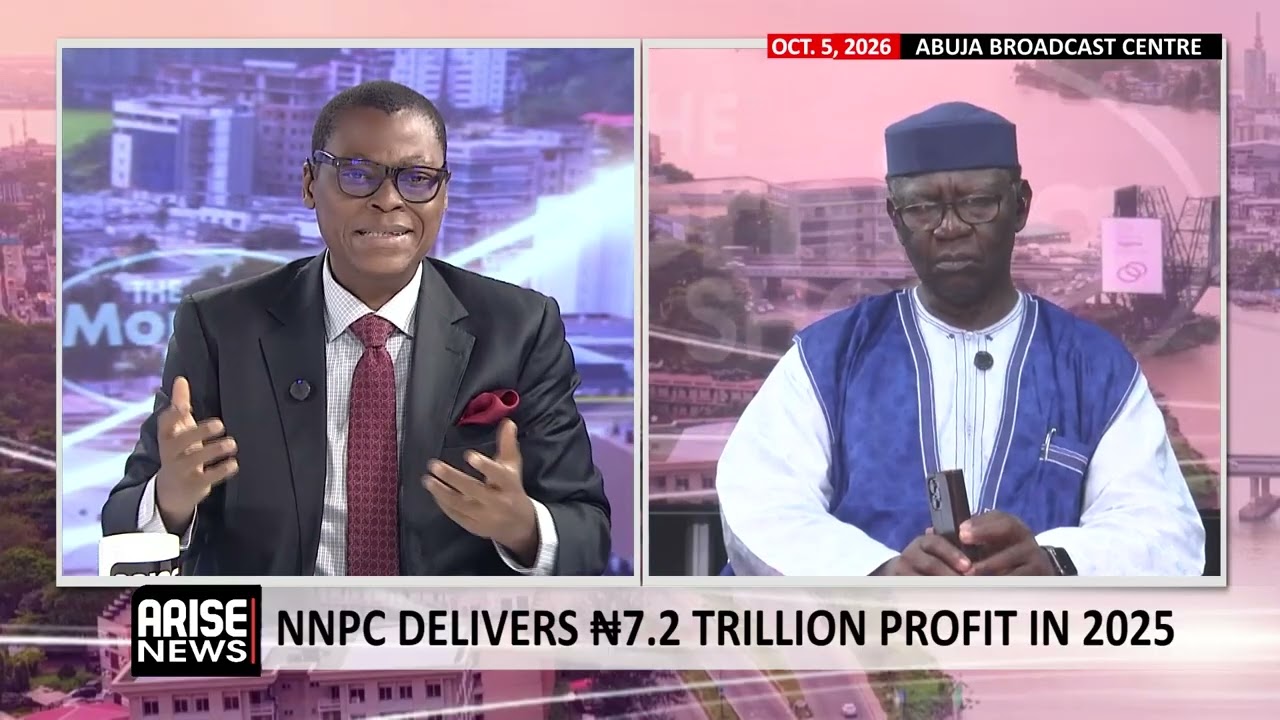
Iledare, made the remarks in an interview with ARISE NEWS on Monday while reacting to questions surrounding NNPC’s reported profit, receivables from the Federal Government and the company’s energy security obligations.
He said the public must distinguish between professional scepticism and cynicism, arguing that NNPCL would benefit more from constructive scrutiny aimed at improving its operations.
“I want to look at the bigger picture, and your question is very legitimate. And even some of the professional scepticism is also okay. But we must always celebrate incremental performance, even though we may have to look at this audited report.
“We cannot lose sight of the commerciality, the public expectations, and the vision to the federation. But we must find a way to balance the three.
“Knowing fully well that commercialisation begins with good governance and accountability, I want to celebrate NNPC for at least making their books open and being also willing to listen to professional scepticism because of sustainability questions. So congratulations to them for doing the right thing as intended by the Petroleum Industry Act.”
Addressing concerns over the N11.2 trillion recorded as receivables from the Federal Government, Iledare said the figure should be examined within the broader context of energy security, profitability and sustainability rather than automatically being regarded as missing money.
“Energy security — what do we mean by energy security? You are talking in terms of the value derived from that N11.2 trillion. The magnitude must be questioned. And those are professional scepticism that NNPC is willing to look at.
“Accounts receivable is not necessarily missing money. Accounts receivable also can have implications with respect to profitability and sustainability.
“So the basic question then is, what did you derive from that N11.2 trillion? From a petroleum economic point of view, you could decide to spend money to produce an additional barrel or decide to spend money to make sure there is continuous flow of production from the asset that you have.
“The question you are going to ask yourself is, does that N11.2 trillion produce more value that wouldn’t have been produced if it was not spent?
“Yes, the sustainability of commerciality intent of NNPC Limited requires enough cash flow. But at the same time, there are security obligations that have to be funded.
“And this is where the government has to balance the funding of obligations that NNPC Limited alone can provide if the asset of government will generate the type of reward for the federation.
“Nobody is saying that you should not look at that number and ask the questions. And then you have to look at that account receivable within the context of the N7.2 trillion that is declared. This is very key if commercial sustainability of NNPC Limited is to be accomplished.
“So all of these questions are okay, but we cannot, in my opinion, be so cynical as not to see things from a bigger perspective.
“So I come here from an economic perspective, from the point of view of value maximisation and value optimisation, which will depend on operational efficiency and obligation to the federation that must be managed.
“Because if you don’t do that, then you’re going to lose a lot of value that would have been generated.”
Responding to criticism of NNPC’s performance and concerns over its handling of the country’s refineries and energy security obligations, Iledare drew a distinction between public cynicism and professional scepticism.
“Don’t take my word out of context. Public cynicism is not the same thing as professional scepticism, if I can explain that. NNPC would be better off with professional scepticism than public cynicism.”
He said NNPCL was operating within competing expectations and needed to balance its commercial responsibilities with the country’s energy security needs.
“But let me go back to the three things that are conflicting that NNPC has to balance.
“What we are saying is, okay, let’s assume that NNPC does say that I want to wear my commercial hat and the moment they get the new management, just fire everybody in the refinery. Everybody will talk to me differently.
“Or NNPC just says, okay, energy security is not my base. I’m commercial now.
“And so when everybody is cleaning up on the petrol stations and they know they can receive money on behalf of the government that the government does not have in terms of royalty, equity and taxation, we don’t care whether people don’t have petrol. Our rights will be seen differently.
“So let’s make sure we understand the progress in which NNPC is making.
“It’s just like the perfect market. The perfect market does not exist anywhere in the world, but it’s an ideal that we are looking forward to arriving at to optimise our output at the right price.
“NNPC is making progress. They are not there yet. I’m not here to defend them, but I’m here to educate the public that the process of attaining expectations is just like your marriage, my friend. When you married, due to lack of years, I want to guarantee you have not attained your expectation.
“Yes, you are popular. That is what you need to do. Yes, they’re going to make mistakes because you are operating in a political environment that cannot see the expectation of the PIA that NNPC is looked at and cannot continue to judge the performance of the past without looking at the expectation of the future.
“Look at how you have evolved at ARISE. That’s not what you were when you started, but you are taking it day by day.”
Returning to the N11.2 trillion receivables, Iledare said the key issue was not simply whether the money was recorded as receivable, but whether it was spent efficiently and achieved its intended purpose.
“Let’s go back to the N11.2 trillion, which has actually become a headline. One thing I want to take away from here is it’s not missing money. The question you’ll be asking is, was that money spent efficiently? If it is spent efficiently, did it attain what it was designed to attain?
“When there’s not an accounting problem, you cannot see that in the financial report. That means you have to do a detailed analysis of the component of that N11.2 trillion.”
On questions surrounding NNPC’s reported N7.2 trillion profit and its plans to commit more than 186,000 barrels per day through forward sales to meet obligations linked to Project Gisele, Project Leopard 1 and Project Leopard 2, amounting to more than N8.1 trillion, Iledare said the issue was legitimate and should be properly investigated before any conclusion was reached.
“That is a legitimate question. And that is what the public is supposed to ask NNPC. But until they give you an answer, you cannot make a conclusive statement.
“Contract sanctity is contract sanctity. You have a contract with me. Whether the contract was proper or not proper by your predecessor, you cannot come and cancel the contract.
“And that’s why I continue to engage with you, the fourth arm of the public. You are doing a good job by raising questions, but I don’t want you to come to a conclusion without proper investigative journalism,”he said.
Boluwatife Enome
Follow us on:


