


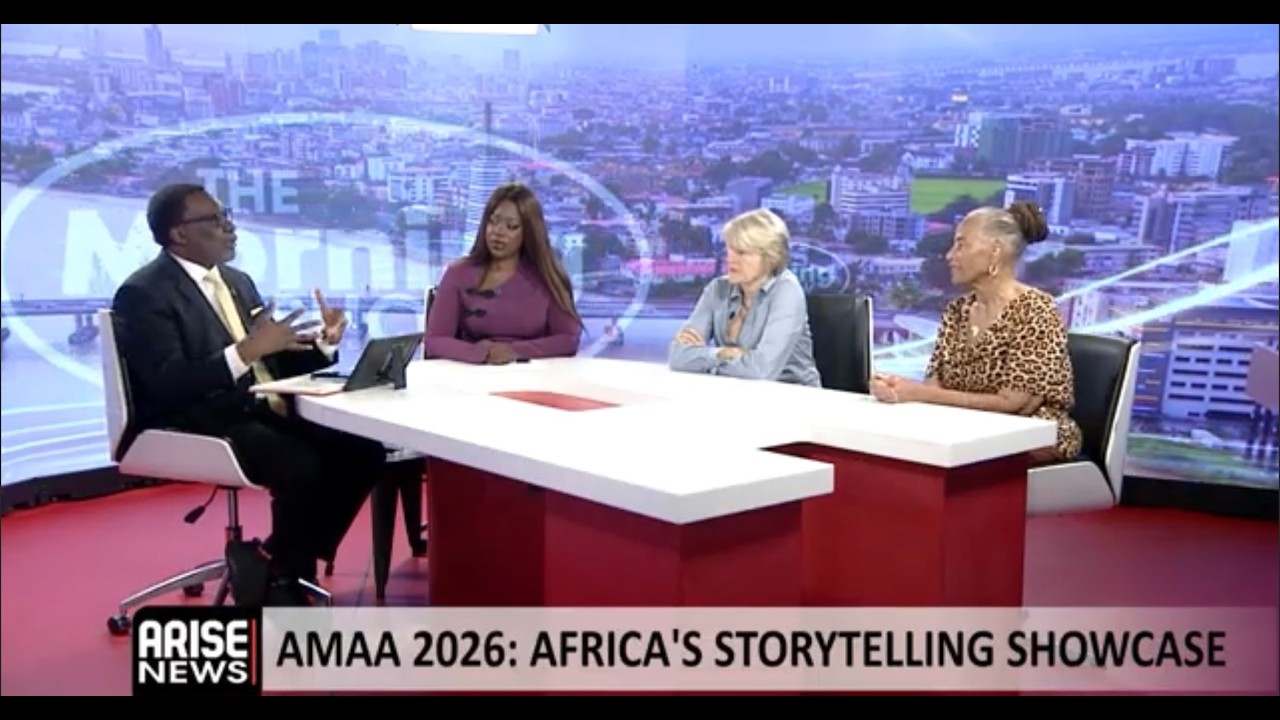
Dorothy Wenner, President of the 2026 Africa Movie Academy Awards (AMAA) Jury, has urged African filmmakers to stop copying Western cinema and develop their own approaches to storytelling, drawing from their cultural backgrounds and experiences.
Speaking during an interview with ARISE NEWS on Sunday, Wenner said filmmakers should resist pressure to meet foreign expectations and have confidence in their ability to tell authentic African stories.
“This is a new way of telling a story that is not a spoof of Western cinema, but it comes from storytelling from an African background and culture, So authenticity is something that you don’t create. It is something where, you know, you come to yourself. And it’s not an imitation.”
She explained that emerging filmmakers should develop original ideas instead of reproducing stories and styles that had succeeded in previous years. “Don’t imitate the winner from last year. Very often happening. What I think is to really think, what have I to say? And what is my new way of telling my story, not imitating something that was successful earlier.”
Wenner also encouraged filmmakers to take creative risks and explore subjects that interest them. “I say, well, surprise the jury. Be courageous. And when it comes to subject matters, do look out, ask your friends and trust, do have a trust in what interests you.”
She said the jury was impressed by the quality of films submitted for this year’s awards. “This was an exceptional year. I think overall internationally the film industry is in kind of like where do we move to, what’s happening, who’s coming to the cinemas.
“And so having had the chance of watching all these films I was extremely happy and excited and especially I would say because there were a lot of surprises. In a such new names and new names filmmakers also in other artistic departments that really climbed to the top in lightning speed and the films that we got to see were surprising, innovative and they have a kind of, there is an urgency to say something and that we got films from all over the continent I think was making all of us very proud.”
Wenner singled out Nigeria’s The Herd and Kenya’s One Woman, One Bra as two outstanding entries. “This is a film that really, really took me by surprise. And I remember when I was watching it I didn’t know where it would go to.”
Speaking about One Woman, One Bra, she said.
“The title is very provocative. It’s a satire. It’s a comedy. But I can’t really remember to having seen a film that would put as a topic international aid and how it affects communities in film, in a feature film. Stunning, stunning actress, lead actress.”
Wenner also raised concerns about the difficulty African films face in securing mainstream distribution in Europe. She said distributors often consider them too risky to release. “I’m from Berlin, Germany, and I can only say it’s so tough to have, to bring a film of African descent, no matter if it’s a documentary, if it’s comedy or whatever genre it is, into regular distribution. The distributor says, but this is so old-fashioned. Sometimes it drives me nuts. So to say, oh, it’s such a risk. We are in such difficult times. It is too risky to bring an African film into distribution.”
She said the Africa Movie Academy Awards had a role to play in creating new opportunities for African cinema through strategic efforts to promote its films. “So here is where I find AMA is really at the fore of fighting for new revenues. And not with aggression, but with clever films and with clever strategies.”
Wenner said African filmmakers should also avoid creating films based on what they believe European audiences expect to see from the continent. “So sometimes it’s also, and I hope I don’t sound too critical, but sometimes it’s also the African filmmaker thinks, oh, this is what is expected from us by the Europeans. And I think this is an outdated thing. This is a trap that I’ve seen. Quite a lot also African filmmakers get into.”
She said filmmakers needed to observe their surroundings and develop fresh approaches to documentary storytelling. “If you go into documentary, allow the new reality in which everyone is constantly having their phones and has become a director of his and her own film. Life, sorry, not sure. Director of your own film.
“So thereby you have to find new ways of storytelling within documentary. Observe. Observation is very important to create something like authenticity.”
Wenner also urged filmmakers to trust their creative instincts and remain confident in the stories they want to tell.
“I think we have to find our own voice. As creative people, that’s very important because oftentimes creative people are the lead, you know? So you find your own voice and you have confidence in yourself and confidence in your ability to tell that story. And know that what you are telling is based on truth. Not someone else’s truth, but your own truth.”
She added that the quality of a film was not determined solely by its budget, but also by how creatively filmmakers used the resources available to them. “It’s always a big issue, you know, no matter where we are. But how is it that you use the resources that you have in order to tell that story? How do you apply what you have to communicate those ideas that you feel are important and how you do that in a creative way?”
Erizia Rubyjeana
Follow us on:


