


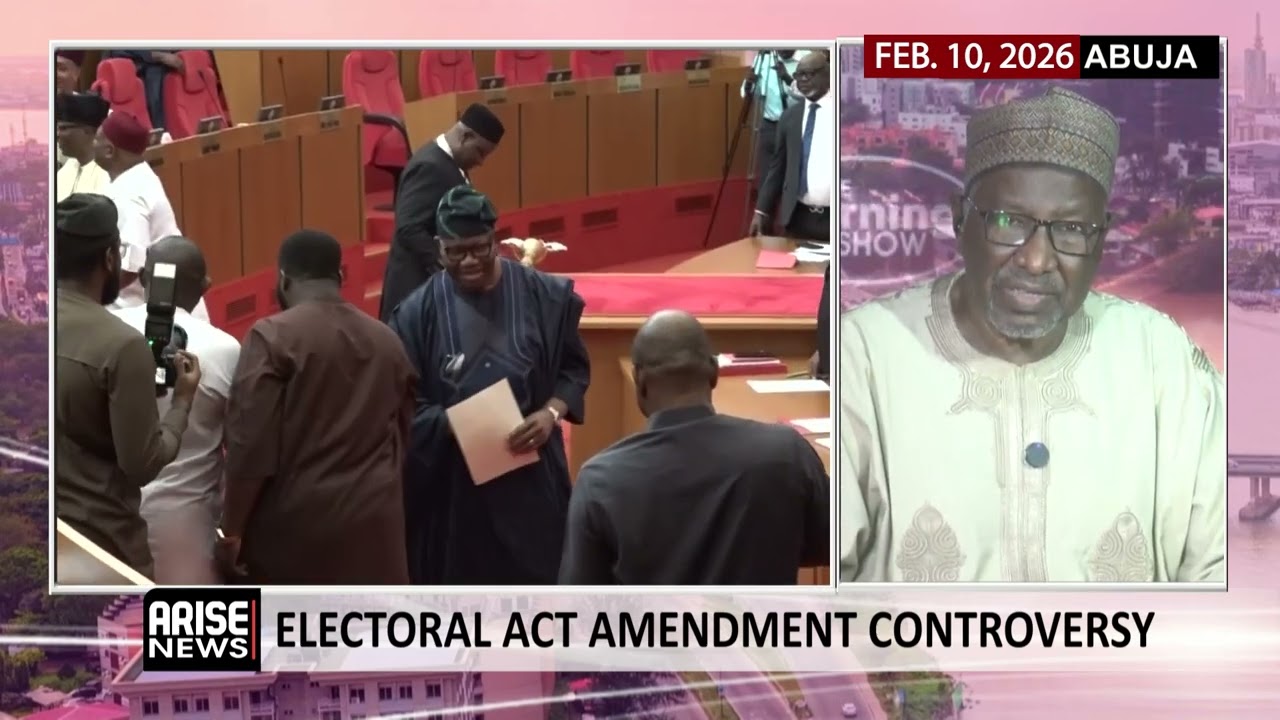
Islamic Scholar, Political Activist, Civil Society Leader, Dr. Usman Bugaje has sounded the alarm over delays in Nigeria’s electoral reform process, urging urgent implementation of mandatory real-time electronic transmission of election results while also warning that failure to act decisively could create opportunities for manipulation and undermine the integrity of the country’s democratic process with the Senate’s repeated inaction on legislative responsibilities worsening governance and electoral credibility, leaving citizens and businesses in a state of uncertainty.
In an interview with ARISE NEWS Bugaje on Tuesday, discussed the controversy surrounding the amended Electoral Act, emphasising the importance of transparency in Nigeria’s elections and the need for legislators to prioritise national interest over political expediency, arguing that the Supreme Court ruling on the Independent National Electoral Commission (INEC) highlights the urgency of clarifying the law to prevent ambiguity in election procedures.
“Because the whole idea is to do a transparent election. The best way to do it is to make sure that the results are available electronically, immediately, that’s real time, so that everybody can see exactly where the votes are. And the idea of this amendment is precisely to address the very point that the Supreme Court had raised earlier.”
Bugaje criticised the Senate for failing to perform its basic legislative functions, citing past controversies over the tax law and budget processes. “The Senate leadership, at least, is now being the biggest problem of this country. And we need to begin to ask of what use are these leadership? What kind of responsible behaviour is this?”
Addressing arguments that Nigeria lacks sufficient internet coverage to implement real-time transmission, Bugaje dismissed these claims as excuses for election rigging. “These are all alibis to prepare for rigging. It’s very clear. You have POS in the remotest villages. You have telephones working, WhatsApp, people sending, communicating, sending messages and communicating. In any case, it is for INEC to say that we do not have the capacity to do that. It’s not for the legislature to do that.”
Bugaje highlighted that INEC itself has recommended real-time transmission and that experts confirm Nigeria has the capacity to implement it successfully. “Like I said, INEC itself has recommended in its submission during the public hearing that this is the position. And experts in the last few days have come out to say that the amount of coverage is more than sufficient for INEC to deliver.”
Bugaje also warned about accountability, stressing that the President and the National Assembly must uphold the law. “If the president does not implement it, he is breaching a law that has been signed and passed by the National Assembly, and that is an impeachable offence. It’s just that the National Assembly has no lever. They have no courage. They don’t even know their work. They are just there collecting money, left, right and centre.”
On broader electoral reforms, Bugaje highlighted issues the Senate has avoided, such as internal democracy in party primaries and the consequences of elected officials switching political parties. “There are lots of issues that are deliberately being suppressed or blocked so that the proper democratic practices will never see the light of the day. But these are going to be part of the struggle which both the citizens and the civil society will have to continue. We are prepared to continue having incremental development, incremental gains until we eventually get to where we should be.”
Bugaje concluded by insisting that there is sufficient time to prepare for the next election, despite Senate delays. “We have to insist that the 360, if you are going to do any adjustment, okay, take the time that the Senate has wasted, three weeks, four weeks, five weeks off that and then try to rearrange so that there’ll be sufficient time to deliver.”
Erizia Rubyjeana
Follow us on:


