


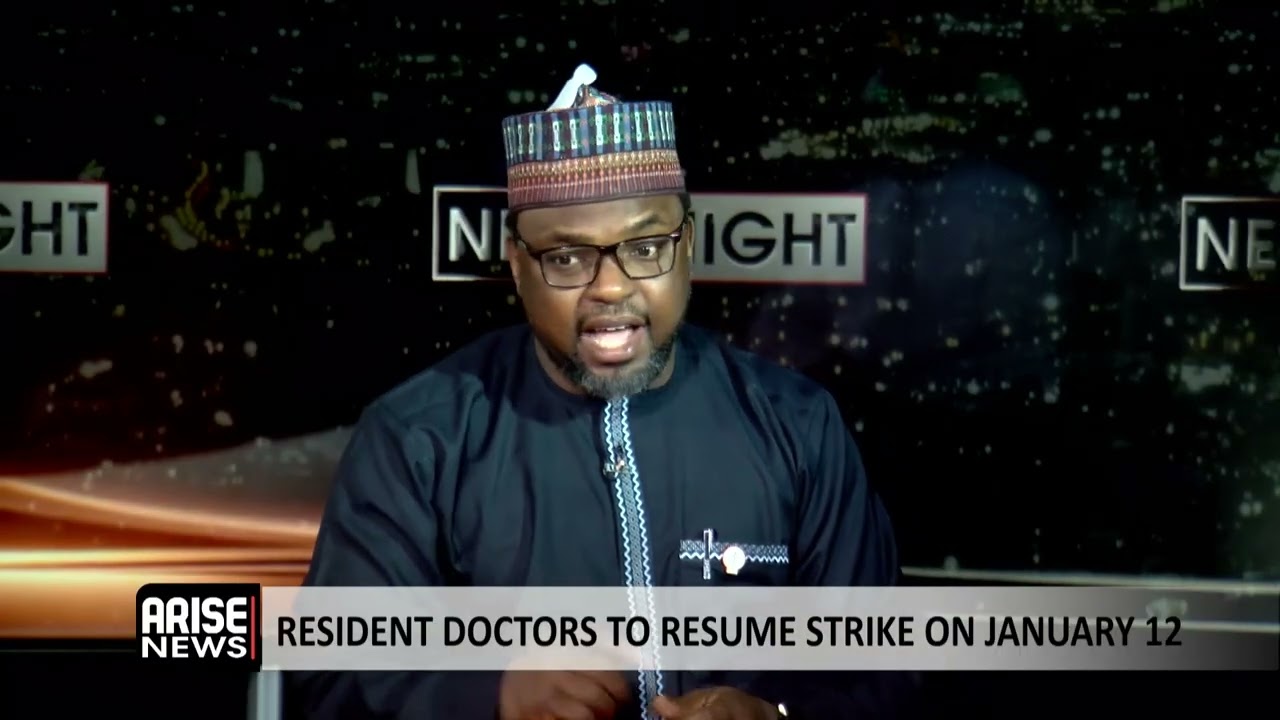
The Nigerian Association of Resident Doctors (NARD) has announced it will resume a total, indefinite strike from January 12, 2026, citing the Federal Government’s failure to implement agreements reached in a Memorandum of Understanding (MoU) signed in November.
Speaking on ARISE NEWS on Monday, the National President of NARD, Dr. Mohammad Suleiman, said the decision followed the government’s continued delay and selective implementation of the 19-point agreement that led to the suspension of the previous strike on November 27.
“It’s unfortunate that we’re here. We suspended our strike on the 27th of November when we signed an MoU with the Federal Government. In that MoU, we agreed on all 19 items,” Suleiman said.
He identified the unresolved Lokoja doctors’ case as a key trigger for the renewed industrial action, noting that despite clear recommendations from both the House of Representatives and a Ministry of Health–constituted committee, affected doctors remain unreinstated.
“The House of Reps received a petition from Lokoja and made a pronouncement that our colleagues be reinstated. The Ministry of Health set up a committee which recommended not only their reinstatement but also payment of their back pay. To our greatest surprise, the Ministry of Health is now advising us to ask our colleagues to apply elsewhere,” he said.
Suleiman described the move as an attack on unionism and a dangerous precedent for labour activism in Nigeria.
“These are union leaders. If today, because of agitation, I receive a query and I’m asked to leave my job, what message are we sending? That is a deterrent. That is a slap. That is a legal conundrum to unionism and activism in Nigeria. It is totally unacceptable.”
He stressed that union activity is protected under Nigerian law and warned against victimisation.
“Unionism is protected by law in Nigeria. The Department of Labour frowns at singling out union leaders and victimising them. It is a constitutional right to associate and form unions to protect welfare.”
Highlighting the human cost of Nigeria’s healthcare crisis, Suleiman painted a grim picture of resident doctors working under extreme conditions.
“These are human beings. They are not AI. They are not computers. They have debts. They can’t pay school fees. They can’t pay rent.”
He cited the case of a doctor in Gombe as an example of unsafe workloads.
“There’s a Dr Halima in the Internal Medicine Department of the Federal Teaching Hospital, Gombe, who is on call from January 1 to January 31. If we don’t protect Dr Halima, Nigeria has already left her out to dry.”
On remuneration, Suleiman accused the Ministry of Health of failing to correct longstanding salary anomalies, particularly errors in professional allowance tables dating back to 2019.
“What we asked for is not a salary increase. It is a correction of errors. We accepted 18 months arrears because that is what Nigeria can afford. It was captured that implementation would start in January 2026. As I speak to you, it is not captured in the budget.”
He added that other government agencies had fulfilled their roles, leaving implementation solely with the Ministry of Health.
“The Ministry of Labour has done its due diligence. The Office of the Head of Service has clarified entry level and specialist allowance. The Minister of Finance and the Budget Office assured us of a payment plan. Every facet of government has passed the ball to the Ministry of Health.”
Suleiman further alleged persistent underpayment of newly employed doctors across federal institutions.
“Doctors are still being placed on CONMESS 2 instead of CONMESS 3. That is a loss of ₦120,000 to ₦150,000 monthly. This is happening in Kaduna, Ekiti, Bauchi and other centres.”
He revealed widespread salary arrears affecting doctors nationwide.
“There are doctors who have worked for 20 months without salary arrears. In FMC, some are owed four to nine months. OAUTHC, up to 14 months. Benue State University Teaching Hospital, about 18 months.”
According to Suleiman, even agreed administrative steps, such as setting up workload and locum committees, have stalled.
“The Minister of Health is now saying there is no money to set up committees that were agreed in the MoU. It’s like people sat down and looked for ways to alter or delay the agreement.”
He accused vested interests of frustrating the Lokoja reinstatement process.
“After the ministerial committee submitted its report, a petition suddenly appeared. Within two or three days, it was on the Minister’s table. We’ve been trying to resolve this for over a year.”
Suleiman warned that Nigeria risks losing more doctors if conditions do not improve, noting the scale of medical brain drain.
“In 2024 alone, about 4,700 doctors left Nigeria. I’m waiting to see the figures for 2025, and they will be staggering.”
He called on President Bola Tinubu to intervene urgently.
“I have called on the President to declare a state of emergency, even if it is only on the welfare of healthcare workers.”
Despite public frustration with recurring strikes, Suleiman insisted resident doctors had acted in good faith.
“Senior government officials sat down with us and signed an MoU. We convinced our members to suspend the strike. Today, it looks like that trust has been betrayed.”
NARD has warned that unless the MoU is fully implemented, medical services across federal hospitals will be severely disrupted from January 12.
Boluwatife Enome
Follow us on:


