


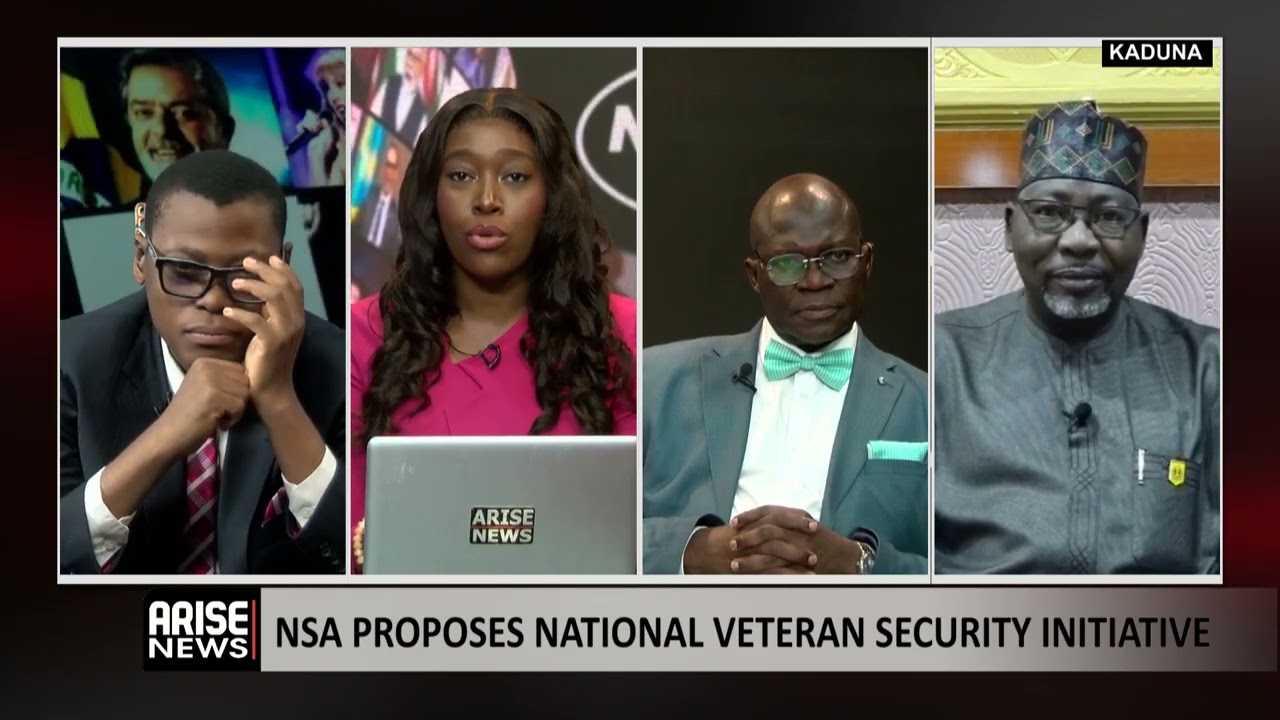
A former army spokesman,Brigadier General Sani Usman (rtd), has welcomed the Federal Government’s proposed initiative to engage military veterans in national security efforts, stressing that Nigeria must harness the wealth of experience, training, and discipline of its retired service members for national development.
Speaking in an interview with ARISE News on Monday, Usman described the move as timely and essential, warning that the nation’s failure to utilise the skills of its veterans—much like in other sectors such as academia and journalism—was a costly oversight.
“This is a timely initiative,” Usman said. “One of the most staying powers of the Nigerian state is human resources, and the military is one of the most experienced, one of the most trained. It is very important to harness that expertise, experience, and knowledge for the development of the country—either within the service or even outside the service. So it’s a welcome initiative.”
He explained that although similar directives existed under previous administrations, they were never fully operationalised. “There should have been an established Veterans Affairs Department at the Ministry of Defence headed by a two-star general in conjunction with civilian staff. But it has not seen the light of day. I hope this will be followed through so that we harmonise and get the best out of our veterans,” he said.
Usman insisted that the value of military service could not be measured in material or financial terms: “This is somebody who voluntarily elected to serve the country—on land, sea, or air. After disengaging from service, it is crucial the country harnesses that material, especially in these challenging times.”
While many veterans are already engaged in advisory roles and training capacities, Usman emphasised that their contribution goes beyond combat: “It’s not about comfort or carrying weapons, though some are still able-bodied,it’s about using the benefit of hindsight to perfect the system.”
He called for proper harmonisation of the new initiative with existing structures, citing examples from countries like Egypt, the UK, and the US, where veterans receive comprehensive welfare support. “In Egypt, even the extended families of fallen veterans are taken care of. In the UK, there are homes where veterans who have no family live freely with all amenities provided. We need to look at international best practices,” he said.
Addressing fears that greater involvement of veterans might be seen as a step towards re-militarisation, Usman dismissed such concerns, saying Nigeria’s democratic governance was well-established.
“We have had uninterrupted democratic governance for the past 26 years,” he said. “The military has been the vanguard of democracy. Democracy has come to stay, so forget about that aspect. The way forward is the most important thing.”
He cautioned against using Russia as a cautionary example, instead pointing to democracies like the UK and US. “There is nothing to fear because the fine details will be worked out. Even now, many states have engaged veterans in security efforts, such as Amotekun and various vigilante groups, with training and leadership provided by former military officers,” he explained.
The former army spokesman underscored that the military is part of society, and soldiers return to civilian life after service. “You owe it to be a good and responsible citizen. Even while in service, you are subject to both military law and the constitution,” he added.
Commenting on the welfare of officers who have been forced out of service under disciplinary circumstances, including the high-profile case of 17 soldiers highlighted by human rights lawyer Femi Falana SAN, Usman expressed sympathy but defended the military’s handling of the matter.
“In the military I know, punishment is the last resort. The unfortunate incident that happened in 2015 involving some soldiers who almost killed General Mohammed led to their court-martial and death sentence, which was later commuted to life imprisonment. Eventually, the President granted them amnesty,” he explained.
He noted that issues around discharge dates and terminology—such as “compulsory discharge”—were legal technicalities, stressing that none of the affected soldiers had voluntarily requested retirement. “In such cases, discharge is necessarily compulsory,” Usman said, adding that he welcomed ongoing discussions between the army’s legal department and Falana to resolve the matter amicably.
On the question of whether Nigeria has a functional military reserve and whether retired soldiers could be called back to active service, Usman clarified that the armed forces’ harmonised terms and conditions provide for an “active reserve,” although it has not been fully activated in practice.
“It is not necessarily about taking up arms. Many veterans can serve in advisory roles, training, or support capacities. In fact, quite a number, including myself, are already doing that,” he said.
Usman recounted how the recent Nigerian Army Day celebration in Kaduna witnessed a massive turnout of retired personnel, indicating their continued commitment to the military community. “Some even joked that the event should happen twice a year so we can meet more often,” he said.
He also rejected the notion that Nigerians would be unwilling to volunteer if the country faced an existential threat. “Whenever there is recruitment, you see the massive turnout. I remember when I was Director Army Public Relations, we were looking for 4,000 recruits but received over 200,000 applications within 24 hours. So Nigerians are still willing and able to defend their country,” he said.
While noting that Nigeria is not currently facing the kind of threats that would require mass mobilisation, Usman assured that, if the need arose, both veterans and civilians would rise to the occasion.
“We still have interested Nigerian men and women who are ready to join the military and serve their country,” he concluded.
Boluwatife Enome
Follow us on:


 has emphasised the importance of harnessing veterans’ expertise, experience, and knowledge for Nigeria’s development.</p>
)