


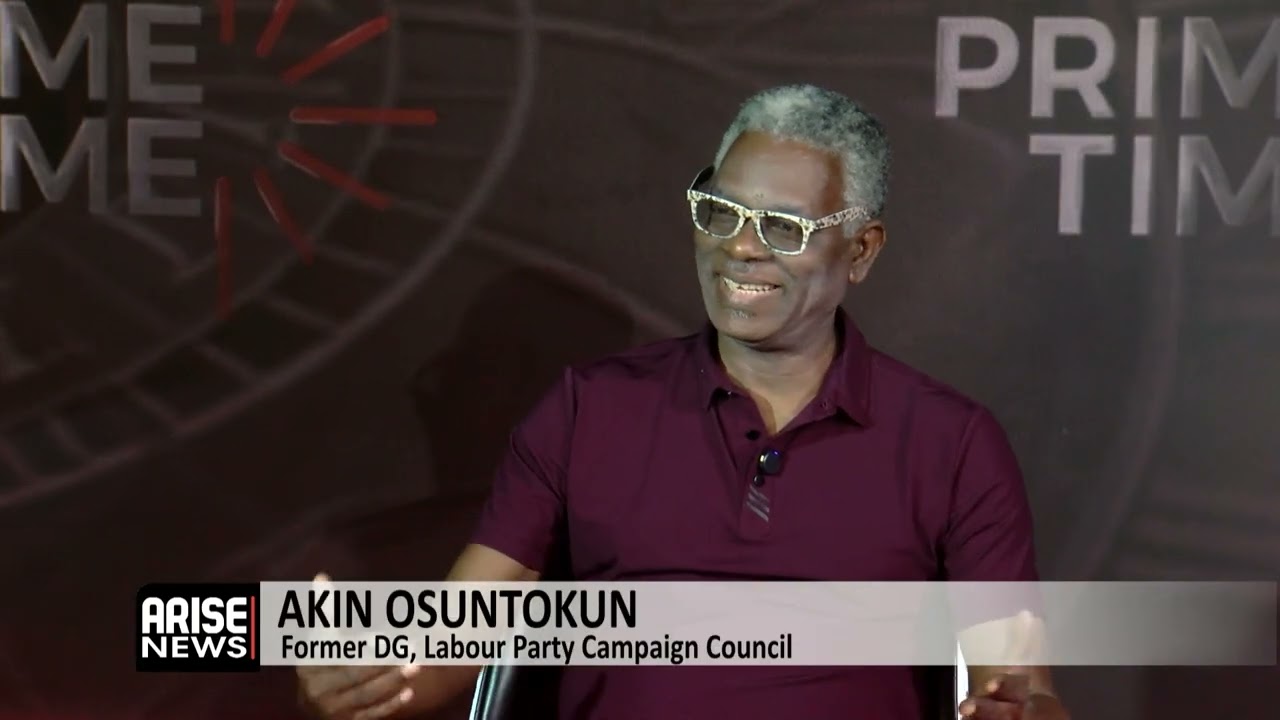
A former Director-General of the Labour Party Presidential Campaign Council, Akin Osuntokun, has claimed that the long-running political rift between Nasir El-Rufai and Nuhu Ribadu was fuelled by Bola Tinubu’s decision to back Ribadu over El-Rufai in the build-up to the 2011 presidential election — a development he says El-Rufai “never really got over”.
Speaking in an interview with Arise News on Tuesday, Osuntokun said the roots of the rivalry stretch back to the final years of President Olusegun Obasanjo’s administration and the succession battle that produced Umaru Musa Yar’Adua.
Osuntokun, who served as Obasanjo’s political adviser, disclosed that a nine-member caucus set up in 2006 to design the President’s exit strategy had reached a near-consensus to present El-Rufai as a preferred successor — a move Obasanjo rejected.
“Individually, we were close to the President. That was a kind of father-son relationship,” Osuntokun recalled. “When he decided to put together an exit strategy, he then convened us into a formal caucus, nine of us.”
The caucus, chaired at the time by then Attorney-General Bayo Ojo, was tasked with guiding the transition process and identifying a successor. According to Osuntokun, the group eventually settled on El-Rufai.
“We resolved that we should push this on him,” he said. “It was a consensus — almost.”
He added that Ribadu, then Chairman of the EFCC, was fully aligned with the proposal.
“Oh yes. He was actually one of the main motivators. He and El-Rufai were like this — they were five and six. They were quite close. Being from the North, very high profile, and both of them very efficient and effective public officers. Nasir’s record in the FCT and Nuhu as chairman of the EFCC — they were quite close. So it was a done deal as far as we were concerned.”
“He suspected that we were going to come up with El-Rufai,” Osuntokun said. “Like he told us, he said he knows El-Rufai more than us. He didn’t want to be harsh on Nasir by not considering him. He just said, ‘You guys are naive. You don’t know what I know about him.’”
According to Osuntokun, Obasanjo ultimately chose Yar’Adua, citing his credentials and longstanding relationship with the Yar’Adua family.
“If you were to pick from the pool of governors from the North, Umaru had almost the best credentials. He was a highly disciplined person, with relative integrity and credibility,” he said.
He added: “The President always recalled that when he was going to run the presidential primaries in 1999, the first governor to declare for him was Umaru Yar’Adua. He also had that relationship with the Yar’Adua family. The image of Shehu Yar’Adua was always on his mind.”
Osuntokun dismissed suggestions that the 2006 episode triggered a fallout between El-Rufai and Ribadu.
“No, not at all,” he said.
He explained that the caucus had assumed Yar’Adua would retain them within his political fold.
“We felt that Umaru as president was going to adopt us the same way — that we were going to be with him. So it wasn’t a difficult outcome as far as we were concerned.”
However, relations with the Yar’Adua administration deteriorated.
“Umaru didn’t want us near him. He wasn’t well-disposed towards us. That destabilised the group,” Osuntokun said, adding that both El-Rufai and Ribadu eventually went into exile amid political pressure and investigations.
“That led to a rise in their political profile because of the way they were treated.”
The decisive rupture, Osuntokun said, came years later when Bola Tinubu — who had just completed his tenure as Lagos governor — sought to back a northern presidential candidate.
“He wanted to support a member of the younger generation from the North, whom he could put his South-West support behind,” Osuntokun explained.
Tinubu, he said, commissioned a public opinion survey.
“The results clearly favoured Nuhu. The opinion poll gave Nuhu 45 per cent, El-Rufai 7 per cent. It was on that basis that Tinubu reached out to Nuhu and adopted him as a candidate.”
Ribadu subsequently emerged as the presidential candidate of the ACN.
Osuntokun believes that decision left a lasting mark on El-Rufai.
“I think that created bad blood with Nasir — that the rating elevated Nuhu above him. And I think he never really got over that disappointment.”
Even El-Rufai’s later emergence as a two-term governor of Kaduna State did not resolve the tension, he added.
“No, he didn’t get over it,” Osuntokun insisted. “If you compare the two of them, he had the upper hand by becoming governor of Kaduna State for eight years while Nuhu was languishing in the political wilderness. But then 2023 came.”
He noted that Ribadu had by then consolidated his relationship with Tinubu.
“Nuhu solidified his relationship with Tinubu. He had become his confidant all through that period. Tinubu had already appointed Nuhu as National Security Adviser, which is a very powerful position.”
Osuntokun also alluded to El-Rufai’s failed ministerial nomination, suggesting it deepened suspicions.
“I think that was a struggle,” he said. “He then began having what, to me, seemed like an obsession with Nuhu Ribadu — almost every time finding a way to link him with whatever problems he had.”
While expressing reluctance to dwell on internal matters, Osuntokun said he felt compelled to clarify the historical context.
“As a matter of fact, I don’t like talking about some of these things that we have done together,” he said. “But I think things have gone too far.”
Boluwatife Enome
Follow us on:


