


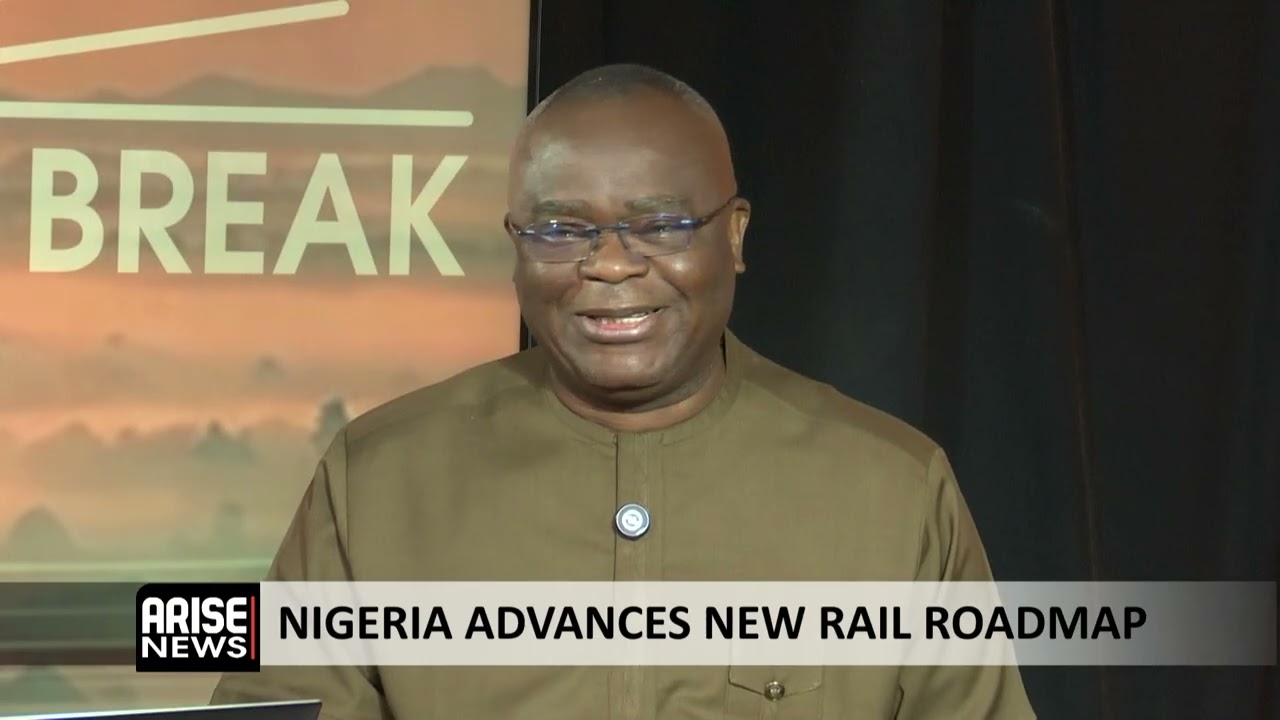
The Managing Director of the Nigeria Railway Corporation, Dr. Kayode Opeifa has said that the rail sector is growing rapidly, insisting that derailments are regular occurrences everywhere.
He said this while speaking in an interview with ARISE NEWS on Wednesday, where he discussed the proposed national railway development roadmap.
“Let me say the rail sector is coming up gradually and fast. The responsibility will be to facilitate trade, aid growth, and reduce poverty—linking people easily to jobs, linking the manufacturing sector to the markets, the farmers to the market, and improving the logistics and supply chain mechanism for trade.
“Let me say straightaway that derailments are regular occurrences in the rail sector. In February alone, I’m sure in Britain, they will have not less than one. At least there was a major one on February 6th. Around the time we had one, there were derailments—not less than 15—all over the world. It’s a normal occurrence”, he stated.
He added that the NRC swiftly handled the derailments which occurred across several states in Nigeria.
“In the last year, 2025, there were three major derailments: August 26th at Asham in Kaduna, and two on the Warri-Itakpe line—the first at Abraka on November 1st, and on November 8th at Agbor. Regardless, these are not setbacks per se. These are occurrences that the Nigerian Railway Corporation tackled, and we were able to bring them back. One was brought back within 24 hours; another one took 21 days; another one took 28 days”, he explained.
Dr. Opeifa insisted that these derailments are normal, and should not be seen as attacks against Nigerians.
“It is usual—let me say a ‘normal usual crisis.’ What you mean by derailment is when a train moves away from the track. It can be from the switches—mostly from the switches. It can be human error; it can be a major accident. The one we had was a major accident. The one in Egypt was a major accident. The one in Spain recently was a major accident. We thank God in our own case there were no deaths. The last one in Spain there were 38 deaths. In the one on February 6th in the UK, I think there were two or three deaths. So, that you will not have derailments is not a big deal.
“However, these are accidents that are preventable and you want to do away with. If you have rainfall, weather conditions, glitches on the signal system, or somebody not doing the proper thing—somebody speeding unnecessarily—then you also have aging infrastructure. Like we have. You are not away from derailment. So, derailment is not the major setback”, he clarified.
Addressing allegations of financial mismanagement within the Railway Corporation, the director said:
“I’m not a lawyer, and the little that I know in jurisprudence says that when a matter is in court, it is sub judice. I cannot comment on that. I know we all know that there are matters that should be left to the court. With due respect, I disagree with you. You said there is mismanagement going on—prove it. Mention one.”
Adding, he said issues of mismanagement in the Corporation should be left for appropriate authorities to handle.
“If there are corrupt cases, if there is mismanagement, they are matters to be dealt with by appropriate authorities. My concern is to reposition the Nigerian Railway Corporation, take it to global standard best practice, and ensure the railway works for Nigeria”, he said.
Assuring Nigerians of better railway services, Dr. Opeifa said:
“We are bringing back the lines. We are bringing back the coaches. The coach that had the incident at Asham, the one at Warri and at Agbor, we retrofitted—they were brought back to life by Nigerian engineers and technicians, 100 %. That is to tell you that the railway is alive. What we are also concerned with, as you mentioned in the beginning, is the roadmap. We are putting together a rail system that works for us. The Warri-Itakpe is working. The Abuja-Kaduna is working, and by Friday we are moving from two trips to three trips with one rig.”
Speaking on the roadmap, Kayode Opeifa said the NRC is expanding services and plans nationwide rail connections, pending funding.
“You can judge us from what we have been able to do. We have been able to prove that we have the capacity to fix tracks and even to construct tracks. We have been able to prove that we can run trains. Go on the internet, check the preview of the Lagos train services. People are saying this matches international standards. We are running entertainment and tourism programs, experience programmes.
“Now going forward, we are saying we are connecting every major city in this country with a rail line. The roadmap is there. What is left is funding; what is left is execution. That is the future; that is our focus”, he stated.
Dismissing claims of incomplete projects, Kayode Opeifa said the Nigerian Railway Corporation has not abandoned any rail line, noting that projects are progressing in phases due to funding and their capital-intensive nature.
“Now, on the issue of abandoned projects: I am not aware of any project that is currently abandoned. For the record, maybe just for Nigerians to know: the Lagos-Ibadan (which is the arm of the Lagos-Kano project) was completed within three to four years. That’s a record worldwide. Give it to Nigerians; we did that.
“That project is going on; we may not be making so much noise about it. The Kano-Maradi, which will link through Daura, Jibia, and Funtua—linking Abuja to Daura, Abuja to Funtua, Abuja to Jibia, and Abuja to Kano—will also be completed, scheduled for completion this year. So none of them is undergoing any delay. They are divided into phases, and this is also based on availability of financial resources”, he maintained.
Speaking on Lagos–South-East rail plans, Opeifa said the NRC will expand connections from Warri to Abuja and Lekki Port to Onitsha, carrying passengers and cargo.
“We have the central line that runs from Warri to Itakpe, and there is a plan to connect the Warri end to the Warri Port. There is also a plan in 2026 to award the contract to connect the Itakpe end to the Federal Capital Territory (FCT). That will automatically connect people from the South-South straight to Abuja. There is the plan, and it’s in the budget, to move a line from Lekki Deep Sea Port to Kajola on the left flank (the Western line), and on the Eastern flank, the line will also extend to Benin, Onitsha, and Aba from Lekki Deep Sea Port. When completed, it can be used for both passengers and cargo”, he explained.
He further revealed that Nigeria’s rail system is gradually modernizing, with upgraded signaling and new metro lines progressing toward faster, smarter trains.
“That’s an area we need to improve much more. The level of digitalization depends on the gauge itself, and what you did at the level of construction and design. Now, there are different signal levels. I can tell you the signal levels of the Abuja Rail Mass Transit (the one by the FCT) compares to what you have in the world; it is the best we have in Nigeria today. And the Lagos-Ibadan, which was on signal level zero, is now being upgraded to meet the level required to run the Lagos metro line.
“The new lines that are coming up, like the metro for Kaduna, the metro for Kano, and the metro in Lagos supported by the federal government, are coming with a higher level of signaling. What we have had is narrow gauge and standard gauge. We are already at the level of standard gauge, and in a few years, we are moving to fast trains. So we are on the developmental stage. I told you, for 60 years after independence we did nothing. What was postulated in 1970 is where we started in 2015. So we are not at the topmost level, but we are moving gradually up”, he said.
Favour Odima
Follow us on:


