


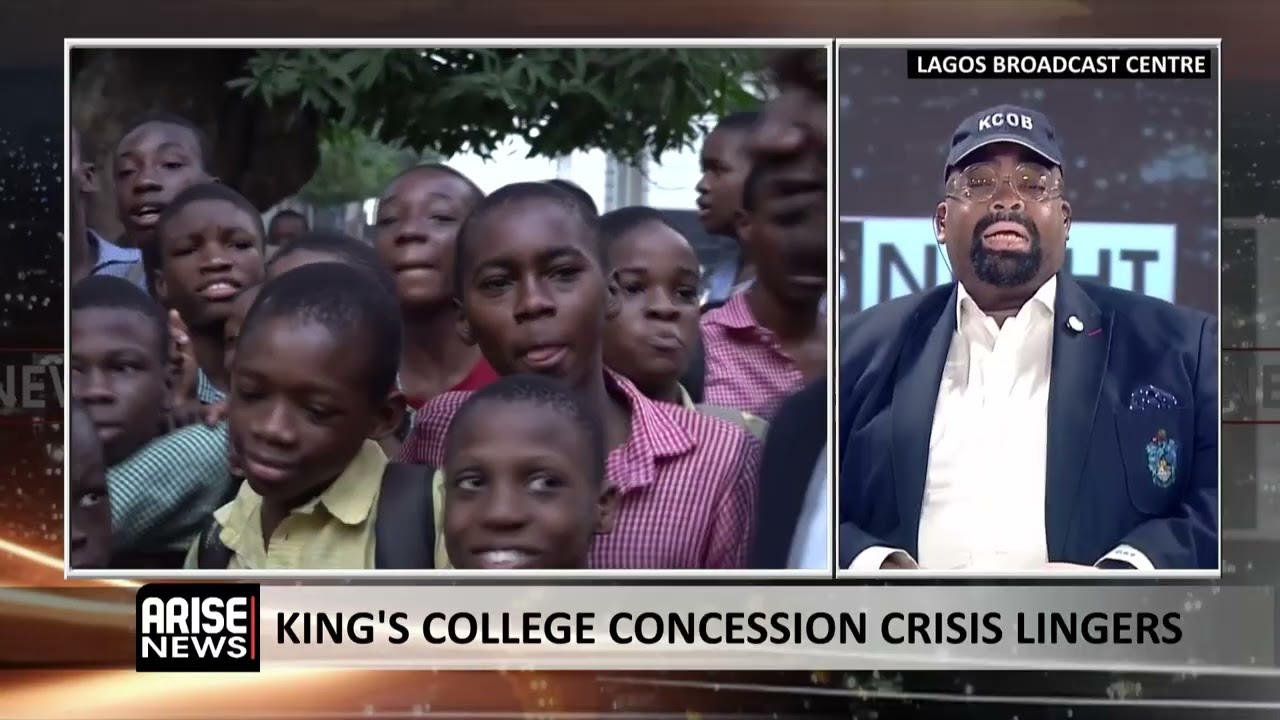
A member of the King’s College Old Boys’ Association, and former president of the Nigerian Bar Association, Olumide Akpata, has clarified that King’s College has not been sold to the association, saying the old boys only seek to restore and transform the 117-year-old institution.
Akpata made the clarification during an interview on Arise News amid opposition from unions and other stakeholders over the Federal Government’s decision to concession the Lagos-based unity school to KCOB.
“King’s College has not been sold. We have not bought the school, the school has not been offered to us, and we are not interested in buying our school. The expression Alma Mater is a Latin expression which literally translates to ‘nourishing mother.’ You must understand that this school is our mother, and no son will sit idly by and watch his mother deteriorate in such a dastardly manner.”
Akpata said the KCOB’s planned ₦100 billion investment would be used to upgrade the school’s infrastructure and improve the learning experience, noting that the association had previously spent billions of naira renovating buildings, improving the sports facilities and providing generators, an ICT laboratory and a library for visually impaired students.
“Yes, we have our old boy community ready to put together these funds—the 100 billion Naira. The commitments are on the table. They have waited for the concession agreement, which has now been executed, and the monies are rolling in.
“Now, why don’t we just give the money to the school? We’ve done that before. We’ve done that in the last—the school is 117 years old. The King’s College Old Boys’ Association is at least 75 years old. In the first 50 years of our existence as an association, we played a complementary role because things were functioning at that time. We played a complementary role, helped with the training of the boys, came into the school now and again to give pep talks, gave career guidance, and did back-to-school exercises. But that was then.
“In today’s Nigeria, there are so many competing interests, so many things before the Federal Government of Nigeria that they need to deal with. Running secondary schools may not get priority in today’s Nigeria. Which is why we have gone to the government to say: our interventions in the past—and there have been a lot, we have spent billions of Naira on that school.
“We have renovated every building standing in that school at one point in time or another. We have redone the sports pitch, put tartan tracks, put drainage under the football pitch. What have we not done? We have put generators in that school, an ICT lab, and a library for the blind students where Braille and other equipment have been provided. We have done everything conceivable, but as soon as we turn our backs, these facilities deteriorate immediately because there is a lack of a maintenance culture, as with most things around here.”
He also explained that the agreement with the Federal Government was intended to formalise KCOB’s longstanding interventions at the school, allowing the association to raise and deploy funds towards upgrading infrastructure, improving maintenance and providing a world-class learning environment for students.
“So when we went to government, we said, ‘We know you have a lot on your plate. We are ready to help. We have been helping, and we have demonstrated capacity. Going forward, can we formalize this engagement?’ We are going to raise money to make sure that we upgrade infrastructure. We are going to raise money to make sure that the learning experience of our boys will be top-notch, world-class.
“We have the money, but we wanted a more formalized arrangement. That is what we are doing, and the government was persuaded by our argument.”
On whether stakeholders were adequately consulted, Akpata said the Federal Ministry had engaged with the unions, adding that KCOB remained open to further discussions with teachers, parents and other stakeholders.
“With regard to the fears expressed by some of the stakeholders—the teachers, the Parents Teachers Associations—as far as I know, there was engagement with the unions by the Federal Ministry in the course of this process.
“I don’t think the door has been shut on conversations and engagement. As we have said from time to time, we are ready to continue the conversation. We are ready to talk to the stakeholders so that they can hear from us. If the stakeholders will come around to the table and sit with us, they will understand that we are well-meaning, well-intentioned, and that over the years, we have continued to establish our bonafides.”
On the allegation of admission racketeering at King’s College, Akpata said he had not personally witnessed it but acknowledged reports of illegal payments and multiple levies, which he said the concession was intended to eliminate.
“I have heard these allegations. I cannot put hand to heart and tell you that I have witnessed anything of the sort, but we have heard these stories so many times. Not only have we heard about admission racketeering, we have also heard about parents being made to pay all types of levies just to keep their boys in the school.
“Yes, there are such rumors: admission racketeering, lots of levies and fees being charged. These are the leakages that we intend to block. There is no doubt that if indeed there are persons who have been benefiting from the dysfunction, obviously they will be upset to hear that this concession is going through, because their gravy train has essentially been taken away from them. But all of that will stop. All of that must stop.”
Projecting a turnaround within three years, Akpata said KCOB expects to begin delivering visible improvements while adhering to strict standards on access, inclusivity and fees under the concession agreement.
“It is a marathon, not a sprint, but we are committed. The concession agreement holds us to a very high standard. These schools were established based on underpinning principles: inclusivity, unfettered access, not charging arbitrary fees. There are things in that agreement that we will be held to, and in the event that we do not keep to those principles, upon review, we could get kicked out. So we must stay true; we must pay fidelity to those provisions in the agreement.
“How long will it take? I think in the next couple of years—in three years maximum—you will begin to see a turnaround. Government College Ibadan has done it. Give us another couple of years, three years, and you will see a total transformation.”
Akpata further stressed that the initiative has no profit motive, saying KCOB’s goal is to restore King’s College and ensure it continues to produce the kind of leaders envisioned by its founders.
“There is no profit motive here; it is all altruistic. We want to look after our mother. We want to make sure that the products of King’s College are those that were envisaged by the founding fathers: leaders who will continue to steer the ship of our nation ahead. That is what the school was set up for, and that is what we want to return it to,” he said.
Favour Odima
Follow us on:


