


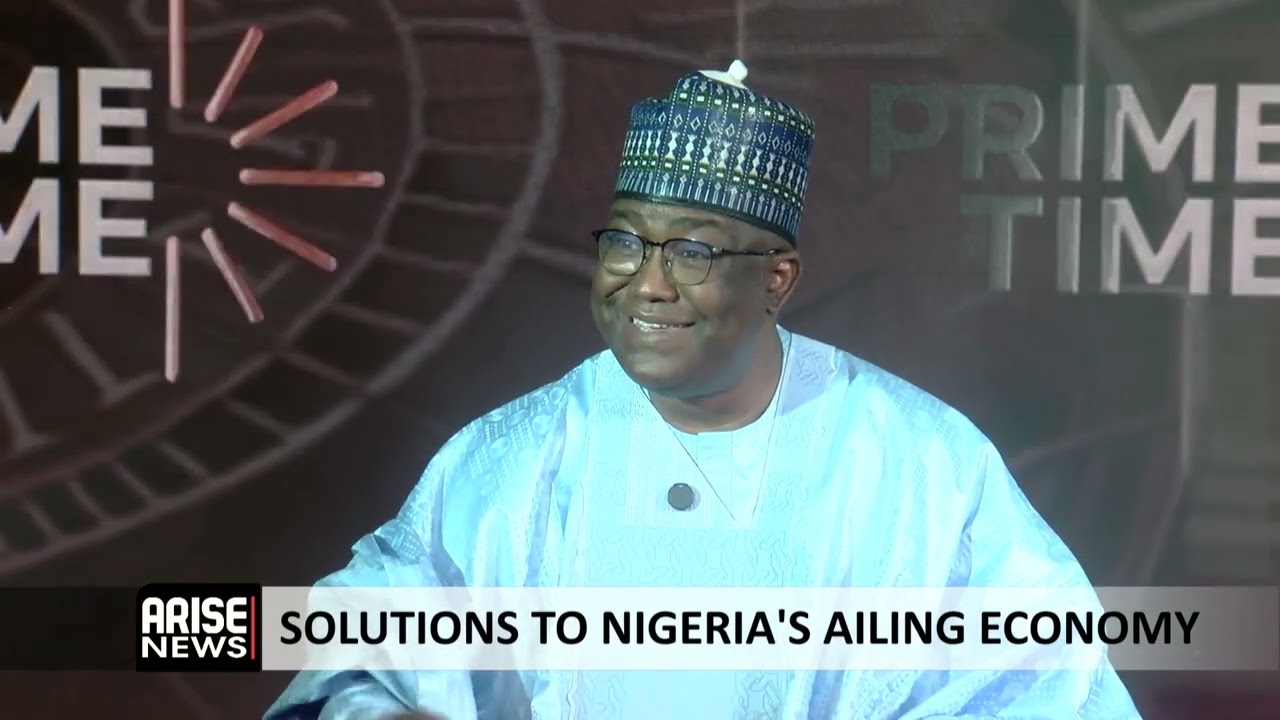
Former presidential contender and former governorship candidate in Kwara State, Gbenga Olawepo-Hashim, has declared that Nigeria’s economy has collapsed under the All Progressives Congress (APC), shrinking from about $574 billion in 2015 to roughly $230 billion today, describing the situation as evidence of deep policy failure rather than temporary reform pain.
Speaking in an interview with ARISE NEWS on Monday, Olawepo-Hashim said the dramatic fall in Nigeria’s Gross Domestic Product reflects a collapse across key productive sectors, insisting that official narratives of recovery do not align with economic realities experienced by Nigerians.
“Of course it reflects a real collapse in productive capacity. We’ve seen collapse in the agricultural sector, we’ve seen collapse in manufacturing. Nearly every sector of the economy has collapsed,” he said.
He argued that agriculture, once a stabilising force, has been severely undermined by insecurity and policy missteps, noting that Nigeria lost about $5 billion in the sector over the past two years due to attempts to artificially suppress food prices.
“When the Naira was over-devalued, the cost of imported inputs like herbicides went up over 100 per cent. Then, instead of supporting farmers, the government allowed massive food importation from countries where agriculture is heavily subsidised,” Olawepo-Hashim said. “What we ended up with was a near collapse of Nigeria’s agricultural sector.”
He added that currency devaluation has further depressed GDP figures when measured in dollar terms, stressing that Nigeria’s current GDP of about $230 billion is lower than what it recorded under former President Olusegun Obasanjo nearly two decades ago, despite a much larger population.
“Under Obasanjo in 2007, Nigeria’s GDP was about $278 billion when our population was around 120 million. Today, with over 230 million people, we are at $230 billion,” he said.
Rejecting claims that recent economic shocks such as COVID-19 explain the decline, Olawepo-Hashim argued that Nigeria still maintained GDP levels above $300 billion during the pandemic years.
“There was no COVID in the past year. Yet in just two years, GDP fell from over $300 billion to $230 billion,” he said.
Olawepo-Hashim dismissed projections by the International Monetary Fund (IMF) that Nigeria could become Africa’s third-largest economy by 2026, describing them as misleading and politically convenient.
“When you lose 50 per cent of your GDP, and then you post four per cent growth, you are still deeply in deficit. That is not real growth. This Mickey Mouse growth of four per cent cannot get Nigeria out of this quagmire,” he said.
He contrasted current projections with Nigeria’s historical performance, noting that the country achieved 5.5 per cent growth in 2000 and 9.5 per cent by 2003 under Obasanjo.
“What Nigeria needs now is not cosmetic reform. You need bold intervention — a Roosevelt-style New Deal — to get out of this level of economic depression,” he added.
Olawepo-Hashim criticised the Tinubu administration’s economic reforms, arguing they lack innovation and merely recycle policies first introduced during the Structural Adjustment Programme of the 1980s.
“There is nothing innovative in this so-called reform. We’ve been here since 1986. The difference is that there was more discipline then. Today, what we see is massive indiscipline,” he said.
Questioning official claims of a strengthening Naira and easing inflation, Olawepo-Hashim said the true indicator of economic health is the lived experience of citizens.
“The best indicator is the pockets of the people. Purchasing power has been wiped out. We have 18 million children out of school. People can’t get jobs. These realities disprove whatever data is being celebrated,” he said.
While acknowledging improved oil production levels, he argued that Nigeria should not be celebrating output of 1.8 million barrels per day given its population and resource base.
“Saudi Arabia, with about 40 million people, produces roughly the same. Nigeria should not be drumming and dancing about that,” he said.
He also questioned why the Naira remains weak despite higher oil production, subsidy removal and reduced fuel imports due to local refining.
“Basic economics says higher dollar supply should strengthen the Naira. So why is it still weak? Only the central bank governor and the finance minister can explain that,” Olawepo-Hashim said.
He alleged that money laundering and speculative demand by politically exposed actors have distorted Nigeria’s foreign exchange market.
“You give trillions of Naira at FAAC, and next week people are in the bureau de change buying dollars and storing them. That dollar is not going into production. So you don’t have a rational market,” he said.
Looking ahead, Olawepo-Hashim said that if given the opportunity to lead, his first priorities would be the oil and electricity sectors, which he described as foundational to economic recovery.
He reiterated his claim that Nigeria could grow into a $4 trillion economy within eight years, arguing that double-digit growth is achievable through aggressive infrastructure investment and the use of sovereign guarantees rather than increased taxes or austerity.
“Nigeria has massive infrastructure deficits. By using sovereign notes to give comfort to investors, we can stimulate up to $500 billion in investment in two years without borrowing or raising taxes,” he said.
On concerns about reform pain, Olawepo-Hashim insisted his approach would focus on growth stimulation rather than burdening citizens.
“A Roosevelt plan is not more taxes. It is using the sovereign power of the state to stimulate growth. Investors don’t need lectures; they need confidence,” he said.
Addressing concerns about internal divisions within the Peoples Democratic Party (PDP), Olawepo-Hashim blamed the ruling APC for destabilising opposition parties but said recent court rulings have at least created a pathway for nominations and internal resolution.
“Democracy is a law-governed process. We have moved from total paralysis to some level of recognition. That gives people hope that the party can function again,” he said.
Boluwatife Enome
Follow us on:


