


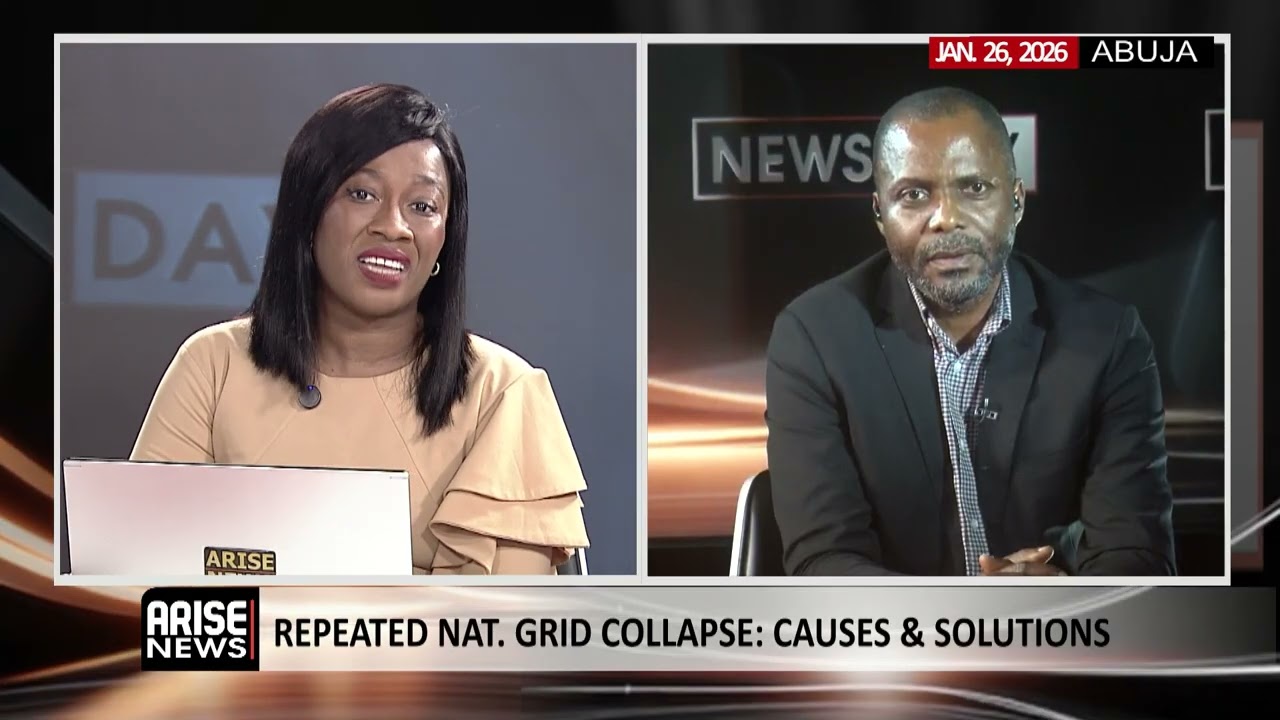
Energy analyst Nick Agunle has criticised Nigeria’s electricity sector, saying recent tariff increases have only deepened citizens’ hardship without addressing the structural weaknesses responsible for persistent power outages.
Speaking in an interview with Arise News on Monday, Agunle said the country’s recurring national grid collapses and poor electricity supply are symptoms of a flawed power sector reform that has remained unresolved for nearly two decades.
He argued that Nigerians were not surprised by the recent nationwide blackout, describing the collapse of the national grid as inevitable given years of underinvestment and mismanagement.
“I would rather be surprised that anyone was surprised that the national grid went down,” he said. “The challenges with our national grid are well known and they have been there across the ages.”
Agunle traced the roots of the crisis to the 2005 Electricity Power Sector Reform Act, noting that while generation and distribution were privatised, transmission was left under government control. According to him, this decision created a bottleneck that crippled the entire electricity value chain.
“By leaving transmission in the hands of government, the entire electricity privatisation process failed before it even started,” he stated.
He explained that although private investors acquired generation companies and had the financial capacity to increase output, the weak transmission network made expansion impossible.
“They cannot invest to generate more because there is no transmission capacity to wheel what they are generating out to the market,” Agunle said.
The analyst also criticised the licensing of electricity distribution companies to firms he said lacked the technical, managerial and financial capacity to serve a population of over 200 million people. He noted that many of the distribution companies are now insolvent.
“Licences were issued to entities with no experience, no capacity, and unsurprisingly, almost all of them are now bankrupt,” he said.
Reacting to the introduction of electricity tariff bands, Agunle said the policy had failed to deliver meaningful improvement, insisting that Nigerians were now paying more for unreliable supply.
“People are paying more for power, but because the infrastructure has not been sorted, we don’t have extra megawatts in the system,” he said.
“You are charging people a lot of money for power that is not there.”
He held the Minister of Power, Adebayo Adelabu, accountable for focusing on tariffs rather than addressing core infrastructure challenges, particularly transmission and distribution.
“If transmission and distribution had been fixed, we would not be having this conversation today,” Agunle added.
Comparing Nigeria with the United Arab Emirates, Agunle highlighted the scale of the country’s energy poverty.
“The UAE, with about 12 million people, generates 45,000 megawatts daily, while Nigeria, with over 200 million people, struggles with about 5,000 megawatts,” he said.
He dismissed arguments that transmission should remain under government control due to security concerns, citing Nigeria’s successful privatisation of the telecommunications sector.
“Our president and security chiefs use private-sector telecoms to discuss government business. Is that not more of a security risk than power transmission?” he asked.
Agunle called on President Bola Tinubu to take decisive leadership on the power sector, urging the federal government to limit its role to regulation while allowing private capital to drive infrastructure expansion.
“Electricity is the lifeblood of any modern economy,” he said. “Without it, Nigeria’s economy will never do well.”
He warned that unless Nigeria urgently revisits the fundamentals of its electricity reforms and attracts large-scale private investment into transmission and distribution, citizens would continue to face higher tariffs without reliable power supply, undermining economic growth and national development.
Triumph Ojo
Follow us on:


