


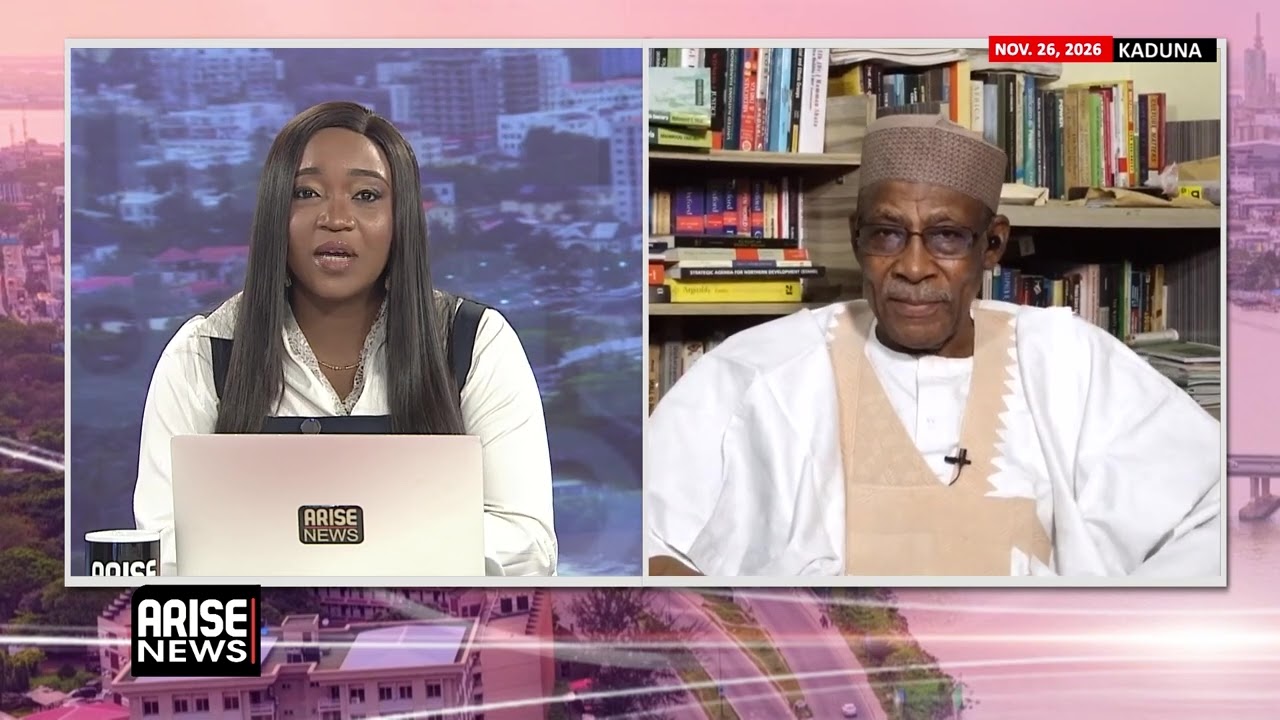
Publicity Secretary of the Arewa Consultative Forum, Professor Tukur Mohammed-Baba has described political campaign rallies as jamborees rather than genuine engagement saying politicians should spend time in communities listening to people instead of staging rallies while also alleging that political representatives were hijacking assistance meant to cushion the effects of economic hardship.
Speaking during an interview with ARISE NEWS on Thursday, Mohammed-Baba said the anger being expressed across the country was driven by worsening living conditions, poverty and insecurity rather than a North-South or religious divide.
“I find that to be more of an engaging political discourse than just jumping from one bandwagon to another, annoying people in traffic and so on. This is just jamboree. Let’s face it. It’s not political engagement. We may pretend all we like when we gather people to sing and dance and carry flags and be paid.
And then after the campaign rally, they start fighting each other on whether they have been fully paid for the promises. You know, it’s a public show, but I’m not impressed.”
He stated that the economic difficulties facing Nigerians had made it difficult for political appointees and governors campaigning for President Bola Tinubu to convince citizens about the government’s performance. “Let me say bluntly that citizens are angry. And I don’t think it’s confined to the north alone. How can you talk to someone who can hardly afford one meal a day about the performance of the government? It’s going to be very difficult because there is a dissonance between what they are experiencing and what they have been told. So it’s not a question of incompetence. I think it’s a question of the living conditions.”
Mohammed-Baba attributed the anger to rising poverty, insecurity, difficulties in agriculture, collapsed industries and poor power supply. “There is no doubt that standards of living have become very challenging. There is more poverty, there is more impoverisation, there is greater difficulties, the insecurity is not helping matters. People are not able to eke out a living from the primary productions that they used to be, agriculture and so on, which is very basic.”
He also questioned the impact of lower food prices, citing a video of a woman from Adamawa. “Yeah, maybe foodstuff has gone down, but at what expense? I saw a video clip of a lady from Adamawa complaining that while maize is selling at about 30,000, 35,000, the same thing with rice, the price of fertiliser is over 60,000 Naira per bag.”
On the role of northern governors and political appointees in securing support for Tinubu, Mohammed-Baba disclosed the their numbers were insignificant. “You ask me about the behaviour of the political appointees, governors, ministers, and others that should be campaigning for the president. Let me tell you that, like I said, the numbers, they are very, very insignificant compared to the total population. So even if they want to be, to what extent?”
He also raised concerns about political violence. “The political violence itself is not new. It’s always been there, you can say, right from our independence in different parts of the country. In the North in particular, you take our minds, we’ll take our minds back to 2011, where the national presidential election brought about a lot of violence, especially in places like Kaduna and other places, but nearly all over.”
On the economic policies of previous administrations, Mohammed-Baba said the current hardship had a history and did not begin under Tinubu. “There is no doubt that the present condition has a history. It did not start today. There was a president who was for eight years, you can say, more or less comatose. He didn’t do a lot.”
“But of course, he was helped by some factors, the fuel subsidies and the electricity and the foreign exchange changes were not as sudden and radical as had happened on May 29th, 2003, 2023, excuse me. So this sudden impact, which brought about a sudden drop, it was gradual. But all of a sudden, there was this big change.”
He maintained that many of the current government’s interventions were yet to make a meaningful impact. “I’ve travelled around our towns looking for CNG vehicles. They are not there. The fuel in the city of Kaduna, for example, when I see the queues lining up, trying to access CNG, and I keep asking myself, is it worth it converting my jalopy into a CNG vehicle? How long will it take? I mean, I count the number of man hours at the stations and I just shake my head.”
Mohammed-Baba also alleged that political representatives including ministers and legislators were diverting much of the assistance intended for families affected by the removal of fuel subsidy. “ There is no doubt, and we shouldn’t pretend about it, that a lot of the subsidy, a lot of the assistance coming are usually hijacked by the same people that should do something about it. That is the political representatives, ministers, legislators and so on. It doesn’t get to the people, not as much. Perhaps we’ll be talking about a different story now.”
Mohammed-Baba described the current government’s economic policies as a continuation of decisions made under the Buhari administration. “Certainly, Buhari was interrogated a lot for sluggishness of his policies and so on. You are right, I’m not an economist, so I will not make pronouncements on the subsidy. But let’s be realistic. For the last four years, the subsidy has been withdrawn. And if you ask me, it will be very difficult for a politician to convince me that this can be reversed overnight. But of course, maybe it should have been studied.”
He argued that governments should focus on sustainable policies rather than temporary interventions. “I think the problem is more of hunt and pack. Hunt and pack means a governor will, no, no, a hunter will go into the forest, kill an animal, sling it over the shoulder, go home and not worry about tomorrow, instead of domesticating animals and ensuring that these are available.”
He emphasised that governments needed long-term programmes in education. “What are you doing about school? What are you doing about healthcare? What are you doing about empowering people economically? If you are not doing it on a sustained basis, you know, the impact will be lost and people will not be convinced.”
Mohammed-Baba maintained that the country’s insecurity and infrastructure problems predated the current administration. “The roads did not deteriorate in just three years and so on. It’s the government response. You see, even when there is a famine, even when there is drought, it’s not so much that people are suffering, it’s the response of the political authorities.”
Turning to the approaching elections, the ACF spokesman said Nigerians should scrutinise political promises. “We should interrogate the promises. You see, the problem is we don’t have a sustained programme of engaging our leaders. It’s only when it comes to the ephemeral time we see them before elections.”
He criticised politicians for moving from one rally to another. “That is not political engagement. We have not seen community engagement. A president or any politician randomly picking a community, go and spend some three hours with them, speak about their condition, listen to them.”
“I find that to be more of an engaging political discourse than just jumping from one bandwagon to another, annoying people in traffic and so on. This is just jamboree.”
Mohammed-Baba decried rallies often involved people singing, dancing and carrying flags. “Let’s face it. It’s not political engagement. We may pretend all we like when we gather people to sing and dance and carry flags and be paid.”
Erizia Rubyjeana
Follow us on:


