


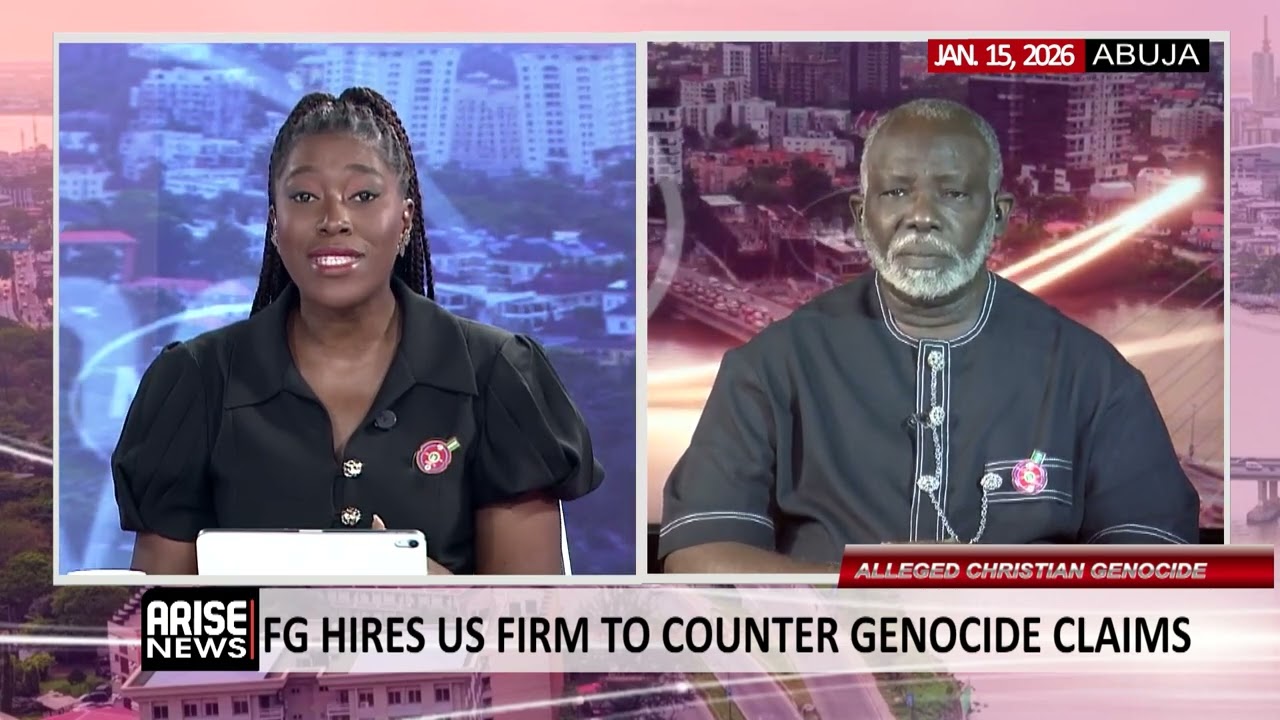
National Security and Defence Scholar, Kunle Fagbemi has stated that Nigeria’s decision to spend over $9 million on lobbying in the United States has sparked criticism from security experts, who warn the funds could be better used addressing urgent domestic crises, including attacks, abductions, and infrastructure rebuilding.
Speaking In an interview with ARISE NEWS on Thursday, Fagbemi questioned both the rationale and the cost of engaging lobby groups in the US, stressing that the expenditure could have been directed toward urgent security and humanitarian needs within Nigeria.
“Ordinarily, lobbying is not a bad idea in terms of engaging stakeholders. However, when you put it in perspective, we are dealing with a situation that when you do lobby, you want to provide additional data, which may help to corroborate, validate, verify, or otherwise determine. In this case where you’re talking about the US government relating with the Nigerian state, the first question you need to ask is, how do you understand the access and capacity of the United States to gather information and data to process, to reinforce their own foreign policy regarding your country?
If there was no poverty of intellectualism and rigours of analytic capacity on this part of the Nigerian state, it would have been open to us that the United States government already has multiple sources of gathering data concerning the Nigerian state.”
Fagbemi pointed out that the United States already interacts with Nigeria through extensive diplomatic, military, and development channels, making the lobbying initiative largely redundant. “There is a United States government, federal government of Nigeria relations at the diplomatic, the military, and through a series of overseas development assistance programmes, which allows them to access official data and to interact with state actors within the Nigerian space, which automatically means that in terms of their joint security working group, in terms of all the dynamics of training, intelligence gathering, and sharing, they have this.”
Highlighting the proliferation of open-source information and social media, Fagbemi noted that Nigeria’s diaspora and media ecosystem already provide a wealth of data. “One of the few things that we must never forget is that a number of data that are used by international and foreign missions all over the world are open source, and they are media-based. And you have the conventional media, the traditional media like Arise, that they can easily monitor and collect data from. And then you have the social media platforms. And when you are talking about the social media platforms, you’ll be talking in terms of Facebook, WhatsApp, you’ll be talking in terms of Snapchat, Instagram, and the like. It should interest us to note that X, that formerly was Twitter, we have 7.5 million Nigerians that are subscribed to X. And we have 48.7 million Nigerians on Facebook. On Instagram, we already have 9.9 to 12.6 million. TikTok, we have 37.4 million. On WhatsApp, we have 51 million penetration in terms of subscription. And we have Snapchat, YouTube, and all others.”
Fagbemi criticised the choice of lobbying intermediaries, questioning transparency and procurement procedures. “When you look at the fact that this is more of a procurement thing, then you will discover that how come the disclosure instruments by the DCI group has indicated that the intermediary entity that handled this is one ASTA Legal Services situated in Choice Plaza, Alkali Road in Kaduna. Is that entity an SPV under the security defence management architecture of the Nigerian state? If so, what exactly went through the office of the National Security Advisor in terms of the procurement procedures, according to which the appropriate committees of the National Assembly will do their oversight?”
He stressed the opportunity cost of spending so much on international lobbying while urgent domestic issues remain unresolved. “Whereas in terms of development, if you are to look at the spectrum of the sustainable development goals, you will discover there is a lot that we can do and achieve deploying that resource, particularly when you look at it from the angle of the internally displaced persons that do not have access to various amenities that will ensure that they have a standard livelihood and be properly catered for and allowed to live like human beings. When you look at it and compare and contrast the same with what I did in public domain before now, you need to ask yourself, how does this affect your integrity status? As it is now, indirectly, this is casting a splash on the officials of the Nigerian state, Now that we are now at this point that they are deploying resources for lobbying, it means that you must be mindful of how much are you spending for the rehabilitation of the IDPs?”
Fagbemi also drew attention to recent security failures that contrast sharply with the government’s spending on lobbying. “On the 3rd of January 2026, the story emerged around the 4th and the 5th of January. Another attack happened in Kwasandaji Market. Several people were killed, about 37 to 42. But the interesting part is, several others were abducted, numbers not known. But let me excite you even more. Some of the students from Papiri that were recently released were re-abducted. Till date, we have not seen any measure by the government to release them. But we are shelling out over a billion in lobbying.”
Fagbemi urged lawmakers to perform due oversight on the lobbying expenditure. “I am hoping that the National Assembly, particularly the Senate Committee on Intelligence and the House Columnary on Intelligence and then the Foreign Affairs Committees, are going to be gracious enough and responsible enough to do their due diligence of oversight to ask the questions. The identity of the interface entity on the Nigerian side is already known. The identity of the DCI group is known. And based on the right of disclosure clauses available in the United States government, there are some instruments already in public domain. One of which has identified that the authorising person on the Nigerian side is a certain Malam Nuhu Ribadu, who is the incumbent National Security Advisor, which automatically means that to do a thorough investigation and inquest is so simple and straightforward.”
He emphasised that the Office of the National Security Advisor should focus strictly on its statutory advisory role to prevent future misallocation of resources. “As it is now, indirectly, this is casting a spash on the officials of the Nigerian state that came out forcefully and were very voice ferrous in stating that there wasn’t nothing that can be related to what the accusation had indicated. And I want to believe that a certain Danny Abuhala, amongst others, will apologise to Nigerians. Danny Abuhala would be gracious to apologise to my very good friend and brother, that they got this wrong and they were only grandstanding. And when you are grandstanding, you need to understand there is a limit. Now that we are now at this point that they are deploying resources for lobbying, it is clear that we need to now ask them the question, Again, and I want to stress it, if the priorities of the Nigerian state under the incumbent administration was in tandem with sustainable development goals, there wouldn’t have been any reason for them to deploy this kind of humongous resource, which is already in the excess of 13 billion naira. When you put 13 billion naira in perspective, what it will give to you is very, very meaningful.”
Erizia Rubyjeana
Follow us on:


