


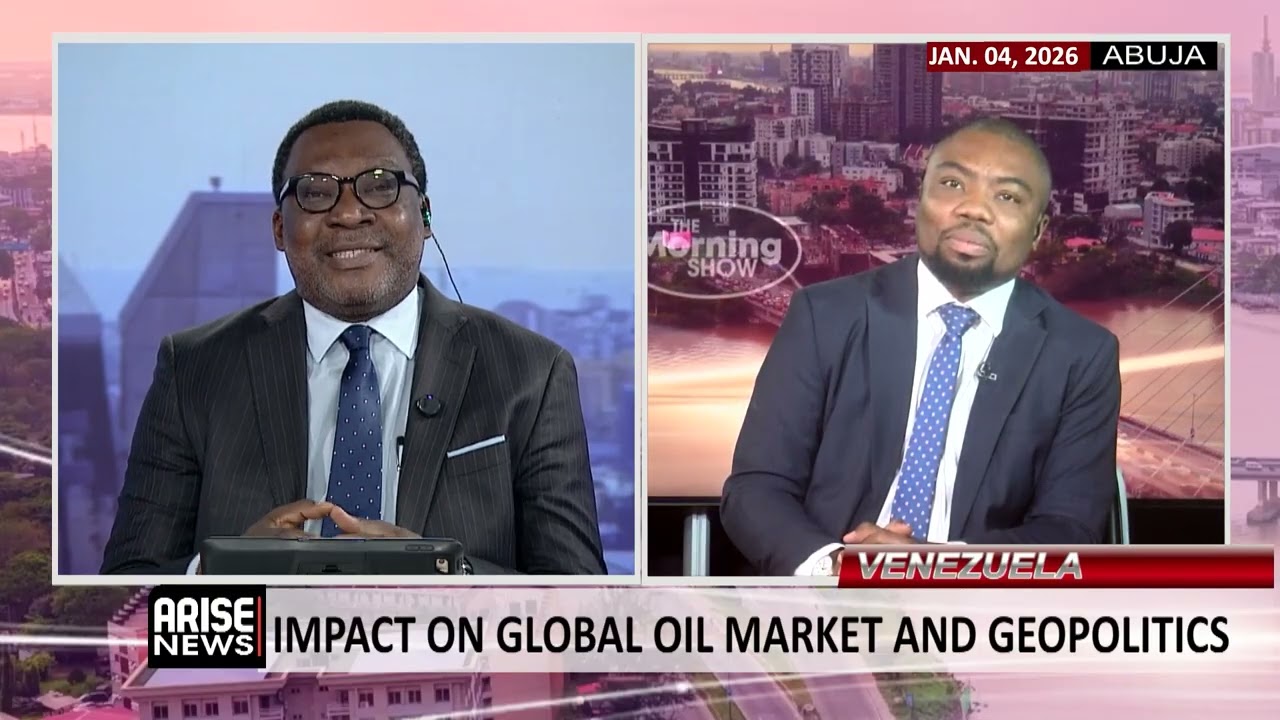
Economist and energy analyst Kelvin Emmanuel has said the United States’ arrest of Venezuelan President Nicolas Maduro is driven primarily by oil interests, with potential ripple effects across global markets and oil dependent economies such as Nigeria while advising against confronting the US over the matter.
Speaking on ARISE News Sunday, Emmanuel said the focus of US President Donald Trump’s move was Venezuela’s crude oil, particularly its heavy grades needed by American refineries.
“Oil. The answer is oil,” Emmanuel said.
He explained that Venezuela holds the world’s largest proven oil reserves but has struggled to sustain production levels due to years of underinvestment, sanctions and operational challenges.
“Venezuela has the largest proven reserves in the world… Today, Venezuela is barely able to do 1.2 million barrels per day,” he said.
Emmanuel added that although Venezuela has installed refining capacity of about 1.3 million barrels per day, its refineries are operating far below capacity.
“The refineries in Venezuela are not able to function above 130,000 barrels per day,” he said.
He said any immediate reopening of Venezuela’s oil sector to major international oil companies would take time, noting that production is not something that can be ramped up overnight.
“Give or take, it takes at least two to three years if you’re very quick,” Emmanuel said.
On short term market reactions, he warned that oil prices could come under pressure when trading resumes.
“When the oil markets resume tomorrow morning, you might see pressure on price down,” he said.
He added that prices could dip below a critical threshold in the near term.
“I see crude oil prices in the near term going below $60 and trading WTI Brents trading below $60 for the most part of this week,” Emmanuel said.
Emmanuel said the development could complicate Nigeria’s fiscal planning, given its heavy reliance on crude oil revenues.
“The oil price benchmark for 2026 appropriation is about $64.85, which in my opinion is very high. I think the government needs to be more realistic,” he said.
He also highlighted Nigeria’s relatively high cost of crude production.
“Nigeria has one of the highest cost production per barrels in the world,” Emmanuel said.
Addressing Nigeria’s diplomatic posture, Emmanuel advised caution, saying Nigeria should avoid directly confronting the US over the issue.
“Concerning Nigeria, I don’t think it’s wise for the Nigerian government to challenge the US government on it,” he said.
He urged Nigerian leaders to focus on domestic challenges rather than international disputes.
“I think Nigeria needs to be pragmatic and realistic,” Emmanuel said, adding that the country’s priorities should include security and food production.
On whether Maduro’s arrest could set a dangerous precedent for other resource rich countries, Emmanuel dismissed comparisons with Nigeria.
“I don’t think Nigeria descended to the point of Venezuela,” he said.
He added that relations between Nigeria and the United States remain cooperative.
“I think there’s cooperation. I think the line of communication is open,” Emmanuel said.
Emmanuel also argued that Africa has limited influence in the evolving global power structure.
“I don’t think Africa has the leverage to stand up to Donald Trump,” he said.
On the role of OPEC, Emmanuel said the group no longer has the influence it once wielded over oil prices.
“OPEC doesn’t have the kind of leverage that it used to have 10, 12 years ago,” he said.
He explained that rising US scale production and quota violations by some members have weakened OPEC’s ability to control supply.
Emmanuel said Trump’s preference for lower oil prices is tied to domestic US politics.
“Donald Trump wants lower crude oil prices because going into the midterms in 2026, lower crude oil prices means lower gas prices in America,” he said.
However, he noted that prices cannot fall too far without hurting US shale producers.
“The more prices drop below their benchmark… the more they are going to wind down some of their drilling rigs,” Emmanuel said.
He also warned that sanctions and political shifts could disrupt Venezuelan oil exports to key allies.
“You’re going to see reduced exports of Venezuelan oil to China… reduced oil export of Venezuelan oil to Russia… You’re also going to see reduced Venezuelan oil go to Iran,” he said.
Emmanuel concluded by questioning Nigeria’s preparedness to manage the fiscal impact of volatile oil prices.
Faridah Abdulkadiri
Follow us on:


