


A former presidential candidate and one-time critic of Nigeria’s major parties, Shitu Mohammed Kabir, has defended his decision to join the ruling All Progressives Congress (APC), arguing that the country’s refusal to build ideological political parties and adopt proportional representation has entrenched desperation, opportunism and a winner-takes-all political culture.
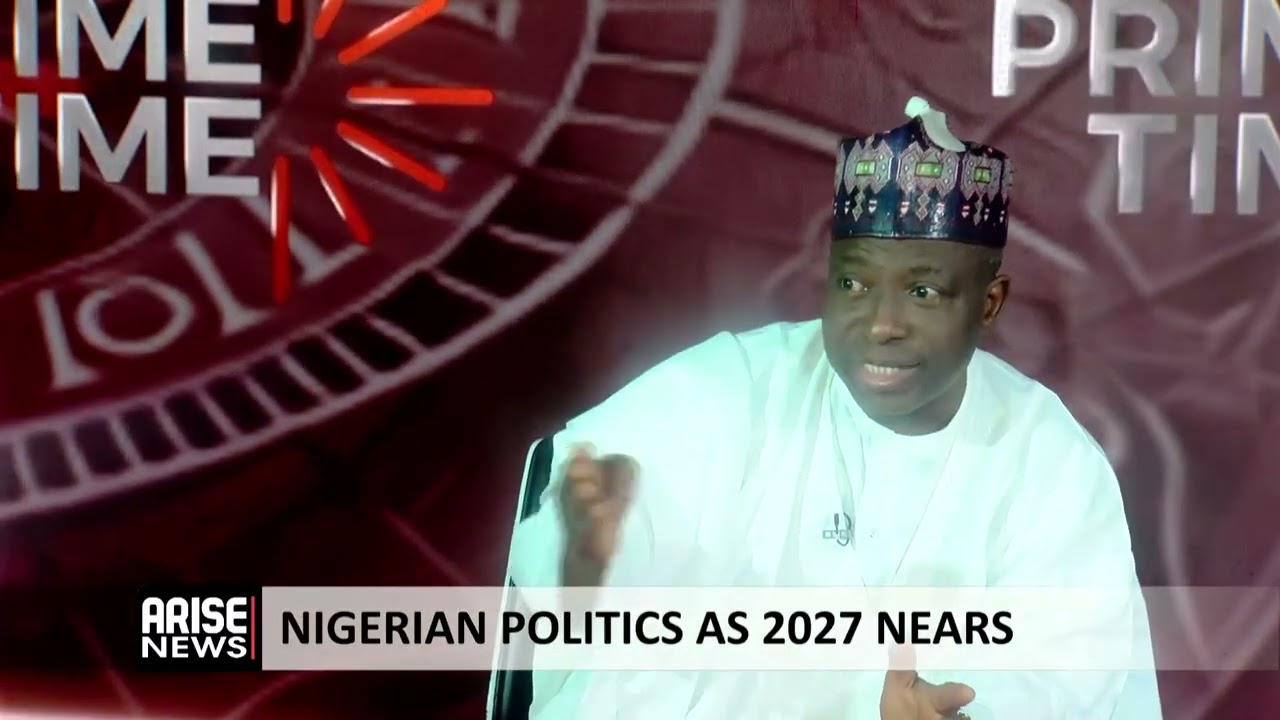
Kabir, a former leader of the Advanced People’s Democratic Alliance (APDA) and a past chairman of the Inter-Party Advisory Council (IPAC), made the remarks during an interview with ARISE on Wednesday, where he was challenged over what many Nigerians see as a shift from his long-held principled stance to political pragmatism ahead of the 2027 elections.
“What we have been telling Nigerians is now happening,” Kabir said. “As chairman of the Inter-Party Advisory Council, I brought two, three bills into the National Assembly. I brought proportional representation into the National Assembly, and we also brought up this local freedom, this local government State Electoral Commission.”
He argued that Nigeria’s democratic journey would have been stronger if those proposals had been adopted.
“We said, look, you must remove that to allow one single system, because these are two things that would have strengthened our democratic journey, and we wouldn’t have found ourselves in this mess that we found ourselves, because it’s a mess where everybody just knows ideology is absent. We have no ideological political parties now. All we want is to find a way to just get what I want to get,” he said.
Kabir explained that proportional representation would have encouraged ideological consistency and reduced desperation in politics.
“If we had done proportional representation, when a political party wins 20 to 30 per cent of certain votes at the national and state level, they would have certain percentages of legislators awarded to them. That promotes ideology, because people now know that, okay, if I’m a conservative and I get into the legislature, I’ll propagate that conservatism. If I’m a progressive and I get there, I’ll propagate that progressivism,” he said.
“People will now stay in the party. But we built our political system and parties in a manner that breeds desperation. It breeds desperation in the sense that if I have 49 per cent and A has 49 per cent and B has 51 per cent, B takes it all. The winner takes all. So you have to wait for another four years.”
Asked why the proportional representation proposal failed, Kabir said: “No, it didn’t go through. We worked with bodies like IRI and the Democrats, we moved it to the National Assembly, we propagated it, we sent it, but it couldn’t see the light of day.”
Responding to questions about ideology and his decision to join the APC despite earlier warnings about parties without belief, Kabir insisted that his principles had not changed.
“We refuse to build ideological political parties,” he said.
Pressed on why he was now in the APC if ideology mattered to him, Kabir replied: “Why do you call that a point? You cannot build an ideology or propagate an idea in isolation.”
“I’m not sacrificing my principle. What I’m doing is this: I believe that you cannot be in isolation. You can’t just develop and then propagate an ideology and stand alone. Because under the Nigerian constitution, you must be in a political party in order to compete,” he said.
“And again, for you to propagate ideology, within the little space of people that meet me, within my own little corner, we tell them we must build ideological political parties.”
Kabir rejected suggestions that his move mirrored the wave of defections to the APC driven purely by political calculation, insisting it was still possible to reform the system from within.
“I’ve told you why we could not build ideological political parties, and I want to let you also know that in order for you to build ideological political parties, it is not yet late. It’s not yet late,” he said.
“That’s why I’m here. We can be confirmed with ourselves in the evolution of power. You see that you can build ideological political parties.”
Drawing comparisons with federal systems abroad, Kabir said devolution of power was central to ideological development.
“If you know that today the federated units in the United States are given power to control their resources, to control their health system, education system and security system within those states, because everything is local, politics is local. And where we copied the presidential system from, they also go local,” he said.
On his long-standing advocacy for a two-party system, Kabir argued that Nigeria already effectively operates one.
“If you have two major parties, which we already have, from the time we returned to democracy in 1998 till date, we’ve always had two major parties competing for national elections, especially the presidential election,” he said.
He traced the evolution from the PDP and APP through successive mergers to the current APC–PDP dominance, adding: “If you look at the system, it has always been two major political parties.”
Kabir said constitutional reforms and devolution of power would reduce defections and strengthen ideology at the grassroots.
“In order for us to stop people from migrating from one party to another, let us look at it constitutionally. When you devolve power, it gives financial and political power to the federated units,” he said.
“Within my own state, I can go back to my local government, contest, and make sure that if I’m APDA, it is APDA that owns that local government. So the national parties will have to come and bargain with me. I can say, ‘This is what I want you to do for me if you win election.’ That is how we build both ideological and political systems and a society that is politically aware of its own power.”
Looking ahead to 2027, Kabir dismissed claims that elections would merely ratify decisions already taken by those in power.
“For us, we believe that it will still be highly competitive. I know Nigeria. I’ve been in politics for 34 years. I can tell you, it will look easy going, but when you get there, you will see it will be highly competitive this time around,” he said.
However, he admitted that Nigeria had not yet achieved elections driven by ideas.
“For those of us who believe in ideological political parties, we still believe. I cannot say categorically here that it will be ideological. We have not built that ideological bridge,” Kabir said.
“Nigerians have not come to terms with democracy. Nigerians still believe in collecting ten, ten thousand naira. Some of us may not believe in that, but that is the mindset.”
He cited his own political history as evidence of his commitment to ideology. “If I didn’t believe in ideological political parties, I wouldn’t have left RPN in 2007. Myself and Chief Sonny Okogwu put up RPN, and when that didn’t work, we came up with APDA, the Advanced People’s Democratic Alliance,” he said.
In a blunt response to a final question on whether principle still survives in Nigerian politics, Kabir said: “We are not here today.”
Boluwatife Enome
Follow us on:


