


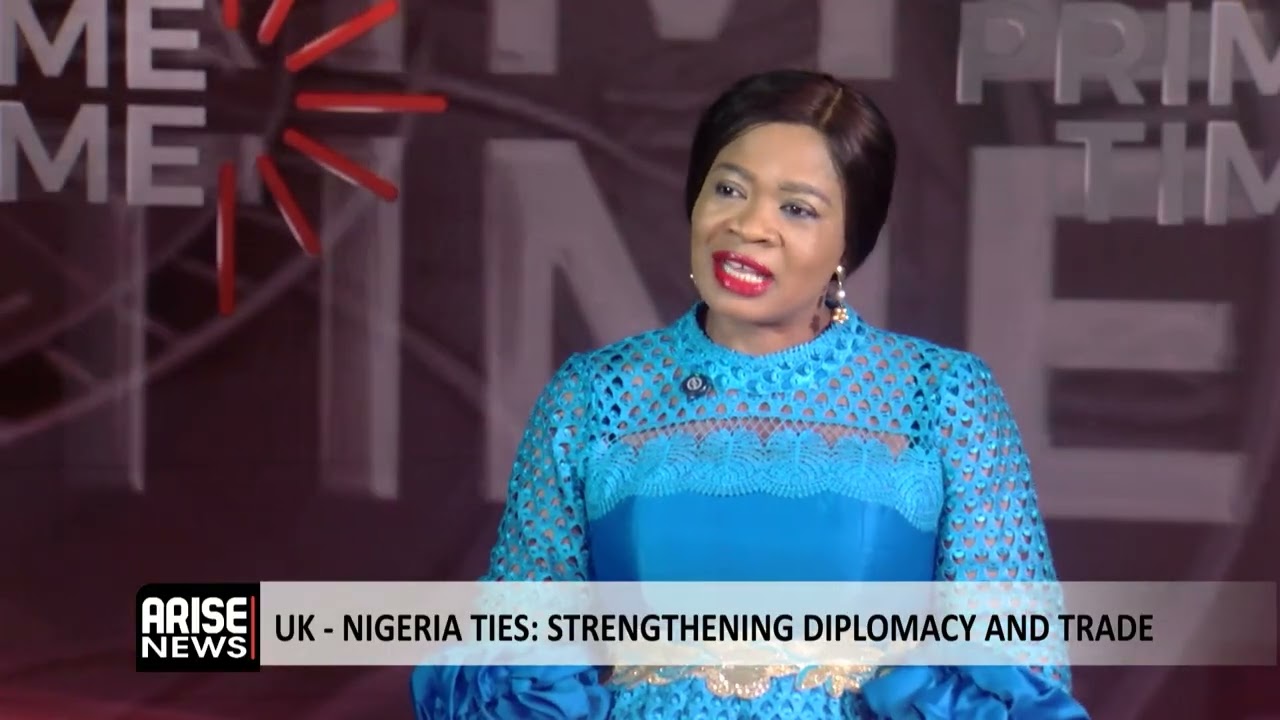
Former Nigerian Ambassador to Ireland and member of the League of African Ambassadors, Ijeoma Obiezu, has called for Nigeria to shift focus from signing agreements to ensuring their full implementation, stressing that real economic gains from the President’s recent UK state visit will depend on follow through.
Speaking during an interview on ARISE News on Thursday, Obiezu emphasised that while the visit produced notable agreements, including a £746 million port modernisation deal, the real challenge lies in execution.
“Talking from experience, you have so many, we don’t need new MOUs. We don’t need new agreements. We need to harness what has been done, and look for a way to really practicalise them for the benefits of both countries involved,” she said.
She, however, described the visit as strategic and timely, noting that securing tangible deals justified the engagement.
“Quite interesting. If there are no such deals, such as those, that visit would have been effort in futility. So permit me to say that that visit was quite strategic. It was timely. That was a diplomacy at its peak. Permit me to use that word,” Obiezu stated.
Despite the positive optics, she warned that Nigeria has historically struggled with implementing agreements, often allowing partner countries to benefit more due to weak follow up.
“Our attitude and our level of follow-up is not enough,” she said.
Obiezu stressed that beyond signing agreements, Nigeria must clearly define and aggressively pursue its national interests in all diplomatic engagements.
“You must say what you want and you pursue it. It goes beyond saying what you want. You must go all out to pursue it in order to get it,” she added.
On immigration agreements reached during the visit, including measures to ease the removal of undocumented migrants from the UK, Obiezu supported the move but called for improved domestic conditions to reduce outward migration.
“Yes, I quite agree. Just like Nigeria, if you don’t have the necessary requirements to be in anybody’s country, you don’t have any business. Being there. Being there. Be that as it may, we also need to put some measures in place to make our own home quite conducive and comfortable. The essence of life is livelihood. If you can’t find your livelihood here, you look for ways and means of meeting, you know, your livelihood,” she said.
She also urged Nigerians to act responsibly when travelling abroad to avoid reputational damage.
“I think Nigerians should apply restraints in moving up and down. They should go where they have the purpose and where they are allowed to come in to curb the embarrassment that we face out there,” she noted.
On the broader challenge of failed agreements, Obiezu identified inconsistency in ambassadorial postings as a major obstacle, arguing that frequent changes disrupt continuity and stall progress.
“We move ambassadors at will, without considering the pros and cons in taking such actions. It is not so in the international community,” she said.
She explained that such instability weakens Nigeria’s ability to sustain negotiations and complete long term projects.
“When you move them up and down, assuming an ambassador came in, and you know you have three years or four years to stay, even if it is one project that you have, you will pursue it until you achieve it. When another person comes, the person will start another project,” she said.
Obiezu also criticised the recall of Nigerian ambassadors without immediate replacements, describing the resulting diplomatic vacuum as costly.
“Because nature forbids vacuum. That vacuum has cost us a lot, but we are not talking about it,” she said.
While acknowledging that ambassadorial appointments are the prerogative of the President, she suggested that poor briefing may have contributed to the decision.
“I think he wasn’t properly briefed. Let me use that word. He wasn’t properly briefed before the recall of the ambassadors that I was one of them,” she stated.
On security concerns raised during the visit, particularly allegations of religious killings in Nigeria, Obiezu said the government must better communicate the complexities of the situation.
“There are killings and there are one-time killings, but it is not only Christians that are being killed. It’s not only Christians that are being killed in Nigeria. There are bombings and there are killings and there are kidnappings. But it’s not only Christians that are affected in all of this,” she said.
She added that diplomatic engagements should be used to clarify such issues to international partners.
Obiezu also welcomed joint Nigeria UK efforts to tackle visa abuse and criminal networks, describing the initiative as necessary.
“That’s a good one. That’s a good one in order to curb, you know, the incessant migration without documentation. And it causes a whole lot of havoc, not only to the nations involved, even to the individuals,” she said.
On the role of the First Lady during the visit, she commended her advocacy on morality and gender inclusion, noting that women bring value to governance and national development.
“We are not just asking for a space or a seat at the table. And if we are given such seats, I don’t think the men, with all due respect, are doing us any favor. You know why? Because we are bringing in value,” she said.
Highlighting cultural diplomacy, Obiezu said Nigeria’s relationship with the UK extends beyond trade and security to shared heritage.
“Nigeria and UK relations does not end in security, economic ties and trade. It’s also we share rich cultural heritage,” she said.
She further pointed to symbolic gestures during the visit, including the British monarch’s use of Nigerian languages, as evidence of mutual respect.
“That shows that we have a very strong diplomatic ties with the UK. We do have a very strong diplomatic tie,” she added.
While the reception of the President at Windsor Castle drew attention, Obiezu downplayed its significance, urging focus on the substance of the visit.
“What is important and paramount is the essence of the visit, not where you were hosted,” she said.
Faridah Abdulkadiri
Follow us on:


