


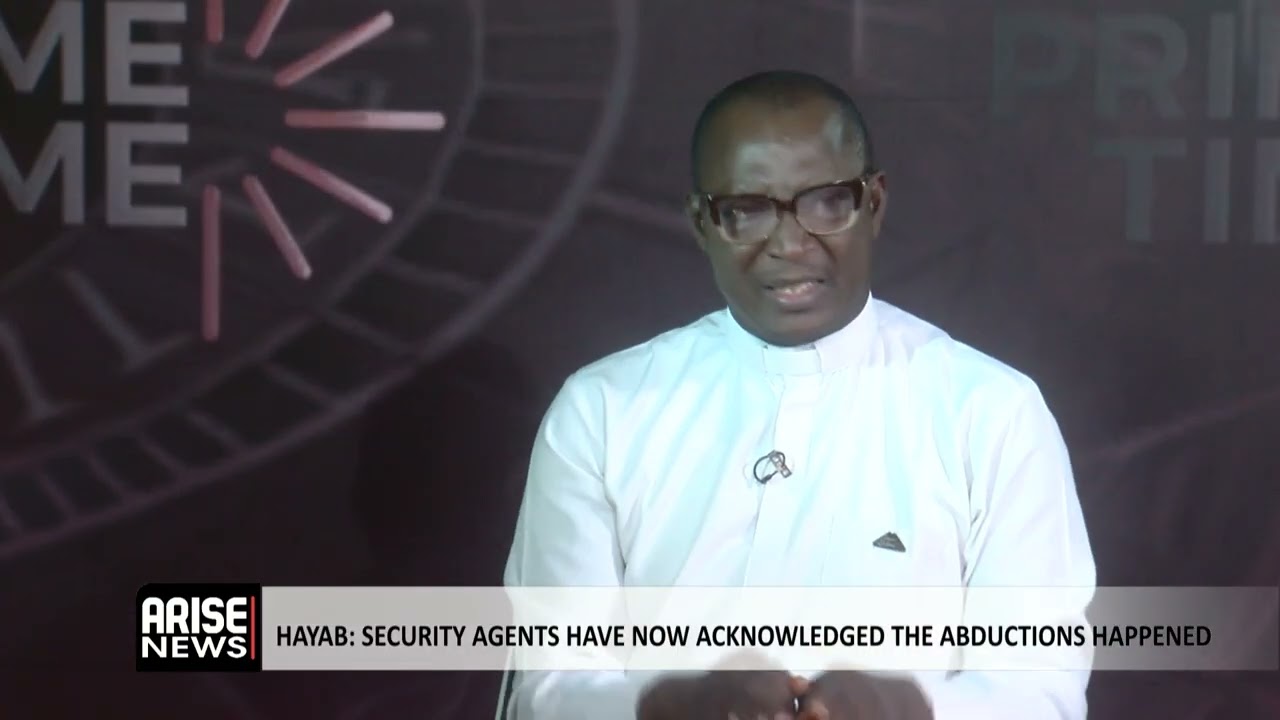
Chairman of the Christian Association of Nigeria (CAN) in the 19 Northern States and the Federal Capital Territory, Pastor Joseph John Hayab, has said security agencies have now acknowledged that worshippers were abducted from churches in Kajuru Local Government Area of Kaduna State, following initial public denials that sparked confusion and outrage.
Speaking during an interview with ARISE News on Tuesday, Hayab said discussions with security authorities confirmed that “innocent Nigerians were taken away from their church” during Sunday worship in the forest community.
“Over an hour ago, we were all on the same page,” he said. “This unfortunate incident happened. Innocent Nigerians were taken away from their church. There is no longer debate about it.”
“If they have not acknowledged it publicly, they have acknowledged it to us as Christian leaders,” he added. “They have given us a promise that they will go after them.”
Conflicting accounts had earlier emerged after local sources reported that three churches were attacked and dozens of worshippers abducted, while security authorities claimed troops found no evidence of an attack.
Hayab rejected claims that the incident was fabricated, insisting that CAN’s information came through its long-established grassroots network.
“The Christian Association of Nigeria is highly connected,” he said. “We operate from the national level to the region, the states, the local governments and down to the ward level.”
“Our system of communication is such that we do not have difficulty knowing when, where and how things happen.”
He said he received the first alert at 2:56pm on Sunday, even though the Kaduna State CAN chairman was out of the country at the time.
“The message came to my phone telling me that unverified numbers of worshippers were taken from churches in Cherebun and Serebun I and II, sometimes called Bishara, Haske, and a nearby ECWA church,” he said.
“They later sent another message to say that gunmen shut the entire church, lined the worshippers up and marched them into the bush.”
Hayab explained that fear and displacement in the community initially made verification difficult.
“Because of fear at the time, nobody could immediately verify who and how many were taken,” he said. “That was why we were careful with numbers.”
He said the situation escalated after reports appeared in the media.
“The first group to break the news publicly was Sahara Reporters,” he said. “One of our pastors posted it on Facebook because it actually happened.”
“When that broke, calls were coming from everywhere asking questions. We were not ready to speak because we wanted to be sure.”
Hayab admitted that figures circulated publicly, including claims of 163 abducted, but stressed that CAN never intended to sensationalise the incident.
“A lot of people were kidnapped — that is the truth,” he said. “Some escaped and returned, which affected the numbers.”
“What we told government is: let us not debate too much about numbers. Let us focus on the fact that people were taken in good number.”
He expressed anger over the initial denial by security agencies.
“The moment the incident happened, security agencies were informed,” he said. “That was why we were worried and angry — how could they later come out to deny it?”
“That denial was the most unfortunate statement,” he added. “I sympathise with Governor Uba Sani, who is working hard, only to receive wrong information.”
Hayab said local officials had earlier confirmed the incident privately.
“The council chairman was the first person to give us the figure,” he said. “So we were shocked to hear him later say publicly that he didn’t know about it.”
Asked whether security agencies were mistaken or deliberately withholding information, Hayab chose his words carefully.
“If I accuse them of withholding information, it will be bad for their image,” he said. “But if I say they were mistaken, then we can dialogue.”
“Sensitive issues like this must not be treated with kid gloves.”
He also explained why CAN was forced to respond publicly.
“When Sahara Reporters went public, we were boxed in,” he said. “Everybody was asking us questions.”
“This became a test of integrity and honesty,” he added. “Imagine the families of those kidnapped hearing someone say it never happened.”
“If there was fire in your house, you would shout. You wouldn’t keep quiet and let the house burn.”
Hayab said CAN has never fabricated security incidents.
“We have never come out publicly to make negative statements to injure government or anyone,” he said. “We produced names. We even have some who escaped with injuries.”
“In good number, people were taken. What we are simply calling for is: get our people back.”
He warned that the Kajuru incident was part of a wider security threat.
“In the last few weeks, we have credible intelligence of deliberate plans to attack Christians in Niger, Kogi, Kwara and other vulnerable states,” he said.
“These are terrorists.”
“Terrorists are out to torment this country and create confusion,” he added.
Hayab rejected suggestions that the attackers were merely bandits.
“Differentiating bandits from terrorists sometimes confuses Nigerians,” he said. “The President himself has said that any group that takes arms against Nigeria is a terrorist group.”
“So I align with my President and call those who took worshippers from church terrorists.”
He also dismissed claims that abductees were released to raise ransom.
“No one was released to scout for money,” he said. “They escaped.”
On concerns that such incidents could be internationalised as evidence of persecution, Hayab said transparency was key.
“This was an opportunity for Nigeria to show commitment,” he said. “If security agencies had simply acknowledged it and said, ‘We will go after them,’ Nigerians would have applauded.”
“Nigerians just want assurance — and action.”
He urged security agencies to work closely with communities.
“What we see and know at the grassroots is often more than what authorities see,” he said. “This work you are doing is our work.”
“We need you just as you need us.”
Hayab concluded by calling for a holistic security approach.
“We don’t want Christian communities safe while others are not,” he said. “If my neighbour is not safe, I am not safe.”
“We must win the trust of citizens, carry them along, and correct lapses,” he added. “That is how Nigeria will be safe.”
Boluwatife Enome
Follow us on:


