


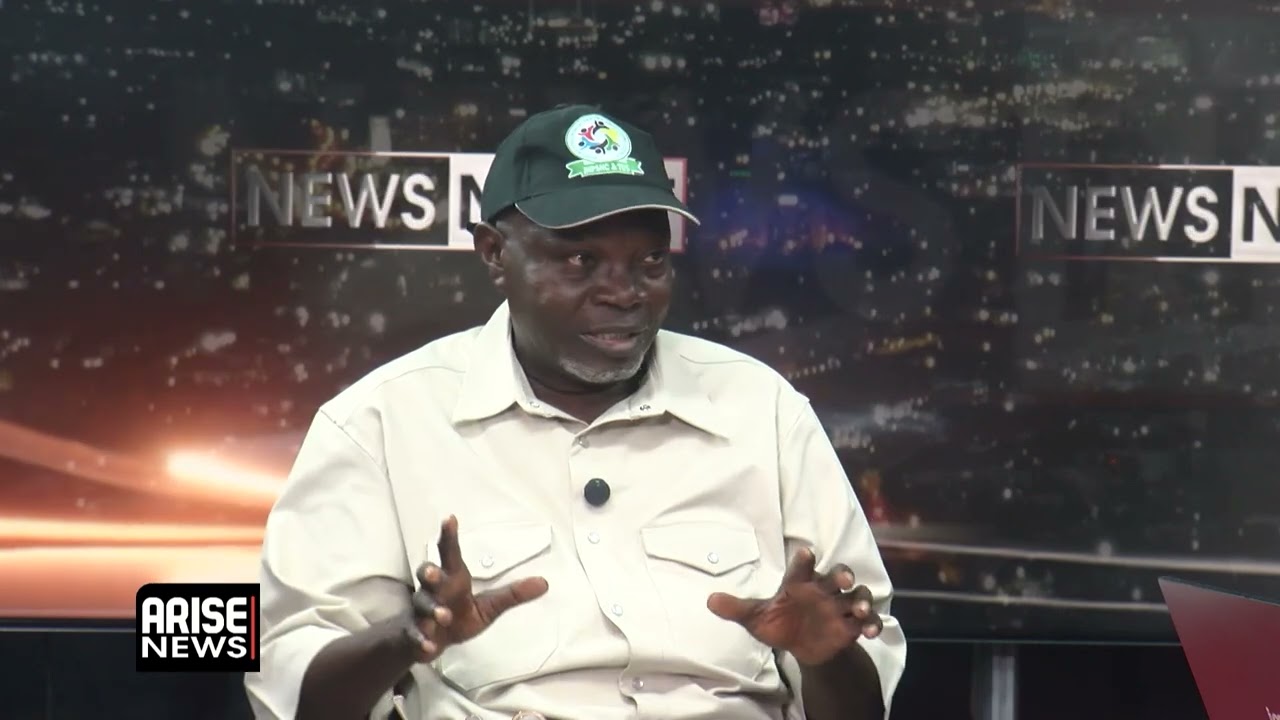
The national secretary of the Joint National Public Service Negotiating Council, Comrade Gbenga Olowoyo, has described the Federal Government’s six-month ₦70,000 transport intervention for workers, scheduled to begin in November, as a positive development following negotiations between the government and organised labour.
Olowoyo made this known in an interview on ARISE NEWS on Tuesday, following a meeting between organised labour and the Federal Government that lasted more than six hours, during which both parties discussed workers’ welfare, the rising cost of living and demands for measures to cushion the impact of increased petrol prices.
He said the agreement, reached through negotiations chaired by the Minister of Labour on behalf of the government, provided for a ₦70,000 transport intervention for workers for six months, beginning in November. Olowoyo described the outcome as a positive development, expressing confidence that the government would honour its commitment to implementing the agreement.
“I think with the recent development that happened today, the negotiation lasted over six hours, and with the outcome of the meeting, I think it is a good omen. I want to believe that this will be a very good development and for further discussion.
“First and foremost, the agreement is a product of a mandate given to the Minister of Labour, who shared the meeting from the government side. I want to believe, and I equally want to say at this moment, that merely entering into signing an agreement is a commitment on the part of government. They told us that, in as much as we have entered into this agreement, it will be implemented, and as it has been now, with effect from November.
“The issue of 70,000 Naira is a transport cost intervention to workers at all levels because it goes to the grassroots. With that, we saw some element of sensitivity on the part of government, especially on the issue of reduction in price of fuel at the point we realized that it was a technical issue which we didn’t want to box government to a corner.
“But we want to believe that with this intervention they have brought forward, that is 70,000 Naira within the next six months, I think we want to believe that we treat now and six months, as other things will follow.”
Olowoyo said the benefits of the agreement would extend beyond the unions initially involved in the negotiations, noting that the Nigeria Labour Congress (NLC) represents more than 40 affiliate unions.
“The affiliate of NLC is over 40 unions. And now that the NLC is, in fact, there is no one can dispute this, because what we have been able to achieve, we cut across workers, in respective of whether you are affiliated to NLC or not, because the fight is a collective fight. That is why most of the time, as leaders, when you are agitated, you know, this matter started with JNC with eight unions.
“And when our leaders now came in and said NLC is on board, you know, it is as good as, by way of consequence, all unions in the public service, all workers that belong to all unions—it doesn’t matter whether you belong to NLC or not, it’s a matter of worker. So ultimately, the benefit is not for the body that left us.”
Maintaining that the Federal Government’s decision to enter into an agreement with organised labour demonstrated its commitment, Olowoyo said he expected the government to establish a tripartite committee to discuss minimum wage negotiations, which was one of labour’s key demands. He added that the agreement provided a basis for further discussions and that the government had committed to implementing its terms.
“I want to believe that if they are not serious with the reason why we are asking for it, now that we have entered into a Congress agreement, it is as good as they set it up, and that is what we got the new milestone for our discussion.
“The commitment is first of all entering into this agreement, and secondly, they said that it will be given effect. What else do you want?”
Olowoyo said the body was maintaining its proposed ₦500,000 minimum wage, arguing that the amount reflected the financial demands on workers supporting their immediate families and other dependants, including children’s education and household needs. However, he stressed that labour remained open to reasonable negotiations and was not rigid in its position.
“We are not going to shake it out on our on our template. The templates of 500,000 Naira is still subsisting. And at the same time if government is able to dance around 500,000, we would be alright to support president. So I want to believe that, like I told you, we are not going to be rigid, but at the same time, we’ll be reasonable.”
Expressing confidence that the Federal Government would fulfil its commitments, Olowoyo said the six-month ₦70,000 transport intervention would provide a window for further negotiations, adding that organised labour expects a new minimum wage agreement to be reached before the support period ends.
“We know government is going to implement it because that is commitment already.
“So let’s stick with that 70,000 Naira transport support from the calculation of six months ends in April of 2027 after the 2027 elections. This particular intervention now is an intervention, and we did six months. And I want to believe that, within that six months, since the government will offer—not like we will sign this agreement, we may reject it. But at the same time, we saw some element of reason in this particular agreement. Then we have to key in so as not to come out with nothing.
“So on the basis of that, and I want to believe that starting from that point, and ending at the point of six months, I want to believe before that time, now you will have agreed on minimum wage. That is it.”
Favour Odima
Follow us on:


