


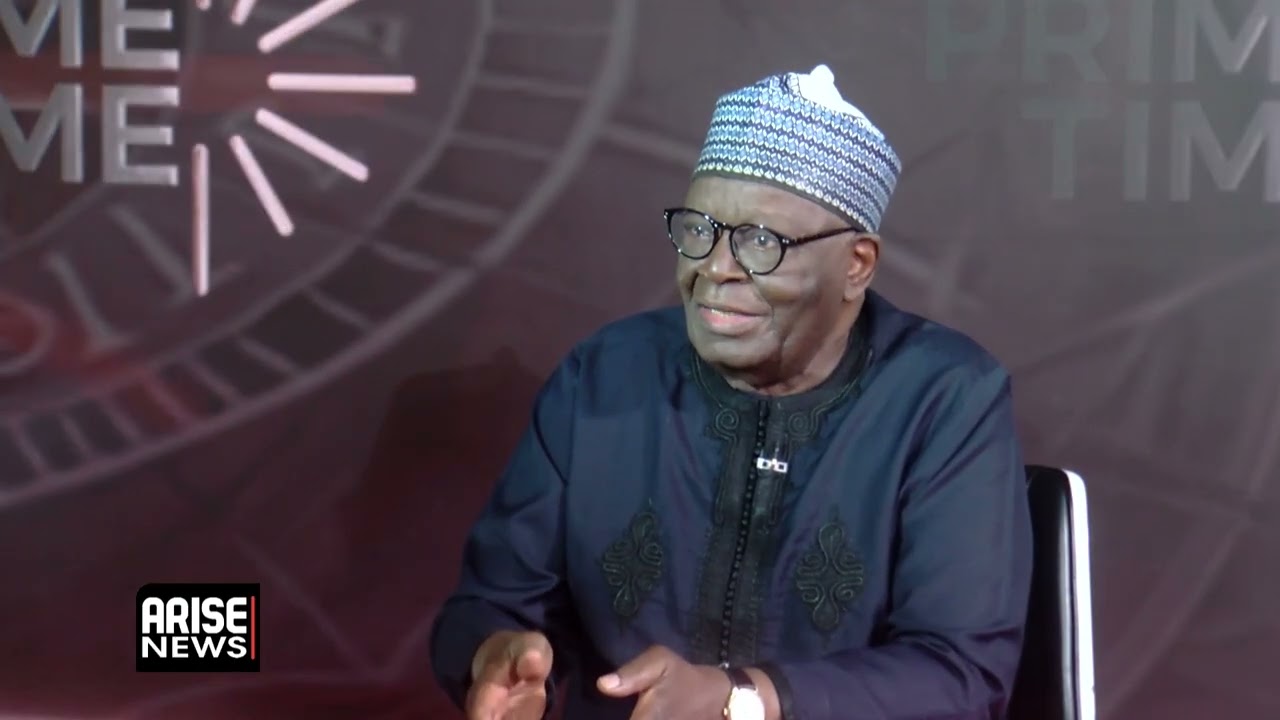
Former Chief of Staff to President Muhammadu Buhari and renowned diplomat, Professor Ibrahim Gambari, has warned that Nigeria is already behind schedule in laying the foundations for credible elections in 2027, blaming weak political parties, poor governance, lack of consequences for misconduct and the absence of national consensus on democratic values.
Speaking during an interview with ARISE News on Monday, Gambari said Nigeria’s democratic crisis could not be solved by rhetoric or strong personalities alone, insisting that only strong institutions, internal party democracy and accountable leadership could safeguard the country’s future.
“I think we are behind schedule, but it is not too late,” Gambari said. “Leadership is key.”
Gambari, a former United Nations Under-Secretary-General and Nigeria’s former Minister of External Affairs, said the institution that worried him most was the political party system.
“Political parties — that is the one that bothers me the most,” he said. “Because if you have strong political parties, even the fear of Nigeria becoming a one-party state will not arise.”
He said Nigeria’s political parties lacked identity, ideology and internal democracy.
“Political parties must stand for something that people can identify with — something against which their performance can be judged,” he said. “That is so much absent, and I am very worried about that.”
While dismissing fears of Nigeria becoming a one-party state, Gambari said history showed such ambitions always failed.
“In the First Republic, the NPC became very strong and powerful. They did not discourage the disintegration of the Action Group, but it did not work. We saw the end of that,” he said.
“The NPN later called itself the ‘superpower’. It did not lead us to progress. The PDP once said it would rule for 60 years. We know how that ended.”
However, he stressed that democracy could not thrive without reforming political parties.
“If we want a system that is not winner-takes-all, then we must think about proportional representation,” Gambari said. “But you cannot have proportional representation unless you have strong political parties.”
He said internal democracy was critical.
“The antidote to anti-democratic forces is more democracy, not less — starting from political parties,” he said.
Turning to the Independent National Electoral Commission (INEC), Gambari said the electoral umpire must be beyond reproach.
“They are the referee,” he said. “INEC must be like Caesar’s wife — beyond suspicion.”
He suggested Nigeria should review how INEC officials are appointed.
“It is not really about whether they are judges or professors,” he said. “It is about people of proven integrity and track record.”
Gambari said politicians themselves were a major part of the problem.
“Unfortunately, many of our politicians do not believe in fair play,” he said. “If they win, they win. If they lose — no matter how free and fair the election — they blame the referee.”
He said Nigeria must eliminate excuses for electoral disputes.
“We must never leave room for scapegoating,” he said. “People must believe in the rules of the game.”
Drawing on his recent experience leading an ECOWAS election observation mission to Senegal, Gambari contrasted Nigeria’s situation with Senegal’s political culture.
“Senegal is a much smaller country than Nigeria, but you will not believe the commitment of the political elite to free and fair play,” he said.
“There is an absolute refusal to allow any president to alter the rules to favour themselves.”
He said Senegal’s elections were conducted without intimidation.
“The security forces were doing their jobs discreetly,” he said. “They were there to facilitate, not to intimidate.”
Asked how institutions could be strengthened beyond rhetoric, Gambari said change would only come through civic pressure and leadership.
“Power does not concede except by demand,” he said. “We need civic education, political education and activism to insist on strong institutions.”
He proposed what he called a national movement.
“I propose a movement for real democracy and the strengthening of democratic institutions,” he said. “It will not happen by accident.”
Gambari said Nigeria’s elite continued to exploit institutional weaknesses because there were no consequences.
“There are no consequences when they misbehave,” he said. “Where there are no consequences, the behaviour will continue.”
Using political defections as an example, he said some democracies declared seats vacant when elected officials defected from the parties that sponsored them.
“That is because voters voted for a platform, not false pretence,” he said. “There must be consequences for behaviour that weakens institutions.”
He warned Nigerians against expecting salvation from individual leaders.
“Do not expect that one person — Buhari, Babangida, Tinubu or Jonathan — will come with a magic wand and solve our problems,” he said.
Reflecting on his time as Chief of Staff to President Buhari, Gambari said Nigeria missed an opportunity to entrench democratic norms.
“Yes, we did,” he said. “President Buhari was a convert to democracy.”
He said Buhari evolved from a military ruler to a democratically elected leader.
“He used to say that in the past, people were locked up and presumed guilty,” Gambari said. “But he realised that under democracy, you cannot just lock people up.”
However, Gambari said Nigerians failed to consolidate that transition.
“What did we, the people, do to make democratic behaviour the norm rather than the exception?” he asked.
On preparations for 2027, Gambari said Nigeria also lacked dialogue between political parties.
“Since when have you seen leaders of all political parties come together in the interest of Nigeria?” he asked. “They only meet to sign documents around elections — which they later disrespect.”
He said Senegal succeeded because of national consensus.
“There is consensus that no president should extend their stay beyond the constitution,” he said. “What do they have more than us? Commitment.”
Gambari also stressed the importance of meritocracy, recounting his interaction with Singapore’s Public Service Commission.
“They identify talents from secondary school, mentor them and prepare them for leadership decades ahead,” he said. “Once meritocracy becomes national consensus, governance improves.”
He lamented the decline of mentorship in Nigeria’s civil service.
“I am a beneficiary of meritocracy,” he said. “Not because I am Fulani or from Kwara, but because people believed in mentoring and excellence.”
Addressing insecurity in the North-Central region, Gambari said Nigeria was failing to address root causes of conflict.
“When you have a wrong diagnosis, you will have a wrong prescription,” he said. “I saw this in Sudan and Rwanda.”
He identified poor governance, exclusion, centralisation of power and lack of accountability as major drivers.
“You either share power or you ultimately lose power,” he said. “And prolonged absence from power also corrupts.”
He concluded with a warning.
“We may have different backgrounds, but we have a common future,” Gambari said. “If we do not address governance, inclusion and accountability, the consequences will be severe.”
Boluwatife Enome
Follow us on:


