


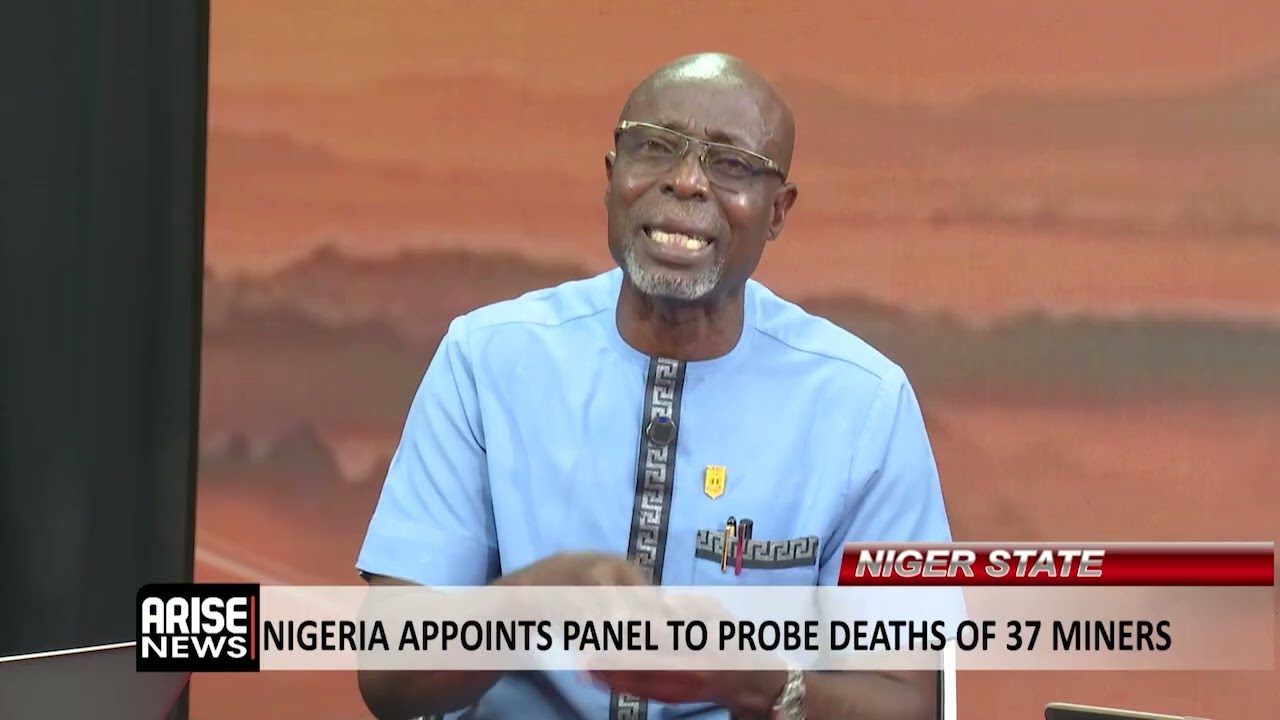
The Controller of Corrections, (RTD), and former spokesperson of Correctional Services, Dr Francis Enobore, has urged Nigerians to exercise patience and restraint while medical investigations determine the cause of death of 37 illegal miners in Niger State.
Speaking during an interview on ARISE NEWS on Monday, Enobore, who commiserated with the families of the deceased, expressed confidence in the panel set up by the FG, and that it must thoroughly investigate the incident and determine what went wrong.
“To start with, I want to sincerely extend my heartfelt condolences to the family members of those that lost their lives in this unfortunate incident. It’s quite painful.
“I have very strong confidence in the panel that the Federal Government has constituted to look into the unfortunate incident, so that they can drill down to know what exactly happened.
“Stories are flying in the air. Some are saying one of the survivors allegedly said chemicals suspected to be poisonous were sprayed into the cell, and even when they started banging on the door to draw attention, they were not answered. As bizarre and weird—if you like, puerile—as that excuse may be, I still want to exercise restraint in pushing it aside with a wave of the hand because medical investigations are ongoing. So let us wait to know what went wrong.
“I want to try to avoid reducing it to the level of speculation. Let us drill down and know what went wrong. So these are some of the issues that I would want to say. Let us exercise a little patience, and I’m very hopeful that we will get to the bottom of it.”
On support for the families of the deceased, Enobore called for psychosocial assistance from experts to help them cope with the trauma, adding that a genuine investigation would also help calm their nerves.
“For me, I think beyond the immediate family members of those that lost their lives, Nigerians would like to seek some level of justice being done. Yes, it’s quite apposite for the government to relate well with the families of the deceased, bringing experts to offer psychosocial support for them, calm their nerves, and one reassuring action that will further help to calm the nerves of these people will be a genuine investigation process.”
Speaking further on the management of detainees in Nigeria, Enobore described the incident as an isolated tragedy, stressing the need for adequate training, risk assessment, intelligence gathering and effective emergency response protocols in custodial facilities.
“Death cannot really be ruled out in human existence. But a tragedy of this magnitude, I think for me, is an isolated incident.
“Keeping people in custody, that is what we call cell management. Cell management is such a complex dynamic that you need adequate training, capacity building, a lot of intelligence gathering to know how to profile people, risk and needs assessment of those to be kept in custody is part of what I’m talking about.
“Beyond that, you the facility manager, what type of knowledge you have as a first aider in case anything happens? While you are doing all that, how do you ensure that as you are evacuating those in distress, the other suspects do not escape? It’s such a complex mix that you need adequate training, retraining, capacity building for you to be able to manage a situation like this.”
He also questioned the size of the cell where the 67 persons were held, noting that while developed societies provide about 48 square feet per person, Nigerian detainees may get less than half of that, which he described as unfortunate.
“One thing that stands out, which like I said earlier, the information is still sketchy, is to know the number of persons that were kept in that cell. What is the size?
“What is the size of the cell? We all know that in developed societies, you have as much as 48 square feet per person. But in our own environment, you may get—you may not even get half of that, which is unfortunate though.
“It speaks further to how we manage pre-trial detainees. I have always cried at every forum I find I have the opportunity to speak on this issue. Management of pre-trial detainees remains a very big problem that we are yet to get right in this environment, and we need to work on it,” he said.
Highlighting measures to prevent a recurrence, Enobore advocated greater use of technology in detention facilities, including CCTV cameras and body cameras, alongside regular training and retraining of personnel responsible for managing holding cells.
“Going forward, I want to advocate for more use of technology. Let technology-driven systems ease all these problems. If—I’m not sure if the facility has a CCTV camera there, or if the officers were wearing body cams. So I will first of all advise that technology-driven systems should be encouraged.
“Secondly, like I said, you cannot replace the human element in any of these discussions we are having. Training and retraining must be carried out, because we are not talking of inanimate objects. We are talking about human lives.
“So you need to train those to administer holding cells. If agencies are to collaborate more, there are security agencies that are specially trained from level one to wherever in this aspect, so their expertise can be sought by others to get a better system for us.”
Reacting to the miners’ vow to return to the sites despite the risks, Enobore described the development as a sad manifestation of desperation, suggesting that artisanal miners should be organised into groups and granted licences to operate legally.
“That is a very sad development, honestly, I must tell you. This level of desperation is just unfortunate.
“I think what we may do going forward is to take a step further in the ladder of this artisanal mining arrangement. If they can be put in blocks and granted licenses to do these things in a more organized manner, pending when we are able to get our acts together to know the proper thing to do, I think that may be a solution to it.”
On alternative livelihoods for illegal miners, Dr Enobore said agriculture could provide a credible option, warning that taking away mining without replacing it with a viable source of survival would not address the root of the problem.
“If you are taking something away from somebody without a replacement, and that thing you are taking away is his source of survival, you are merely talking to yourself.
“What I will suggest is a credible alternative. Thank God the governor of the state is working towards expansion of the state’s agriculture potential, that has the capacity to absorb most of these young men and women to a more credible alternative.
“But I must say that if you are talking of agriculture, and what they are going to get from farming is far less than what they are getting from the mining sites, you may still not get to the root of the problem.
“That was why I started by saying artisanal licenses can be processed and taken a notch higher, so that those that are bent on going to the mining site will do it in a proper way, that they will have licenses for doing it and doing it in a safer condition, and then the left over can be absorbed by other means of providing livelihood to the citizens,” he said.
Favour Odima
Follow us on:


