


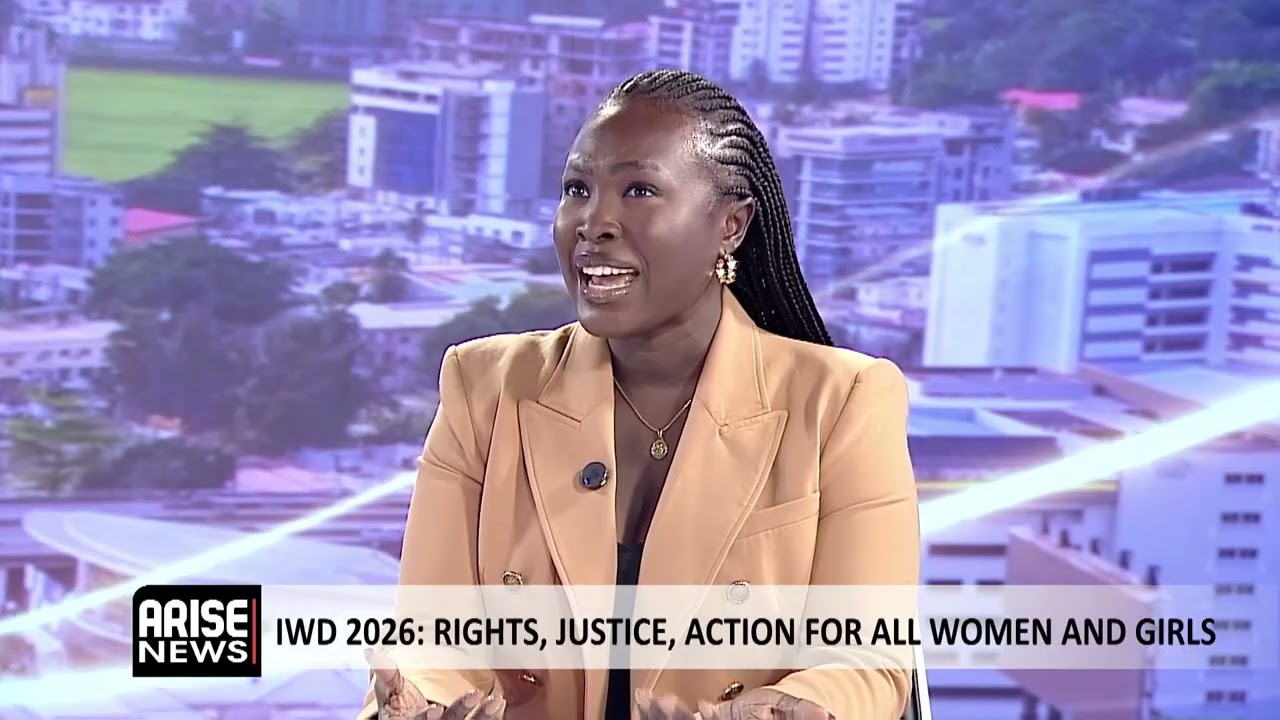
Chief Executive Officer of MotherWell Group, Feyi Bello has said women must be prioritised and given stronger platforms to address structural inequalities and support motherhood, as the world marked the 2026 International Women’s Day.
Bello, a maternal well-being advocate and founder of SWODU, a digital support platform for mothers, made the call during an interview on ARISE NEWS on Sunday, stressing that addressing women’s issues is central to building a better society.
She said the theme of this year’s International Women’s Day — Rights, Justice, Action for All Women and Girls — underscores the urgency of dismantling structural barriers and ensuring women are properly supported.
“I think the time is now, more than any other time. For me, it’s one of those things where we just have to focus on women’s issues,” Bello said.
“I think we focus so much on other things and that has distracted us and brought the world to where it is today. There’s so much more in store, and people don’t realise that women’s issues are human rights issues. Once we start to focus there, we create a better world for everyone else.”
She emphasised that women must be deliberately prioritised and given stronger platforms to amplify their voices and rights.
“It’s essential at this point for women to be prioritised — for their rights and all the things available to us to be prioritised and also to be platformed,” she said.
Bello explained that her work through MotherWell Group focuses on building systems, structures and technological solutions to support mothers, noting that motherhood remains one of the most overlooked areas despite rapid technological advancement in other sectors.
“One of my passions is making sure that I create systems, structures and infrastructure to ensure that mothers are prioritised, taken care of, and accompanied on the journey of motherhood where it’s not done in isolation,” she said.
She noted that while technology has transformed most industries, motherhood has largely remained neglected, particularly in emerging markets.
“The world has moved from how it was. Technology has done so much to help us — the way we live now is completely influenced by technology and almost every industry has moved in that light. But motherhood has kind of been left where it has been for years,” she said.
Bello said her motivation for advocacy emerged from her own experience as a mother.
“I became a mum in 2019. I’m a mother of two children, and it was alarming to realise that very little is in place for mums like me on the continent to ensure that we are mothering well,” she said.
“There is very little to ensure postpartum depression rates are being reduced, to ensure that mums have community.”
She added that the traditional support system for raising children has weakened over time.
“The thing about it is that our villages — you know they say it takes a village to raise a child — but those villages are being broken down now. They’re not what they used to be before,” she said.
“With what I’m hoping to do, I want to re-establish those villages through technology and ensure that mums have a consolidated place to engage with one another and get all the resources they need to thrive, not just survive.”
According to Bello, her organisation is working to reduce loneliness and isolation among mothers by building strong communities where women can share experiences and solutions.
“I believe there is no better resource for a mum than another mum with a shared experience,” she said.
“Sometimes mothers are even more resourceful than medical professionals or experts in the field, because the importance of that situation to a mother is unlike anything anyone else feels.”
Bello also highlighted the significance of the global care economy, which she described as undervalued despite its enormous economic impact.
“My work is in the care economy, which is an $11 trillion industry that is thoroughly underestimated and undervalued,” she said.
“The care economy includes all paid and unpaid work that sustains families, societies and communities.”
She added that her focus remains on ensuring women, particularly mothers in Africa, have access to the support and resources they need.
“My goal is to ensure that on this side of the continent we are prioritised — that women have the resources they need to ensure they are taken care of and that their work is prioritised,” she said.
Beyond motherhood, Bello said Nigerian women are increasingly speaking up, supporting one another and demanding greater accountability in society.
“I feel like as a society we are moving in the right direction. Those conversations are being held and prioritised,” she said.
She also commended women who are challenging entrenched systems and pushing boundaries.
“I think it’s very admirable that the women of this generation are not taking no for an answer and are holding people accountable to a higher standard.”
Bello said Nigeria would benefit from having more women in positions of political leadership.
“Absolutely. I want to see more of the women that we celebrate on International Women’s Day platforms in office making decisions for this country. It would make a huge difference,” she said.
“In my professional capacity, I’ve worked in many different firms and industries for over 12 years. The women who lead these companies are bold, beautiful and intelligent. Nigerian women are intelligent.”
She expressed optimism that Nigeria could one day elect a female president.
“I would love to see a Madam President someday. I genuinely believe that in my lifetime there will be one. There has to be,” she said.
However, Bello noted that many women remain reluctant to enter politics due to the prevailing culture within government institutions.
“I think it’s also the culture within government. No woman wants to go into a situation where she knows she’s doomed to fail,” she said.
“These places are not seen as safe spaces for us. Most impactful women are making their impact outside government because there’s freedom to move and freedom of expression there.”
Nevertheless, she stressed that change would require courageous women willing to challenge existing systems.
“It always starts with one — someone bold enough and brave enough to go into the fiery furnace for all of us and carry us along,” she said.
Bello added that the type of leadership Nigeria needs is embodied by a woman who is capable, resilient and knowledgeable.
“She is intelligent, capable and resilient. She is not afraid. She has a breadth of knowledge about the country and understands what it takes to build systems,” she said.
“I think Nigeria is ready for the international conversation in a big way. I want to see my nation become all that it is destined to be.”
When asked what single message Nigerian women should hold onto, Bello said: “She is capable.”
“She is capable of everything,” she said, adding that women only require support from men to achieve their full potential.
“All we need from the men is their support.”
Boluwatife Enome
Follow us on:


