


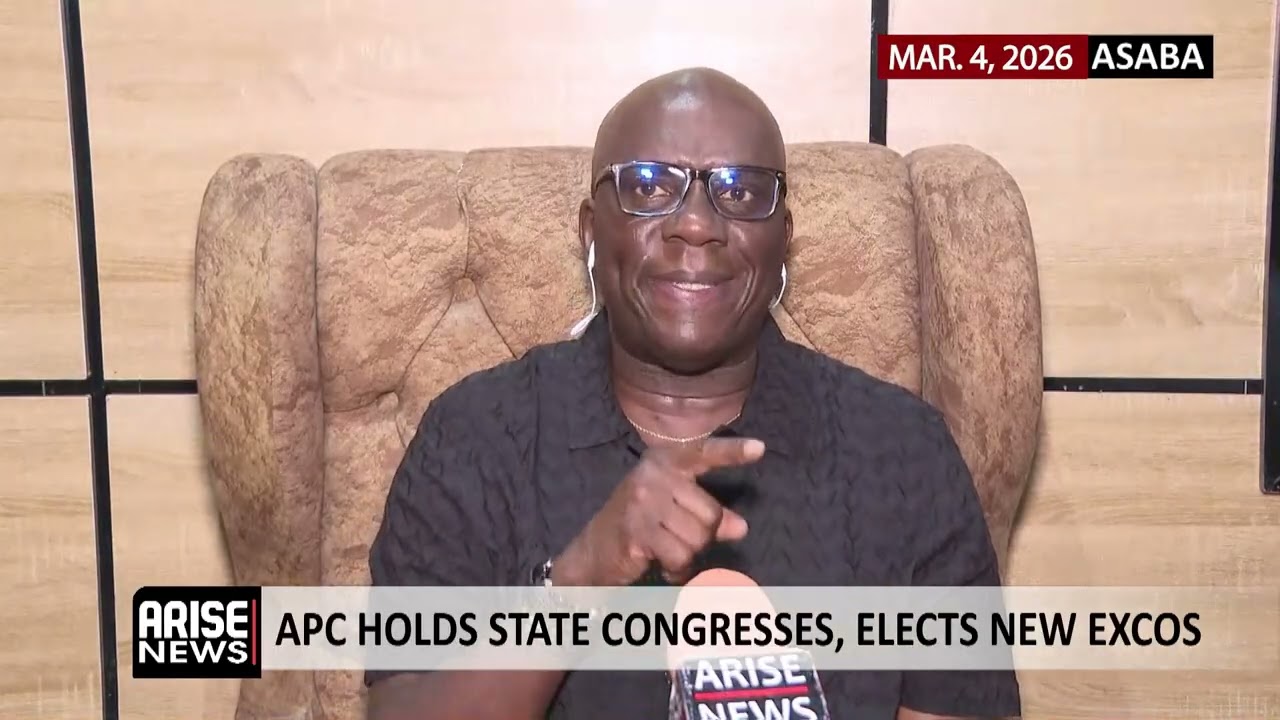
The National Publicity Secretary of the All Progressives Congress (APC), Felix Morka, has defended the party’s recently concluded congresses across the country, insisting they were largely peaceful and cohesive despite pockets of disputes and court actions in some states.
Speaking In an interview with ARISE NEWS on Wednesday, Morka dismissed suggestions that the ruling party was projecting a false image of smooth internal processes, maintaining that the APC had successfully managed a complex nationwide exercise befitting what he described as the largest political party in the country and possibly on the continent.
“No system is entirely perfect. We are not, and we have never told anyone that we’re perfect. We’re not. We’re citizens, we’re Nigerians, we’re human beings, and we’re liable to our own errors. But however, what is important here is that our party has delivered a congress that we can say has been largely peaceful and cohesive.”
Morka acknowledged that there were pockets of issues here and there. “As a political party, we do not joke with the orders of court. We seriously make effort to comply fully with the court directions, You don’t comply with an order you are not aware of.”
There are other states where we suspended congresses because of one challenge or the other, those matters are under review by the appropriate authorities of my party, and I wouldn’t want to preempt the conversations or the direction of those efforts to resolve some of these issues, However, when you go to court and yousecure an interim order of court where the other party, the defendant, is absent, is not in court, didn’t have notice to come, because it’s interim, it’s simply the plaintiff moving the court by themselves without the other party present
they got an interim order to that effect. At the time that this congress was going on, that order had not been either served or communicated to those in those states, Ondo State Chapter was not a party to that suit.”
He stressed that internal conflict resolution remains one of the APC’s defining strengths.
“Look, I’ve always said, even on your show, that one thing that distinguishes the APC from the other parties is that our systems for conflict resolution is very mature, and we don’t take it for granted because we know these issues will arise. People will be disappointed, and we complain. The fact that they’re within the party doesn’t mean they agree necessarily with every position the party takes. So, they have a fundamental, you know, constitutional democratic right to complain, but when they do, we are always willing to take it.”
Turning to allegations that the APC manipulated the newly enacted Electoral Act to disadvantage opposition parties, he said. “We are not coercing, we are not intimidating, and we have no reason to coerce or intimidate anyone or any opposition party.”
He argued that the Electoral Act 2026 was a product of the National Assembly’s constitutional authority. “The APC is not the National Assembly. The National Assembly is an agglomeration of all of the elected representatives of the people across political parties. Yes, we are in the majority, no doubt, but that does not mean that the act of the National Assembly must then necessarily be ascribed or becomes ascribable to the APC. That would be a flaw, which is unfair and actually even nonsensical.”
Morka further dismissed opposition criticism as baseless. “You know, these accusations by the opposition, it’s lame. It’s simply, it doesn’t make any sense. You see, look, the fact of the matter is that, you know, we, the APC, are affected, like everyone else, all other political parties in the country. I don’t know where they think that the APC has an advantage or that the APC is doing something untoward to skew the process in its favour. We’re not doing that. The Electoral Act, you know, for instance, the Electoral Act has proscribed the indirect primary system for the election of those who govern. You know, we’re not screaming because we respect the authority of the National Assembly. Everybody else should do the same.”
Addressing controversy over the speed with which the bill was harmonised and signed into law, Morka explained “must recognise that we have a bicameral legislature. We don’t have a unitary National Assembly. It’s composed of two sections, the Senate and the House of Reps. And whatever law becomes law, whatever bill becomes law, must be assented, must be agreed to by both chambers. Where they don’t agree, a conference of the two chambers usually is impenetrable to reconcile the areas of difference or whatever disagreement that exists between the two sides.”
He insisted that only a harmonised version of a bill becomes validly presentable to the President. “Any bill that comes from the National Assembly, which is, you know, composed of the Senate and the House of Representatives, must be united and harmonised. So any bill that comes from the National Assembly is a harmonised bill. Whatever bill or version that was passed by the House of Reps or Senate is not a bill. It must be harmonised to become a bill presentable to the President. And that’s what happened.”
On the timing of presidential assent, Morka said there was no constitutional breach. “Now, you know, what I’m saying, is that this is not unusual. There’s no schedule of time in the Constitution that says that the president must wait 30 days before assenting, or must wait an hour. Once a bill is generated from the National Assembly to the president, the president has every prerogative to assent on the spot, or delay, or even veto that bill.”
He added that, “The president signed it, and today we have the Electoral Act 2026. And that’s the prism of the law today.”
“I’m sure you heard the Vice President at the summit recently of the Progressive Governors Forum at the Villa, where he publicly, which was very unusual, but I think very instructive, said to both leaders in Benue, the Governor and the SGF, to look, to come together and work out whatever differences that we have in Benue.”
He described the directive as evidence that the party leadership is attentive to internal disagreements. “That tells you that at the highest level of the leadership of our party, they’re very attentive to what’s going on in Benue. They need to, for the sake of the people of Benue, resolve their differences.”
“I think that in time, the Vice President has signalled direction that they need to really resolve this matter, come together for the sake of our party and in the best interest of the party and the people of Benue to enact a singular narrative for our party going forward towards 2027.”
Erizia Rubyjeana
Follow us on:


